
Adaptive Market Value Functions: Moving from Classification to Ranking in Targeted Marketing
Adaptive Linear Market Value Functions for Targeted Marketing
This paper introduces Adaptive Linear Market Value Functions for targeted marketing, utilizing a ranking-based strategy to identify high-potential customers. By employing gradient descent algorithms like AMV and SAMV, the model optimizes attribute weights to outperform traditional baselines like Simple Naive Bayes (SNB) in ranking accuracy.
TL;DR
This paper addresses the inefficiency of binary classification in marketing by proposing Adaptive Linear Market Value Functions. Instead of just predicting "buy" or "not buy," the method learns to rank customers based on their relative potential value using gradient descent-based algorithms (AMV/SAMV). Experimental results demonstrate a substantial performance gain over Naive Bayes, particularly in maximizing "Lift" within limited marketing budgets.
Problem & Motivation: The Rigidity of Classification
In targeted marketing, the goal is simple: identify customers who will respond to an advertisement. However, most practitioners rely on classification rules (e.g., Decision Trees). These models often possess an Inductive Bias toward hard boundaries.
The authors argue that this approach has two fatal flaws:
- Rule Selection Difficulty: Choosing the "significant" rules is often subjective and non-trivial.
- Lack of Granularity: Classification rules might return 5,000 potential customers when your budget only allows for 2,000, or vice-versa. There is no inherent "ranking" within the class.
The authors' insight is to treat targeted marketing as a Ranking Problem. By assigning a continuous "Market Value" to every customer, marketers can simply take the top individuals from a ranked list, where is determined by financial constraints.
Methodology: Adaptive Weight Learning
The core of the paper is a linear model defined as: Where represents attribute weights and is a utility function. While previous work used Information Gain (Entropy) to set these weights, this paper introduces an Adaptive Strategy.
The AMV and SAMV Algorithms
The authors define a preference relation where a positive instance (buyer) must have a higher value than a negative instance (non-buyer) . This creates a set of constraints:
When the model fails this condition (an "error"), it uses gradient descent to adjust the weights.
- AMV (Adaptive Market Value): Updates weights based on the total error across the batch.
- SAMV (Stochastic AMV): Updates weights incrementally upon examining individual positive instances, making it suitable for online or incremental learning.
 Fig 1: The mathematical formulation of the error boundary in the weight space.
Experiments and Results
The researchers tested their approach on two significant datasets (one with 96 attributes and another with 85 attributes).
Lift Index Comparison
The Lift Index measures how much better the model performs compared to a random selection. As shown in the table below, the Adaptive methods (AMV/SAMV1) significantly outperformed the Simple Naive Bayes (SNB) baseline.
| Datasets | SAMV1 | AMV | MV | SNB |
|---|---|---|---|---|
| Dataset 1 | 63.1% | 62.8% | 63.2% | 50.3% |
| Dataset 2 | 71.7% | 73.0% | 71.7% | 58.8% |
ROC and Lift Curves
The ROC curves indicate that AMV provides a lower false-positive rate when targeting a high percentage of the positive population. In practical terms, this means fewer wasted marketing dollars on customers who won't convert.
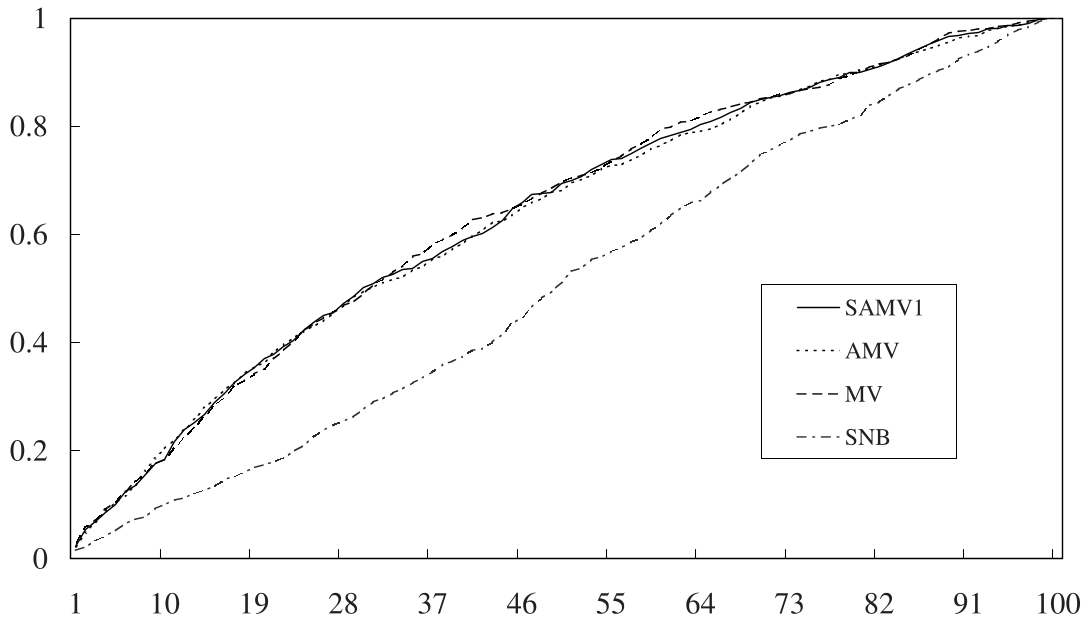 Fig 2: ROC Curve Comparison – Adaptive methods show superior area under the curve compared to Naive Bayes.
Critical Analysis & Conclusion
Takeaway
The paper successfully demonstrates that Market Value Functions are a robust alternative to classification. The transition to an adaptive learning framework (borrowed from Information Retrieval) allows the model to "correct" its weights based on actual ranking errors rather than static statistical measures like entropy.
Limitations
- Binary Bias: The current work only considers "Buy" vs "Not Buy." In modern CRM, we often see "multi-level preferences" (e.g., regular buyer, occasional buyer, churned customer).
- Linear Constraint: The model is strictly linear. While this offers high interpretability (crucial for marketing strategy), it might miss complex non-linear feature interactions that a Gradient Boosted Tree or a Neural Network might capture.
Future Outlook
The authors suggest extending this to Web Intelligence and multi-level preference modeling. For today's practitioners, the SAMV1 algorithm's incremental nature provides a precursor to modern real-time bidding and personalization engines used in digital advertising.