
PROSA: Architecture of a Socially-Inspired Peer-to-Peer "Small World"
An adaptive overlay network inspired by social behaviour
This paper introduces PROSA (P2P Resource Organization by Social Acquaintances), a semantic decentralized overlay network that mimics human social dynamics to organize resources. By using socially-inspired link evolution and query forwarding, the network naturally emerges as a high-performance "Small World" structure optimized for semantic search.
TL;DR
Researchers have developed PROSA, a P2P overlay network that functions like a human community. By mimicking how people build relationships—from casual acquaintances to close collaborators—the network naturally organizes itself into a "Small World." This allows for high-precision semantic search with extremely low overhead, proving that local social rules can solve global data-routing problems.
The Social Intuition: Why Nature Knows Better
In a crowded cocktail party, if you are looking for a doctor, you don't scream to Everyone (Flooding). Instead, you ask a friend who might know someone in medicine (Semantic Routing).
The authors recognize that existing P2P systems are either too rigid (DHTs) or too chaotic (Gnutella). They propose that a network of peers should behave like a growing child: starting with a few random contacts (Acquaintance Links) and gradually forming specialized connections based on successful interactions (Semantic Links).
Methodology: The Three Pillars of PROSA
The core of PROSA lies in how it manages its "social circle" using three specific link types:
- Acquaintance Link (AL): The "weakest" connection, representing a basic awareness that another peer exists.
- Temporary Semantic Link (TSL): A "hint" based on past queries. If a peer previously asked about "Linear Algebra," you remember them as a potential source for math resources.
- Full Semantic Link (FSL): The "strongest" bond, formed when a peer successfully provides a document. This represents a proven shared interest.
Semantic Routing with VSM
To decide where to send a query, PROSA uses a Vector Space Model (VSM). Every document and query is converted into a weighted vector of terms (TF-IDF). Peers evaluate the "similarity" between the query and their neighbors' known profiles, ensuring the message travels toward the most relevant cluster of experts.
 Note: The image above illustrates the conceptual interaction between socially-aware peers.
Experiments: The Emerging Small World
The researchers tested PROSA using thousands of scientific articles. The results were striking: the system didn't just route data; it self-organized.
- High Clustering: Peers with similar interests (e.g., Math or Philosophy) naturally formed tight-knit clusters. PROSA's Clustering Coefficient (CC) was found to be 10x higher than a random graph.
- Short Paths: Despite the clustering, the Average Path Length (APL) remained remarkably low (~3 hops), similar to the "six degrees of separation" found in human societies.
- Efficiency vs. Cost: PROSA achieved a 50% recall (finding half of all relevant files) while visiting less than 1% of the nodes. Traditional systems often need to probe 25% of the network to reach the same level.
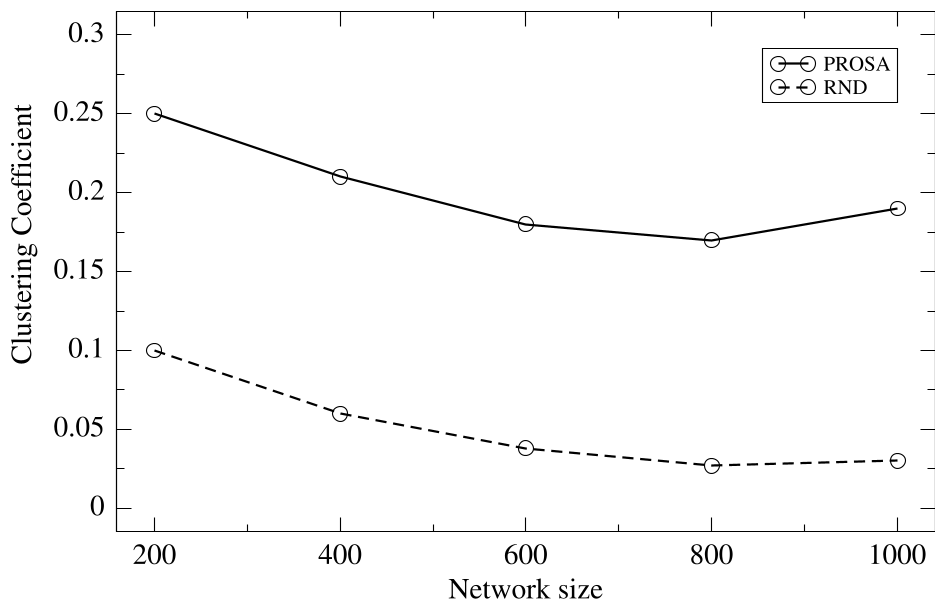 The graph shows how PROSA's clustering grows far beyond random expectations as queries are performed.
Resilience in the Face of Churn
P2P networks are notoriously unstable (peers join and leave constantly, a phenomenon called "churn"). PROSA demonstrates functional robustness. Because it relies on local adaptation, when a "hub" peer leaves, the remaining peers quickly rewire their TSLs and FSLs based on new queries, maintaining high recall even when up to 10% of nodes are cycling in and out.
Deep Insight & Conclusion
The genius of PROSA is its Democratic Nature. Unlike "Aristocratic" networks that rely on a few massive hubs (which are single points of failure), PROSA's link distribution is more uniform. It proves that semantic intelligence doesn't require a central index; it can emerge from the simple, local desire of peers to connect with those who help them.
Takeaway: Future decentralized systems (from Web3 storage to Edge Computing) can look to PROSA's social metaphor to build efficient, self-healing architectures that prioritize semantic relevance over raw connectivity.
Limitations
- Warm-up Time: The network requires an initial phase of queries to "learn" its social structure.
- Vector Complexity: While VSM is effective, it may struggle with very high-dimensional datasets compared to modern latent-space embeddings.