
Adaptive Polling: Transforming Social Influence into State Estimates
Adaptive Polling in Hierarchical Social Networks Using Blackwell Dominance
The paper introduces an Adaptive Polling framework for hierarchical social networks to estimate a time-varying state of nature. It reformulates common polling strategies (Intent, Expectation, and Friendship polling) into a Partially Observed Markov Decision Process (POMDP) and proves that myopic policies provide optimal upper bounds when the observation distributions satisfy Blackwell dominance.
TL;DR
Researchers have developed a mathematical framework to poll social networks more intelligently by accounting for how "influencers" shape the opinions of others. By modeling this as a POMDP (Partially Observed Markov Decision Process) and utilizing the concept of Blackwell Dominance, they prove that simple, "myopic" (short-sighted) polling decisions are often near-optimal, significantly reducing the computational cost of tracking public opinion.
Context & Motivation: The Problem with Traditional Polls
Why do polls often miss the mark? Most traditional methods treat individuals as independent data points. In reality, we live in Hierarchical Social Networks. A "Level 0" influencer (like a movie critic or political leader) dictates the opinions of "Level 1" followers, who in turn influence "Level 2."
When the state of the world changes—such as a political candidate shifting their stance or a movie's popularity peaking—a pollster needs an adaptive strategy. Static polling is too slow and expensive. The challenge is: Which level of the hierarchy should you sample to get the most information for the lowest cost?
The Core Mechanism: Blackwell Dominance
The authors simplify this complex decision-making problem using Blackwell Dominance. In statistics, Matrix Blackwell dominates if is "more informative."
The paper proves a "Meta-Theorem": If the polling actions can be ordered by Blackwell dominance (meaning one action is demonstrably more informative than another), then a Myopic Policy (picking the best immediate action) provides a provable upper bound to the optimal long-term strategy.
1. Intent Polling (Matrix Polynomials)
In Intent Polling, we ask: "What do you think the state is?" The paper models this via Hurwitz Polynomials. If the polling distribution follows certain stability criteria, the resulting "polynomial channel" allows the pollster to rank levels of influence effectively.
2. Expectation Polling (Ultrametric Matrices)
Expectation Polling asks: "What do you think others will say?" This involves "looking through" one level to see another. The authors represent this using fractional powers of ultrametric matrices.
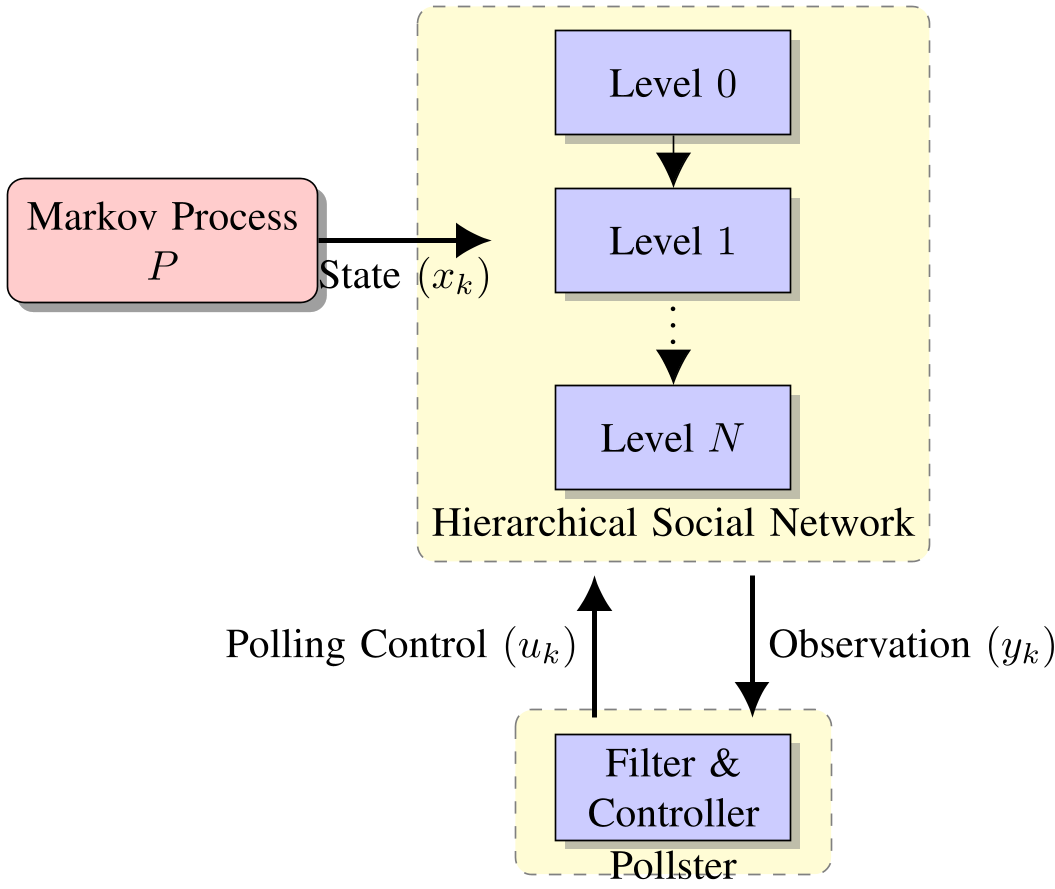 Fig 1: The information flow from the underlying state through various hierarchical levels.
3. Friendship Polling (Friendship Paradox)
Leveraging the Friendship Paradox ("Your friends have more friends than you do"), this method polls opinion fractions. The authors show that multinomial distributions of opinions maintain a Blackwell ordering, making it easier to estimate the state from social neighborhoods.
Experimental Results: Real-World Validation
To test the theory, the authors used YouTube API data from 30 recent comedy movies. They tracked trailer comments and used sentiment analysis to categorize people's "opinions" across different levels (Critics vs. General Audience).
Key Findings:
- Near-Optimality: The "Loss in Optimality" (the gap between the computationally expensive optimal policy and the cheap myopic policy) was remarkably small, especially as the "discount factor" (long-term focus) increased.
- Efficiency: By identifying which levels were "Blackwell comparable," they could avoid polling redundant or low-information nodes.
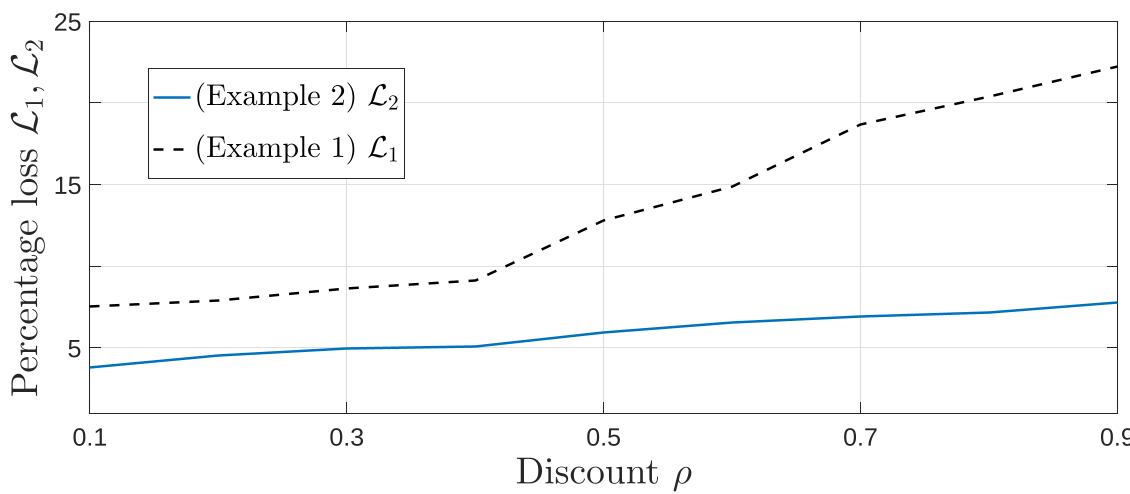 Fig 2: Percentage loss in optimality () across different discount factors (). The myopic policy performs exceptionally well in large-dimensional spaces.
Critical Insight: Why This Matters
The true value of this paper isn't just in "better polls." It's in the Information Theoretic Interpretation. The authors linked Blackwell dominance to Shannon Capacity and Rényi Divergence. They've shown that certain network structures are inherently more "transparent" than others.
If you can identify that a social network is "Ultrametric" or "Hurwitz-stable," you can essentially "crack" the code of how information flows through it, enabling high-accuracy state estimation with minimal samples.
Future Outlook
While the current model assumes a fixed hierarchy, real-world social networks are dynamic. A potential next step is applying Le Cam Deficiency to compare networks where Blackwell dominance isn't perfectly clear, allowing for a "best-fit" informational ranking in messy, real-world data.