
Adaptive Social Networks: Why Leaders Fall and New Stars Rise
Adaptive social networks: Strong attractors and emergence and downfall of leaders
The paper introduces a time-varying stochastic networked dynamical system to model the evolution of connection strengths (ties) in social networks. By employing a reinforcement-penalization framework, it demonstrates that these networks converge almost surely to a "strong attractor" consisting of binary matrices, effectively capturing the life cycle of leadership in complex systems.
TL;DR
This research provides a rigorous mathematical framework for the "shuffling of classes" in social networks. By modeling tie strength as a stochastic process governed by reinforcement and penalization, the authors prove that networks eventually crystallize into binary structures. More importantly, they demonstrate that "Exploration" behaviors in poor nodes, combined with the "Limited Capacity" of others to respond, inevitably lead to the downfall of established leaders.
The "Rich-Get-Richer" Paradox
In network science, Preferential Attachment is the standard explanation for why some entities (like YouTube influencers or Amazon bestsellers) become massive while others stay invisible. While this explains stability, it fails to explain the downfall. History and data show that leaders are eventually replaced. Why does the "rich-get-richer" cycle break?
The authors identify two missing ingredients in classical models:
- Limited Response Capacity (): A node cannot respond to every call it receives. This creates a bottleneck and competition.
- Exploration: The ability of low-ranking nodes to bypass established links and seek new connections.
Methodology: Reinforcement, Penalization, and Fading
The model treats each connection as the probability of node calling node . The weights evolve based on three distinct events:
- Reinforcement (): If calls and responds, the link grows stronger.
- Penalization (): If calls but ignores it (due to over-capacity), the link weakens.
- Fading (): If doesn't call at all, the relationship naturally decays.
The Global Strong Attractor
The beauty of this work lies in Theorem 2. It proves that regardless of the initial weights, the network will converge almost surely to a binary matrix (). In this state, a link either exists (1) or it doesn't (0).
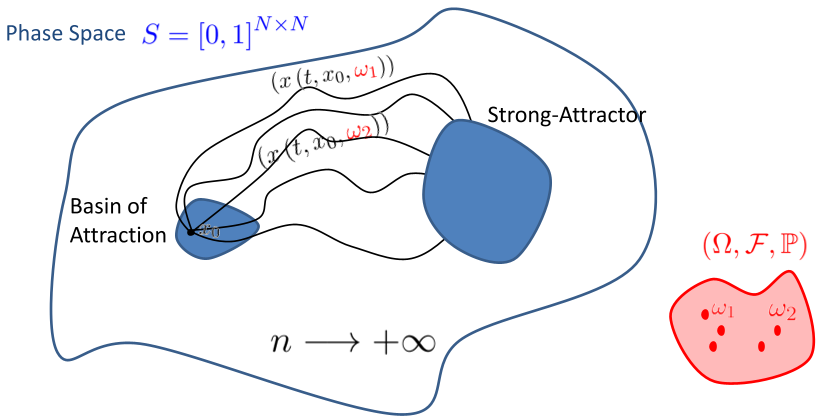 The figure illustrates the concept of a strong attractor, where the system state eventually settles into a specific subset of the phase space (binary graphs).
The Downfall of a Leader
The simulation results are striking. In a pre-processing phase without exploration, a few "latent leaders" emerge and dominate the network. However, once poor nodes are given a small "exploration factor"—allowing them to contact others regardless of current tie strength—the hierarchy shifts.
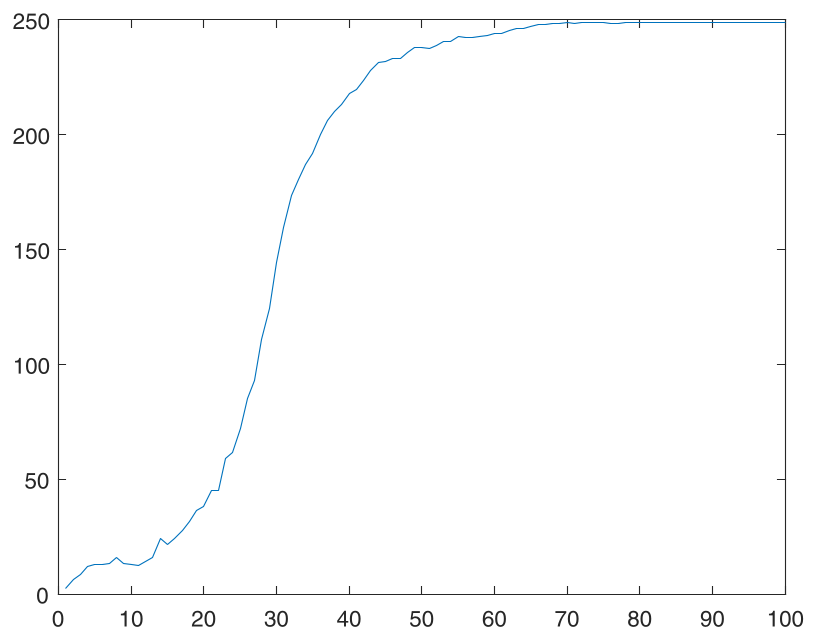 Visualizing the downfall of a veteran leader as new emergent leaders occupy the limited response capacity of the network.
As new leaders gain prominence, they hog the response capacity () of the network's nodes. Veteran leaders, whose calls were once guaranteed a response, start getting rejected. This triggers the Penalization law, causing their influence to plummet.
Critical Insight & Perspectives
What makes this paper significant is its move away from "fitness参数" (intrinsic quality). Instead of saying a leader falls because they got "worse," the authors show that a leader can fall simply because the environment becomes too crowded and others are more active in exploring.
Limitations
- Memoryless Assumptions: The current model assumes the calling/response process is relatively memoryless, which might not capture the long-term "brand loyalty" seen in human social networks.
- Homophily: The model does not explicitly account for nodes preferring others similar to themselves, which often slows down the shuffling of classes.
Conclusion
The study of "Adaptive Social Networks" provides a powerful lens for understanding market churn, biological evolution (like ant colony pheromones), and social media trends. It reminds us that in any system with finite resources, the status quo is only a temporary attractor, waiting to be disrupted by the next "explorer."