
AI Adoption Dynamics: Can Social Networks Self-Regulate Ethical AI?
Adoption Dynamics and Societal Impact of AI Systems in Complex Networks
This paper presents a game-theoretical model to simulate AI adoption dynamics within complex adaptive networks. It introduces a "Societal Value Alignment Problem" and demonstrates that while static networks lead to the dominance of selfish AI, dynamic network rewiring allows for the sustainability of utilitarian and human-conscious AI strategies.
TL;DR
Individual AI ethics—ensuring a robot doesn't harm its owner—is only half the battle. This paper tackles the Societal Value Alignment Problem: How does the adoption of different AI types (from selfish to utilitarian) reshape the fabric of human society? Using evolutionary game theory and complex networks, the authors discover that "who you choose to talk to" (network rewiring) is more important for the survival of ethical AI than the "intelligence" of the AI itself.
The Problem: The Exploitative Edge of Private AI
When an individual adopts an AI to maximize their personal gain, they often do so at the expense of others. In previous, unstructured models, this led to a "dystopian" equilibrium where a small minority used Selfish AI to vacuum up wealth, while everyone else was left behind.
The core challenge is that Utilitarian AI (which tries to maximize the total good for everyone) is easily exploited. If I play a fair game and you play a selfish game, you win, and my strategy eventually goes extinct in the population because no one wants to imitate a "loser."
Methodology: Intelligence and Network Plasticity
The researchers modeled humans (H) and AI agents using a stochastic payoff matrix.
- The AI Advantage: AI agents see the "true" payoff matrix, while humans see a "noisy" version, representing the AI's superior data processing.
- Topological Setup: Instead of everyone interacting with everyone, agents are placed on a Scale-Free Network (where a few "hubs" have many friends).
- The Game-Changer (Rewiring): Agents can choose to "cut links" with partners who exploit them and find new ones. This is akin to a consumer boycotting a company or a user switching platforms.
Core Insight: Rewiring as a Shield for Ethics
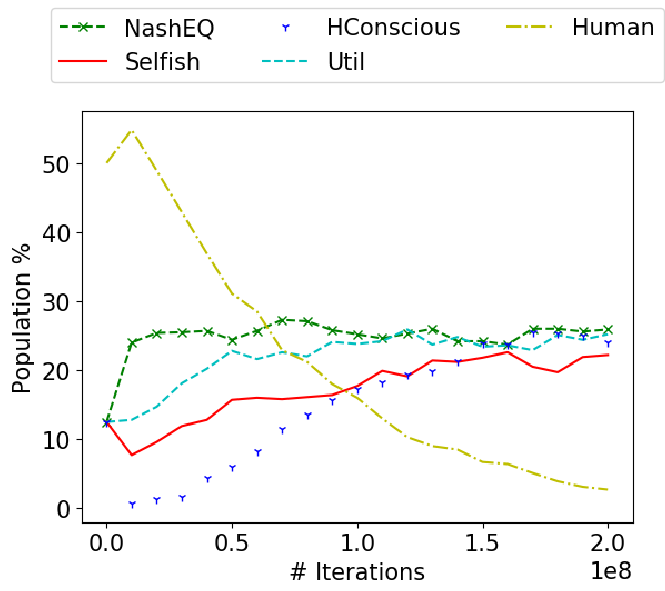
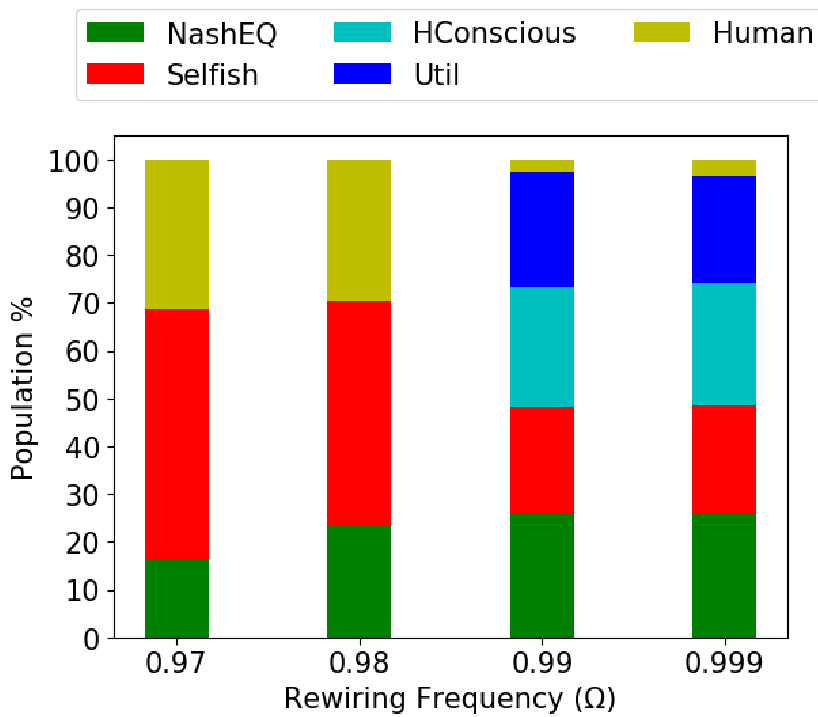
The study found that in a static network, the results remain bleak: Selfish AI dominates. However, when the network is adaptive (high rewiring frequency ), a fascinating phase transition occurs.
1. The Emergence of Ethical Hubs
Once agents can "vote with their feet," Utilitarian AI starts to thrive. Because everyone wants to interact with a partner who maximizes the collective good, Utilitarian AI agents become massive hubs in the network.
2. The Multi-Type Equilibrium
At high rewiring rates, society doesn't just become 100% utilitarian. Instead, it supports a diverse mix of strategies, including Human-Conscious AI—a middle-ground strategy that tries to stay "human-friendly" while still looking out for its owner.
Experimental Results: Fitness vs. Equality
Looking at the data, the impact of rewiring on fitness is staggering:
- Without Rewiring: Selfish AI has a fitness of ~5.01, while humans drop to -0.31.
- With Greedy Rewiring: Utilitarian AI achieves a fitness of 11.7, effectively carrying the society's total average fitness to 3.11 (compared to 1.39 in a 100% Human society).
| Strategy | Fitness (Static) | Fitness (Rewiring) | Avg. Degree (Links) |
|---|---|---|---|
| Human | -0.31 | 0.0 | 0.0 |
| Selfish AI | 5.01 | 0.0 | 0.0 |
| Utilitarian AI | N/A | 11.7 | 14.78 |
Note: Under "Greedy" rewiring, Utilitarian AI becomes the only viable strategy for maintaining links, effectively ostracizing selfish actors.
Conclusion: Lessons for AI Regulation
The paper concludes that while AI intelligence brings an advantage, social structure and mobility are the primary regulators of its impact.
- Trust as Currency: In an adaptive society, a reputation for being utilitarian is a magnet for connections, which in turn boosts fitness.
- The Ostracism Mechanism: Rewiring acts as a form of "Competition Law," allowing the majority to disconnect from exploitative selfish AIs.
The Catch? Even with these self-regulating mechanics, the society remains highly unequal. The Utilitarian "super-hubs" hold all the power and wealth. For future researchers and policymakers, the goal isn't just making AI "good," but ensuring the network doesn't become so centralized that everyone else becomes an "outlier."
Reference: Fernandes, P. M., Santos, F. C., & Lopes, M. (2020). Adoption Dynamics and Societal Impact of AI Systems in Complex Networks. AIES '20.