
S2PD: Revolutionizing Private Data Sharing in Vehicular Social Networks via Selective Search
SPECIAL SECTION ON ADVANCED BIG DATA ANALYSIS FOR VEHICULAR SOCIAL NETWORKS
This paper introduces S2PD, a selective sharing scheme for privacy data in Vehicular Social Networks (VSNs). It utilizes a half-decryption mechanism and searchable encryption (SDB) to enable data owners to securely share specific data with authorized users via a semi-trusted cloud, significantly reducing local computation and communication overhead.
TL;DR
With the rise of 5G and the Internet of Vehicles (IoV), Vehicular Social Networks (VSNs) generate massive amounts of sensitive data. S2PD (Selective Sharing Scheme for Privacy Data) addresses the "sharing vs. privacy" dilemma by allowing vehicle owners to outsource encrypted data to the cloud and share only specific segments with authorized users. By offloading heavy decryption and search tasks to the cloud, it halves the communication burden on vehicles while keeping the data secure from curious cloud providers.
Context: The Computational Bottleneck in VSNs
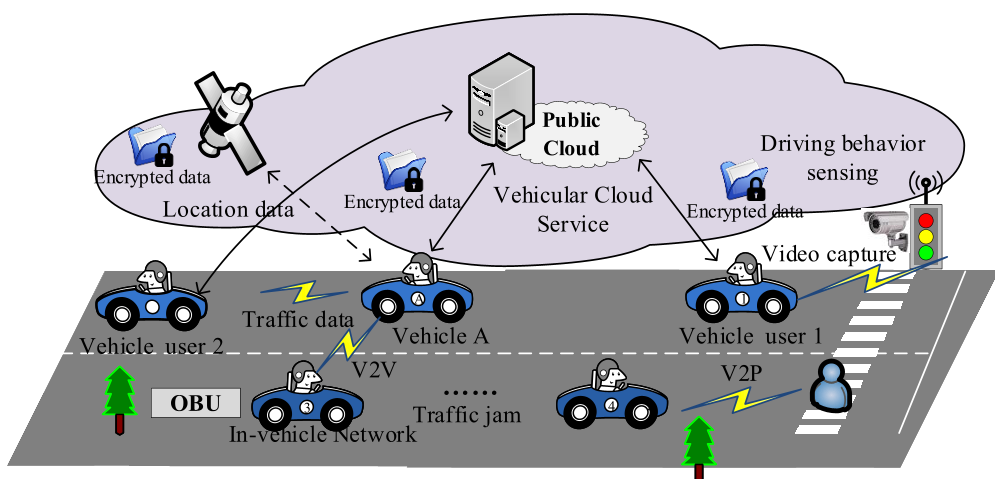
Vehicles today are essentially mobile data centers. They generate traffic info, personal media, and maintenance records. However, On-Board Units (OBUs) have limited storage and processing power. While the cloud offers a solution for storage, sharing encrypted data traditionally requires the owner to be "always online" to manage keys or re-encrypt data—a logistical nightmare for highly mobile VSNs.
The Core Insight: Half-Decryption & Searchability
The authors identify a critical gap in existing sharing schemes like SDS2. In older models, if a user wanted to see a specific 10-minute clip of traffic footage, they had to download the entire encrypted daily archive.
S2PD solves this by integrating SDB (Searchable Encryption with Data Interoperability). The data owner (VDO) splits the decryption key into two parts:
- keyCSP: Sent to a Trusted Authority (TA) and forwarded to the cloud only upon authorized request.
- keyUser: Sent directly to the authorized vehicle user.
This allows the Cloud Service Provider (CSP) to perform "half-decryption," transforming the raw ciphertext into a state that is still encrypted but searchable and operable.
Methodology: The S2PD Workflow
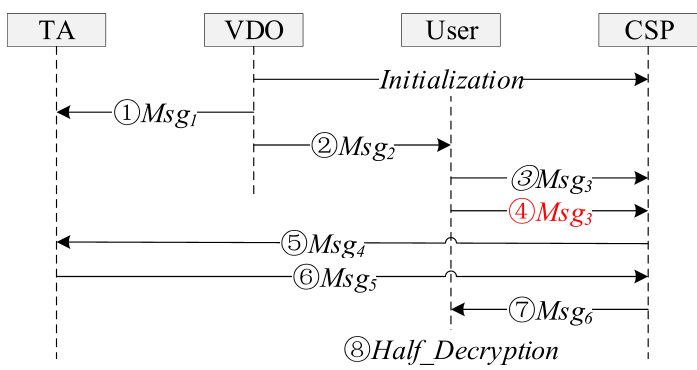
The protocol follows a strictly orchestrated 7-step process:
- Encryption: VDO uses AES and SDB to encrypt data before uploading to the CSP.
- Authorization: VDO provides a "sharing certificate" and a partial key to the user.
- Search & Query: The user sends a query (e.g., ) to the CSP.
- Offloaded Computation: After the TA verifies the certificate, the CSP uses the to half-decrypt the data and perform the mathematical operations requested by the user.
- Final Decryption: The user receives the "half-decrypted" result and performs the final, computationally light decryption using their .
Experimental Validation
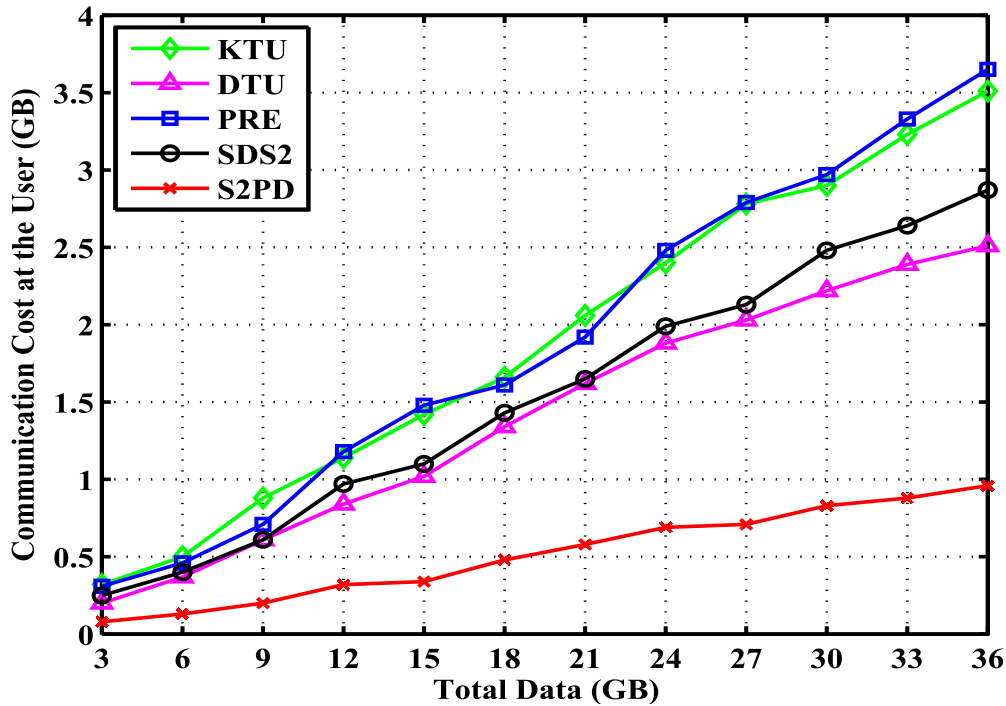
The researchers compared S2PD against five major schemes, including Proxy Re-Encryption (PRE) and SDS2.
1. Communication Efficiency
As data size increases from 3GB to 36GB, S2PD maintains a relatively flat communication cost for the vehicle owner. Unlike the Data-To-User (DTU) scheme, where the owner must send the full dataset to every requester, S2PD only requires sharing a small key and certificate.
2. Computational Speed
The "User Running Time" is the standout metric. In S2PD, because the cloud handles the heavy lifting of searching and combining data columns, the vehicle user's local processing time remains near zero, even as the volume of requests grows.
Critical Insight & Conclusion
S2PD succeeds because it treats the cloud as a collaborator rather than just a vault. By utilizing the algebraic properties of the SDB encryption scheme, it allows the cloud to compute on ciphertexts without seeing the underlying secrets.
Limitations: The reliance on a "Trusted Authority" (TA) remains a single point of failure. Future iterations might benefit from decentralized identity management (like Blockchain) to remove the need for a centralized TA.
Final Takeaway: For the future of autonomous and connected vehicles, S2PD provides a blueprint for scalable, privacy-preserving infrastructure where data utility does not have to come at the expense of security.