
S2PD: Revolutionizing Selective Data Sharing in Vehicular Social Networks
SPECIAL SECTION ON ADVANCED BIG DATA ANALYSIS FOR VEHICULAR SOCIAL NETWORKS
This paper introduces S2PD, a Selective Sharing Scheme for Privacy Data in Vehicular Social Networks (VSNs). It utilizes a hybrid encryption approach combining AES and SDB (Searchable Encryption with Data Interoperability) to allow vehicular data owners to securely outsource and selectively share sensitive data with authorized users via a semi-trusted cloud.
TL;DR
S2PD (Selective Sharing Scheme for Privacy Data) addresses the critical challenge of sharing sensitive vehicular data—like location history and sensor logs—without compromising privacy or overloading vehicle hardware. By leveraging a half-decryption mechanism and searchable encryption (SDB), S2PD allows the cloud to process data queries blindly, reducing vehicle communication costs by 50% and local computation to near zero.
Problem & Motivation
Vehicular Social Networks (VSNs) generate massive amounts of data from heterogeneous sources (OBUs, infrastructure, and pedestrians). While this "Big Data" is valuable for traffic management and social interaction, traditional sharing methods are fatally flawed for VSNs:
- Method A (Double Encryption): The owner downloads, decrypts, and re-encrypts data for every follower. This kills the OBU's battery and bandwidth.
- Method B (Master Key Sharing): An "all-or-nothing" approach. Once you share the key, the receiver sees everything, and the cloud could potentially peek.
- Prior SOTA (SDS2): Improved security but forced users to download entire datasets to find a specific piece of information.
The authors' insight? Use the Cloud Service Provider (CSP) as a "blind processor" that can perform calculations and partial decryptions without ever seeing the raw data.
Methodology: The Core of Selective Sharing
S2PD splits the data protection into two layers:
- key_CSP (AES): Allows the cloud to strip away one layer of protection after identity verification.
- key_User (SDB): Retained by the authorized user to get the final plaintext.
Architectural Flow
The process involves four entities: the Data Owner (VDO), the Cloud (CSP), the User, and a Trusted Authority (TA).

Figure 1: The S2PD framework showing the interaction between VDO, CSP, and User.
The breakthrough is the inclusion of Searchable Encryption with Data Interoperability (SDB). When a user wants to calculate something (e.g., ), the CSP performs this multiplication on the encrypted data and sends back only the result. This keeps the data selective and the transmission concise.
Experiments & Results
The authors benchmarked S2PD against five major schemes (KTU, DTU, PRE, and SDS2).
1. Slashing Running Time
For the end-user (the vehicle receiving the data), S2PD's execution time is significantly lower than SDS2. This is because the user no longer handles the complexity of cross-referencing datasets locally; the cloud delivers the specific requested "search result."
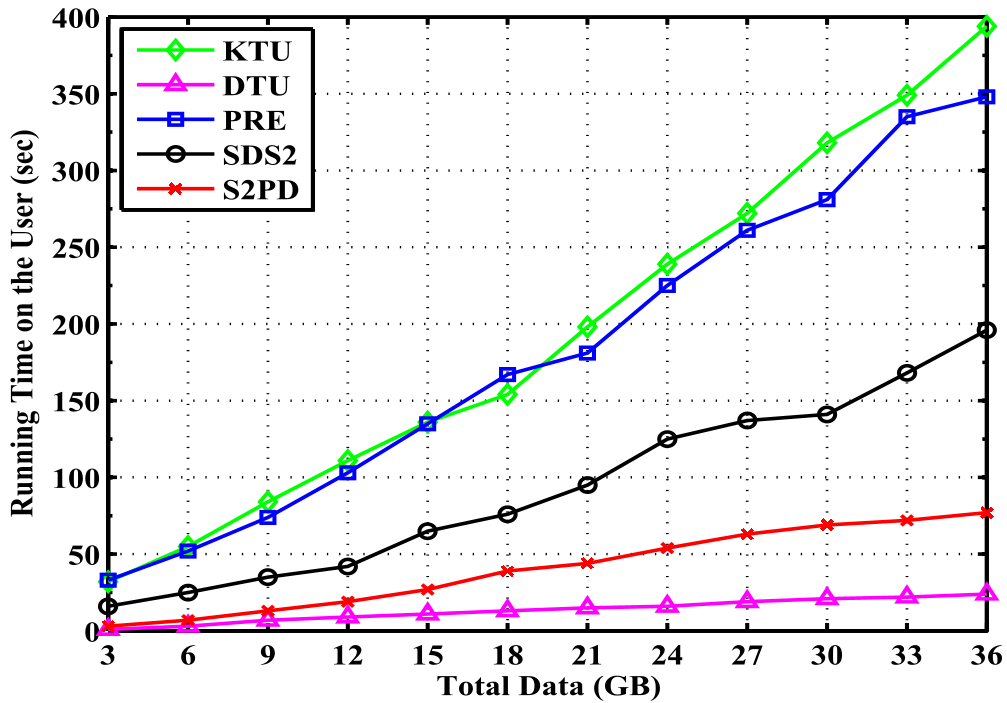
Figure 2: Running time at the User side. S2PD stays consistently low even as data volume scales.
2. Communication Efficiency
By shifting the heavy lifting to the cloud, S2PD achieves a 50% reduction in communication cost at the VDO side compared to the Data-To-User (DTU) scheme. This is vital for 5G-enabled V2X, where bandwidth must be preserved for real-time safety messages.
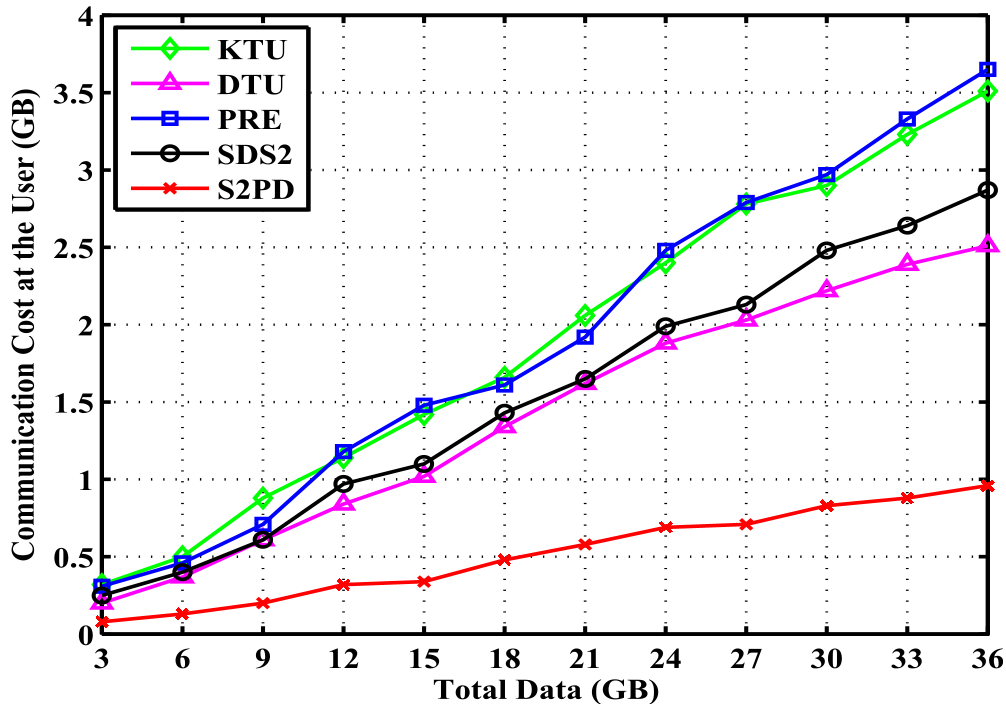
Figure 3: VDO communication cost, showing S2PD's efficiency against standard sharing methods.
Critical Analysis & Conclusion
Takeaway
S2PD succeeds because it recognizes that in a VSN, the vehicle is the weakest link computationally. By delegating "half-decryption" to a semi-trusted cloud, it achieves the elusive balance of privacy and performance.
Limitations & Future Work
- Query Complexity: Currently, the scheme focuses heavily on multiplication and basic algebraic interoperability. Supporting more complex non-linear queries (e.g., machine learning logic) would be the next frontier.
- Trust in TA: The scheme relies on a Trusted Authority for certificate verification. Future iterations could replace this with a Decentralized Identifier (DID) system or blockchain for even higher robustness.
In summary, S2PD provides a robust blueprint for secure data sharing in the 5G era, transforming vehicles from isolated data silos into secure, social, and communicative entities.