
CBC: Driving Fairness and Efficiency in Vehicular Social Networks
SPECIAL SECTION ON ADVANCED BIG DATA ANALYSIS FOR VEHICULAR SOCIAL NETWORKS
This paper introduces the Credit-Based Clustering (CBC) scheme for Vehicular Social Networks (VSNs) to optimize the sharing of geo-data POIs. By dynamic cluster formation and a virtual credit mechanism, it enables a selected cluster head to download data via cellular networks and redistribute it to members via IEEE 802.11p (DSRC), significantly reducing cellular traffic and costs.
TL;DR
The Vehicular Social Network (VSN)-based sharing system, powered by the Credit-Based Clustering (CBC) scheme, transforms vehicles from passive data consumers into an organized social cooperative. By utilizing 3G/4G for a single download and IEEE 802.11p for local redistribution, CBC maintains fairness via a virtual credit economy, ensuring that no single driver bears the full cost of data while everyone enjoys high-speed geo-updates.
Problem & Motivation: The "Free-Rider" Bottleneck
As vehicles move towards new Points of Interest (POIs), they often require large amounts of geo-data (maps, images, text). In a typical scenario, 10 vehicles in proximity would all hit the cellular tower simultaneously, creating massive traffic spikes and costing each driver individual data fees.
Prior works focused heavily on Cluster Stability—keeping the group together—but ignored Incentive Fairness. Why should one driver pay for the data while others get it for free? This lack of incentive leads to social "selfishness" where no vehicle wants to be the cluster head.
Methodology: The Architecture of Cooperation
The CBC scheme introduces a sophisticated workflow managed by a VSN server that monitors vehicle contexts (location, speed, direction).
1. The Triggering Logic
CBC doesn't just form clusters randomly. it uses GPS Sampling Times (ST) to determine three critical geo-points:
- Search Point (SPs): Vehicles with positive credit look for peers to join.
- Create Point (SPc): Vehicles with negative credit (or those who found no cluster) are flagged to start a new cluster.
- Download Point (SPd): The deadline for the Cluster Head (CH) to fetch data from the server.
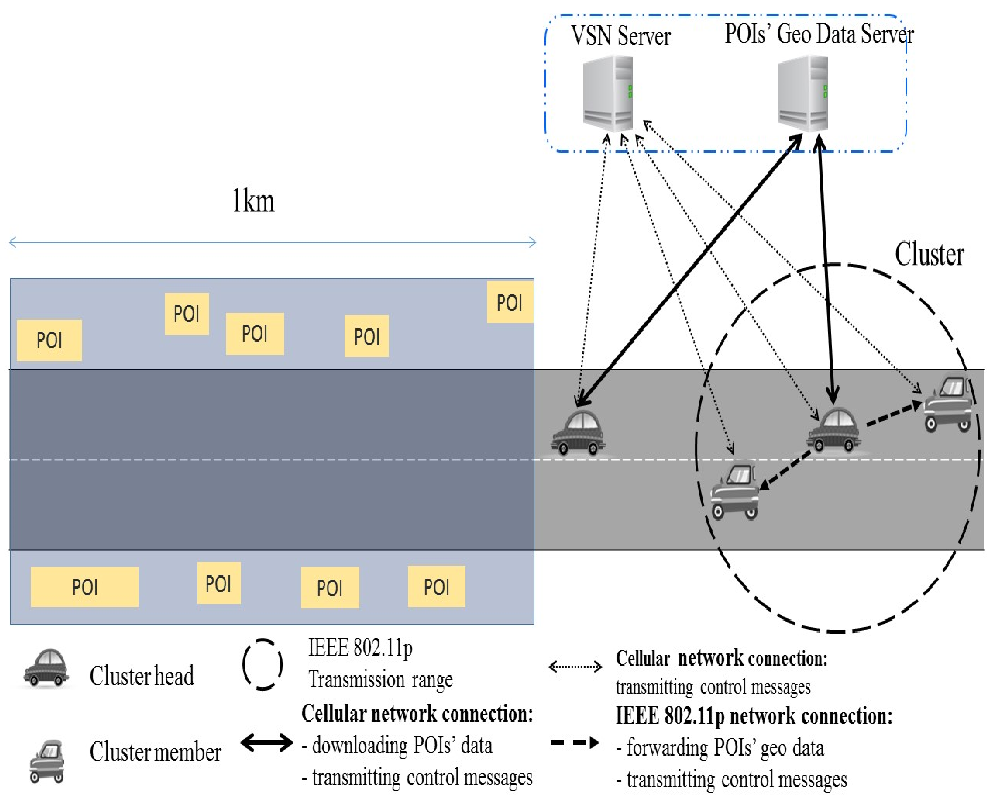 Figure: The abstract architecture showing V2I (Cellular) and V2V (DSRC) communication paths.
2. The Credit Economy
The core innovation is the mathematical model for Credit Exchange. The credit consumed by a member is proportional to the data received and inversely proportional to the number of members sharing the load: This formula ensures that the Cluster Head is fairly compensated for their cellular resource expenditure, incentivizing vehicles to alternate roles over time.
Experiments & Results
The researchers tested CBC against several baselines (Methods A, B, and C) across varying vehicle densities using NS-3.
Standard Deviation of Credits
The study found that CBC leads to a converged credit distribution. While simple clustering (Method B) caused a massive gap between "rich" and "poor" nodes, CBC’s credit-aware head selection forced vehicles to take turns, stabilizing the social economy of the network.
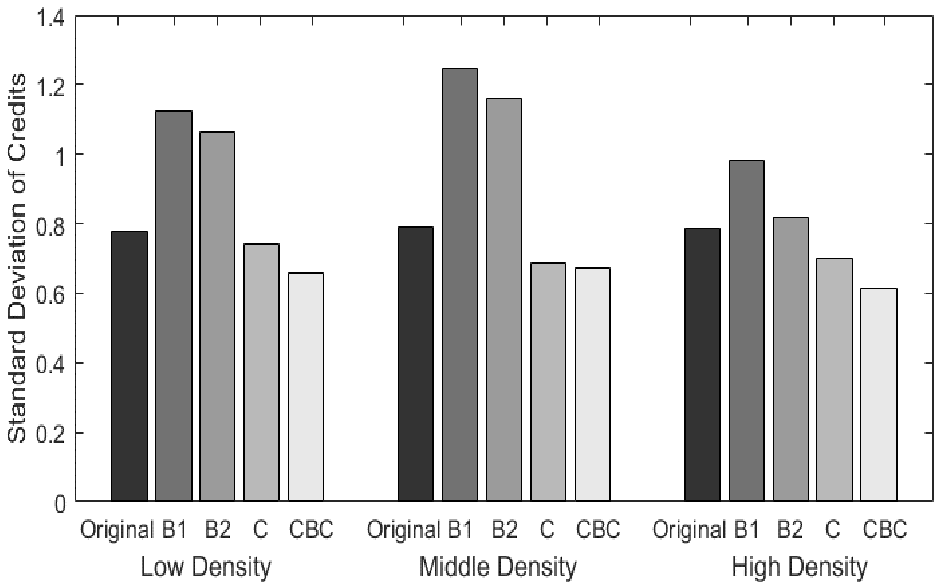 Figure: Comparison of credit standard deviation across different vehicle densities.
Successful Sharing Ratio
In middle-density scenarios, CBC outperformed simple clustering in "Complete Sharing" success. By maintaining smaller, more efficient clusters when necessary to avoid network collisions, CBC ensured that members actually received the full data package before reaching the POI area.
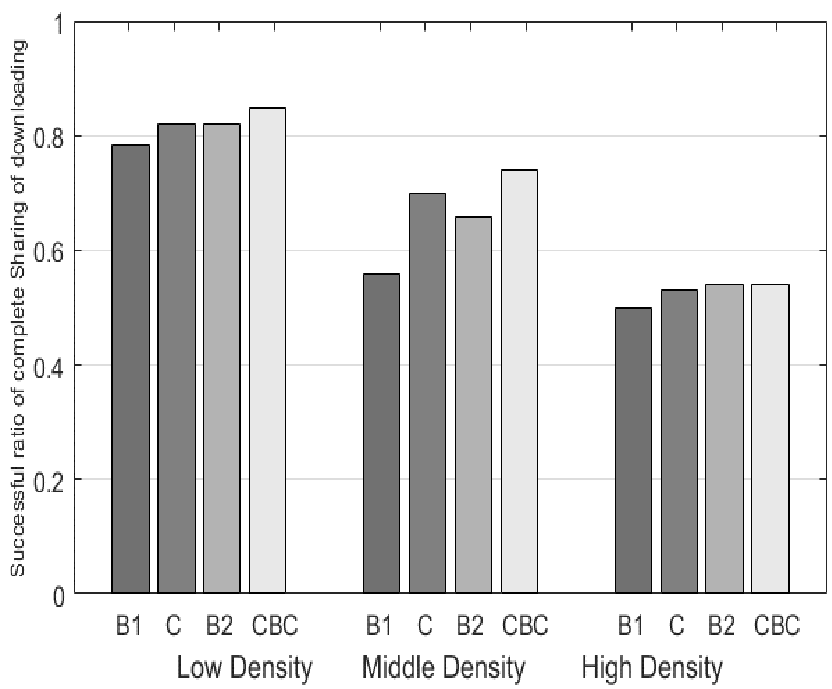 Figure: Comparison of successful data sharing ratios.
Critical Insight & Conclusion
The CBC scheme proves that Social Logic is just as important as Communication Logic in VANETs. By treating a fleet of vehicles as a social network with debts and rewards, we can achieve:
- Cellular Offloading: Substantial reduction in redundant downloads.
- Fairness: A self-correcting system where "selfish" nodes are eventually forced to contribute to regain service privileges.
- Efficiency: Higher data completion rates through optimized DSRC multicast.
Limitations: The reliance on a centralized VSN server for credit management presents a single point of failure. Future iterations could benefit from Blockchain or Distributed Ledger Technology (DLT) to decentralize the credit system, making the network even more robust against server outages.
Takeaway: Effective Proximity Services in the future of smart cities will depend on algorithms that balance technical performance with human-centric incentives.