
NodeED: Boosting Event Detection Sensitivity via Micro-Evolutionary Fluctuations
SPECIAL SECTION ON ADVANCED DATA ANALYTICS FOR LARGE-SCALE COMPLEX DATA ENVIRONMENTS
The paper proposes NodeED, a novel event detection framework for social networks that focuses on individual node evolution fluctuations. It introduces two algorithms: SimJudge, which uses Particle Swarm Optimization (PSO) to find optimal similarity indexes for each node, and MicroFluc, which aggregates these micro-level fluctuations to detect macro-scale events.
TL;DR
Social network event detection is traditionally a "forest" view—looking at the whole network's statistics. NodeED changes the perspective to the "trees," analyzing how individual nodes fluctuate using customized similarity indexes. By leveraging Particle Swarm Optimization to find the best metric for every node, NodeED achieves up to a 100% boost in event detection sensitivity.
Problem & Motivation: The Fallacy of Uniform Evolution
In social network analysis, events (like a corporate scandal or a sudden high-level management change) disrupt the "normal" evolution of links. Current SOTA methods typically pick one metric—like Common Neighbors or Preferential Attachment—and apply it to the whole graph.
The authors argue that this is fundamentally flawed. In a real network:
- Heterogeneity: Different nodes follow different rules. Some connecting based on popularity (PAS), others based on shared local communities (CNS).
- Local Impact: An event might violently fluctuate the connections of a CEO (Node A) while leaving a junior staff member (Node B) untouched.
If we only look at the macro-average, the signal of the event gets drowned out by the noise of unaffected nodes.
Methodology: SimJudge and MicroFluc
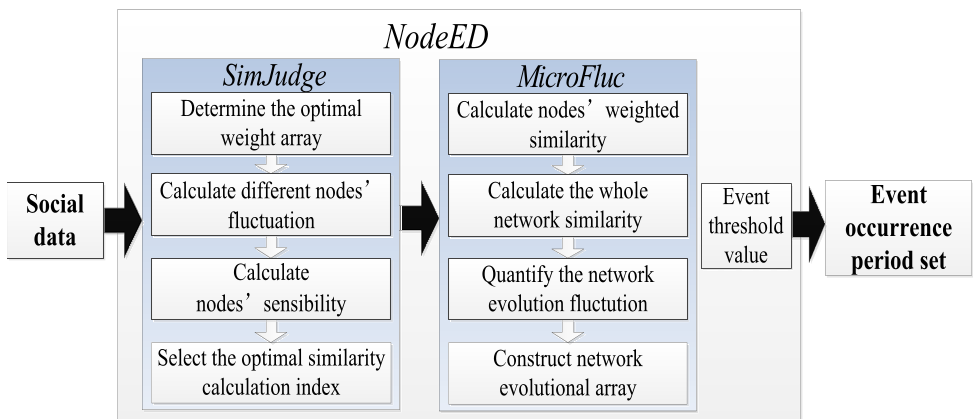
The proposed NodeED framework operates in two distinct phases to capture these micro-fluctuations.
1. SimJudge: Personalized Metrics for Nodes
Instead of choosing one similarity index, the authors consider 8 different indices (CNS, JAS, PAS, SOS, AAS, HPIS, SAS, LNHS). Since these indexes have different scales (e.g., PAS yields much larger values than CNS), they introduce a weight array params.
Using Particle Swarm Optimization (PSO), SimJudge optimizes these weights to maximize the sensitivity of fluctuations. For every node , it identifies the best index that reflects its specific evolutionary anomalies.
2. MicroFluc: Aggregating the Signal
Once each node has its "optimal" lens, MicroFluc calculates a weighted similarity for the entire network. Unlike standard link prediction, this weighted sum accounts for the fact that different nodes "measure" their evolution through different metrics. The final network fluctuation is calculated as the inverse of this graph similarity.
Experiments & Results
The authors tested NodeED on two classic datasets: VAST (Call data) and ENRON (Email data).
SOTA Comparison
The results are striking. When comparing NodeED against traditional macro-level methods (like using a single index like JAS or PAS):
- VAST Dataset: Sensitivity ( value) jumped from 15.73 (previous best) to 31.52.
- ENRON Dataset: Sensitivity increased from 4.21 to 6.50.
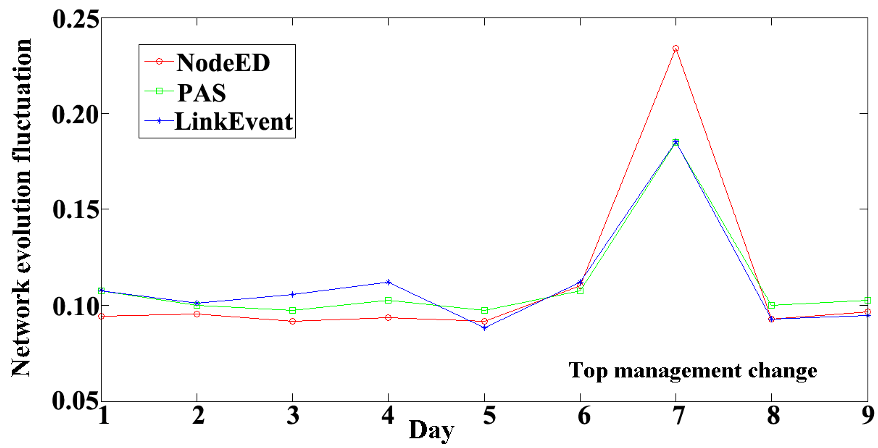 Figure: Network evolution sequences in the VAST dataset. Note how NodeED provides a much sharper peak during the event period compared to macro methods.
The "Why" Behind the Success
The paper provides an ablation-style analysis in Table 5, showing that in the ENRON dataset, 48% of nodes evolved best under PAS, while 40% evolved best under LNHS. By using only one (like JAS, which was optimal for only 1.33% of nodes), traditional models were essentially "blind" to 98% of the node-level evolution logic.
Critical Analysis & Conclusion
Takeaway
NodeED proves that micro-level granularity is the key to high-sensitivity monitoring. By allowing nodes to define their own "normalcy" through PSO-optimized similarity indexes, we can detect the first ripples of an event before they become a tidal wave in the global network statistics.
Limitations & Future Work
- Computational Cost: Using PSO for every time step and every node is significantly more expensive than calculating a global AUC.
- Interpretability: While we know that a node fluctuated, the paper doesn't deeply explore why a specific index (like LNHS) was the best fit for a specific node's role.
- Predictive Power: The authors suggest that analyzing local node evolution could eventually lead to better topology prediction, moving from "detection" to "forecasting."
In conclusion, NodeED represents a shift from "Global Network Monitoring" to "Intelligent Node-Level Auditing," making it a powerful tool for crisis management and organizational health analysis.