
AICM: Leveraging Social Influence for Precision Multimedia Caching
Advanced independent cascade model for YouTube content propagation in Facebook
The paper introduces the Advanced Independent Cascade Model (AICM), an extension of the traditional ICM designed to predict YouTube video propagation across Facebook. By integrating user-specific social attributes—"talkativeness" and "influential power"—mined via the Facebook API, the model identifies potential audience clusters to optimize multimedia caching strategies.
TL;DR
Predicting which video will "go viral" is no longer just a marketing trick—it is a technical necessity for server stability. This paper presents the Advanced Independent Cascade Model (AICM), which mines Facebook social profiles to predict YouTube video propagation. By quantifying "talkativeness" and "influential power," the model allows ISPs and content providers to pre-cache data exactly where the next wave of demand will hit.
Background: The Infrastructure of Virality
When a video goes viral, access demands grow exponentially. Current YouTube infrastructure uses geographical and logical hashing to distribute load, yet the decision to pre-cache—moving data to the edge before users ask for it—remains a reactive challenge. The authors argue that since Facebook is the primary engine for YouTube's spread, we should look at the "social signals" of the users themselves to predict the network's future load.
The Problem with Traditional Models
The classic Independent Cascade Model (ICM) is a staple of social network analysis, but it has a fatal flaw: it assumes every person in a network has the same probability of influencing their neighbor. In reality:
- Talkative users post more often, increasing the frequency of exposure.
- Influential users command more attention (likes/comments), increasing the probability of a "click" or "reshare."
Existing alternatives like the Opinion Disseminating Model (ODM) are too mathematically heavy for real-time scraping and prediction.
Methodology: High-Fidelity Social Mining
AICM personalizes the propagation probability. The core innovation lies in the weight function and the adjusted outcome .
1. Quantification of Social Strength
The authors define two primary metrics mined from Facebook Timelines:
- (Talkativeness): Average postings per week.
- (Influential Power): A composite score of Likes + Comments + Shares per post.
2. The Model Architecture
Instead of a fixed probability , the "infection" occurs if a random variable (weighted by the user's social strength) exceeds a threshold .
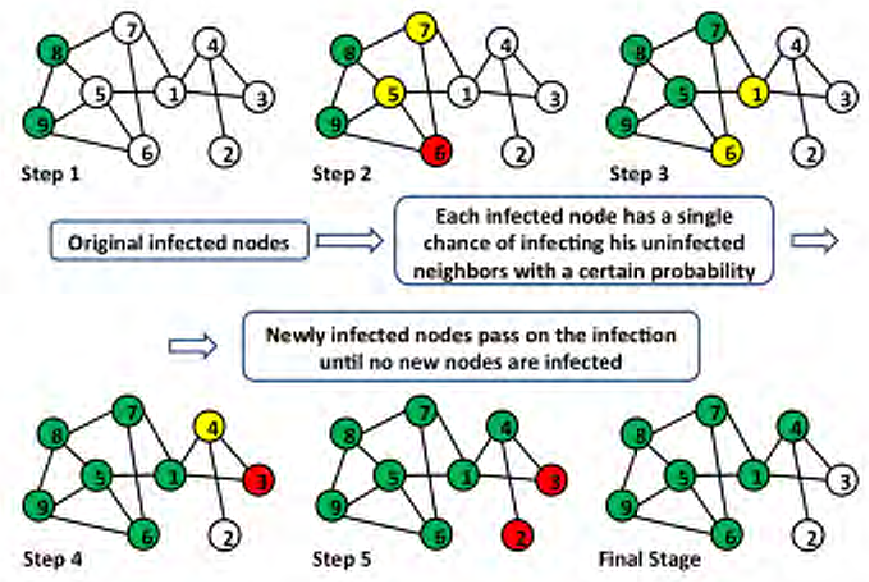 Fig 1: The standard ICM infection process, which AICM enhances by adding heterogeneous node weights.
The weight between user and friend is calculated as: This ensures that spread is most likely when a talkative person () is connected to an influential content source ().
Experimental Insights
The researchers scraped a real-world dataset of 2,344 users and simulated the spread of massive viral hits like "KONY 2012" and "Lady Gaga - Bad Romance."
SOTA Comparison: Actual vs. Random Seeds
The simulation compared "Actual Seeds" (the first 20 people who actually shared the video) against "Random Seeds." The results confirmed that virality is not accidental: the actual seeds for viral videos consistently resided in the 80th percentile of the talkativeness/influence scale.
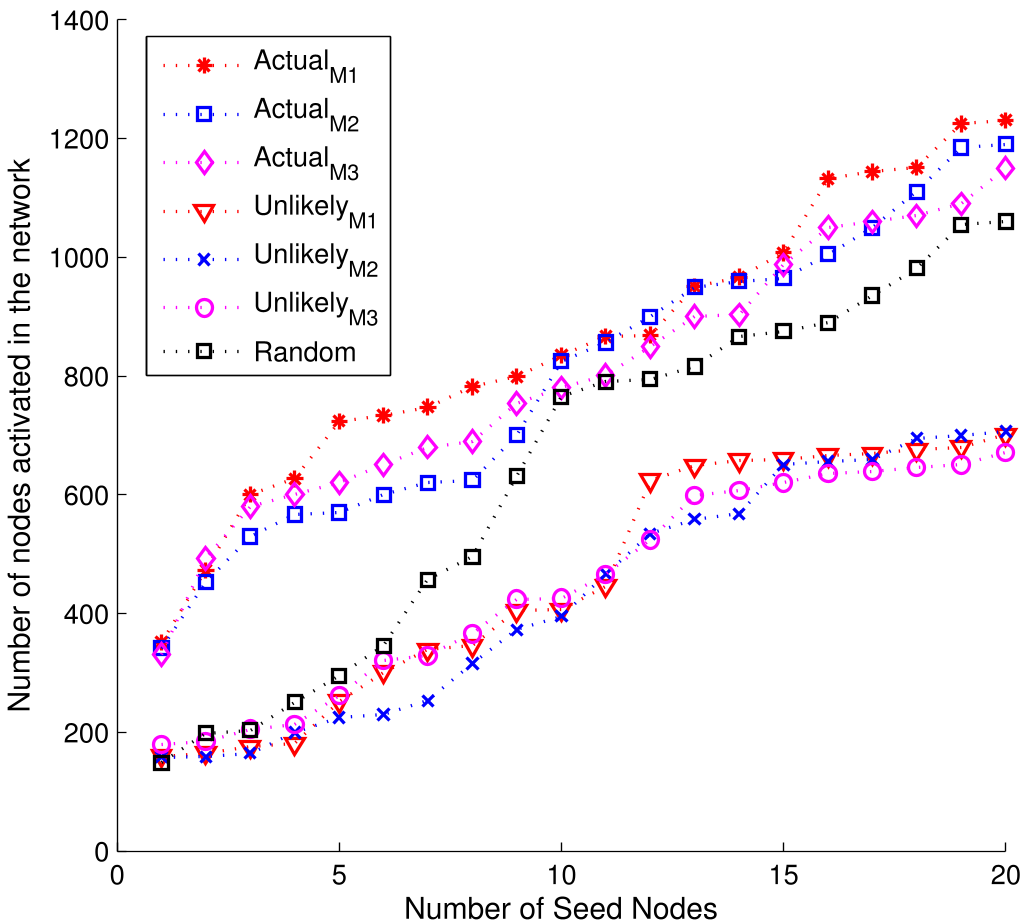 Fig 2: As the threshold increases, only the most "influential" connections can trigger a cascade, reducing the total spread size.
Cluster-to-Cluster Growth
A key takeaway from the experiments was the "slope" of the growth curve. Rapid growth periods correspond to the information jumping from one social cluster to another (across-cluster spread), whereas slow growth happens when the video is merely saturating a group of friends who already know each other (within-cluster spread).
Critical Analysis & Conclusion
AICM successfully bridges the gap between social media behavior and network engineering. By treating "social influence" as a measurable variable, it provides a roadmap for Pre-emptive Caching.
Limitations:
- The "Fun-Factor": The model currently ignores the content of the video itself (the "fun-factor"). A boring video posted by an influential person might still fail to go viral.
- Platform Silos: The data relies on Facebook visibility, which is increasingly restricted by privacy settings and API changes since 2012.
Future Outlook: Integrating AICM with Deep Learning to analyze video thumbnails or titles (Multi-modal analysis) could refine the probability even further, creating a truly predictive "Content Delivery Network of the Future."