
Beyond the Matrix: A Strategic Framework for Cybersecurity via Adversarial Risk Analysis
An Adversarial Risk Analysis Framework for Cybersecurity
The paper introduces a comprehensive Adversarial Risk Analysis (ARA) framework for cybersecurity, integrating both intentional (strategic) and non-intentional threats into a single decision-making model. By utilizing Bi-Agent Influence Diagrams (BAID), it optimizes the allocation of security resources and evaluates the inclusion of cyber insurance as a risk-transfer mechanism.
TL;DR
Cybersecurity is not just a battle against random failures; it's a game of wits against strategic adversaries. This paper moves beyond the flawed "risk matrices" used in many ISO standards, proposing an Adversarial Risk Analysis (ARA) framework. By modeling the psychological and strategic profile of attackers, it allows organizations to find the perfect "Goldilocks" zone of security spending and cyber insurance.
The Problem: The Flaw in the Matrix
Most corporate risk assessments rely on a 5x5 color-coded grid—the "Risk Matrix." While simple, these tools are mathematically broken. As documented by Cox (2008), they often assign the same rating to vastly different quantitative risks, leading to "suboptimal resource allocation."
More importantly, traditional models treat a DDoS attack the same way they treat a fire: as a random event with a fixed probability. But attackers are not random; they adapt. If you build a higher wall, they buy a taller ladder.
Methodology: Thinking Like Your Enemy
The core of this work is the Bi-Agent Influence Diagram (BAID). It visualizes the decision nodes of both the Defender (you) and the Attacker (the adversary).
1. The Sequential Game
The framework operates on a Defence-Attack sequence:
- The Defender chooses a portfolio of security controls (Firewalls, Anti-fire systems, Insurance).
- The Attacker observes these controls (or infers them).
- The Attacker executes an "optimal" attack based on their own utility (profit vs. risk of being caught).
2. Bayesian Simulation of the Adversary
Since we cannot know the attacker's exact thoughts, the authors use a "Random Utility" model. Instead of assuming the attacker is perfectly rational, they model the attacker's goals as a distribution of possibilities and use Monte Carlo simulations to predict the most likely attack vectors.
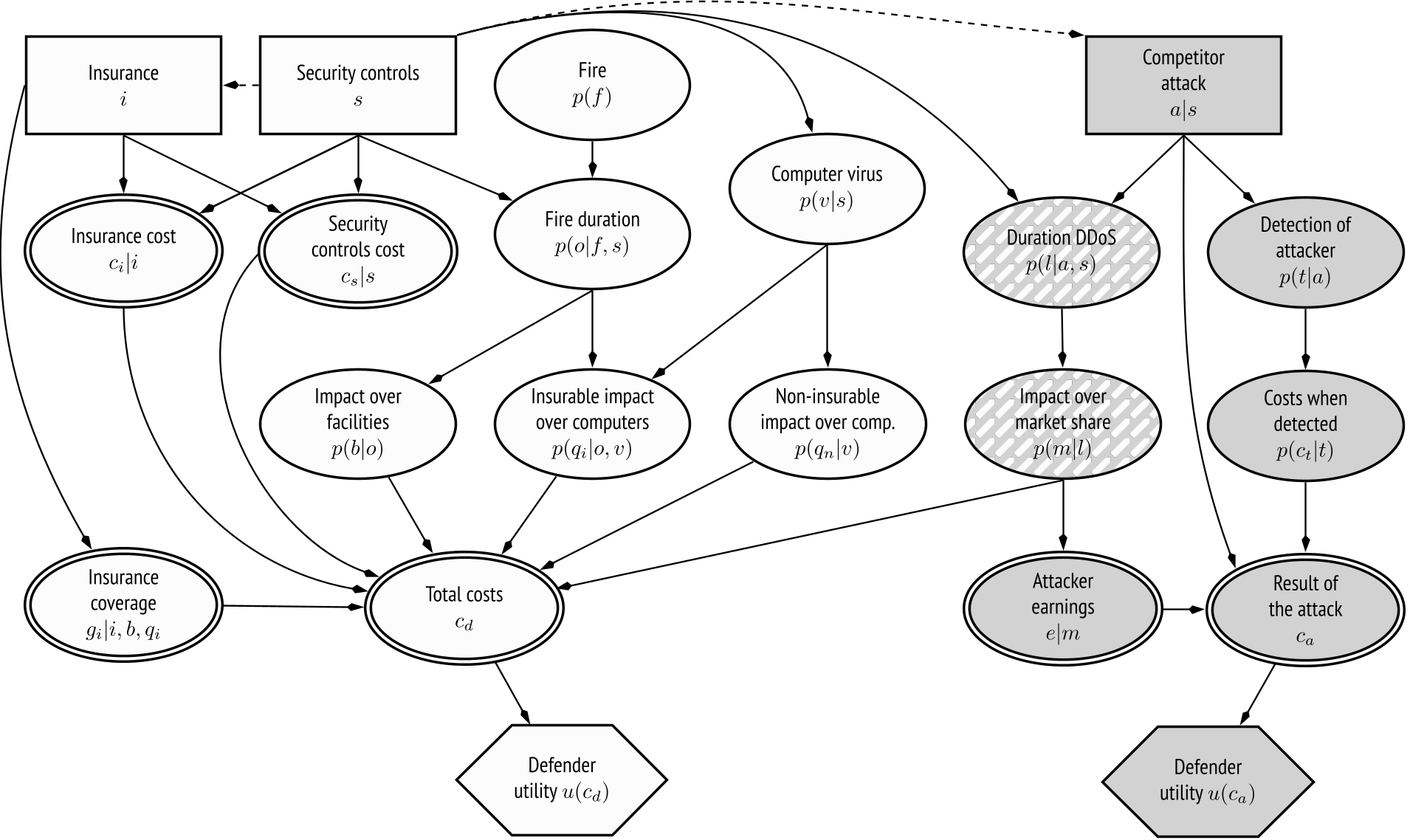 Figure: The Bi-Agent Influence Diagram (BAID) used to structure the case study.
The Case Study: Protecting an SME
The paper applies this to a document management SME. The analysis covers non-intentional threats (fire, ubiquitous viruses) and intentional ones (a competitor launching a DDoS).
Key Decision Factors:
- Technical Controls: Firewalls, cloud-based DDoS scrubbing (up to 1 Tbps).
- Risk Transfer: Four tiers of insurance (None, Traditional, Cyber, Comprehensive).
- Attacker Profile: A competitor seeking market share, balancing the cost of a botnet against the risk of legal prosecution.
Results & SOTA Comparison
The simulation revealed that the "obvious" choice isn't always best. While many SMEs skip high-end DDoS protection due to cost, the ARA model showed that for this specific firm, a 1 Tbps cloud protection combined with Comprehensive Insurance provided the highest expected utility, significantly buffering against the catastrophic "long-tail" risk of total market share loss.
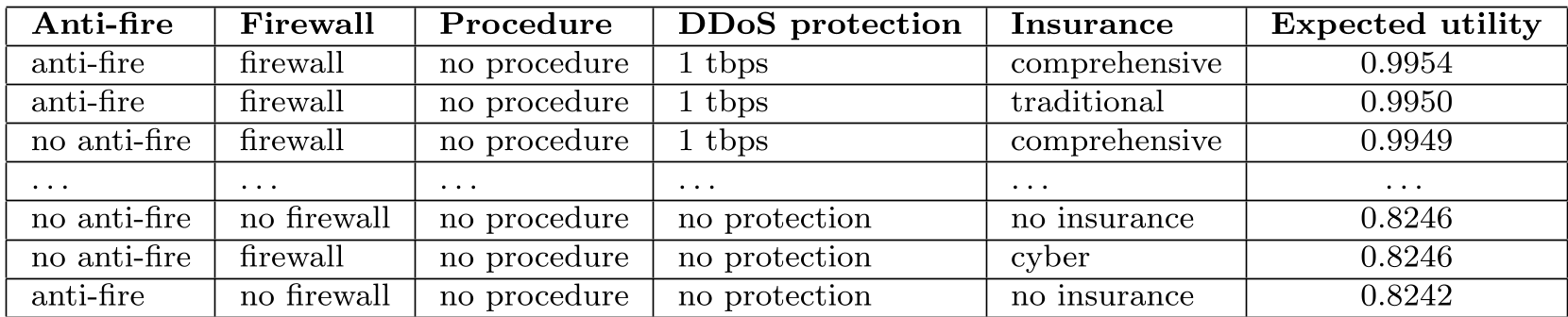 Table: Ranking of security portfolios—the integrated approach (DDoS + Fire + Insurance) takes the lead.
Critical Insight: Why This Matters
The most profound takeaway is the integration of Cyber Insurance. In the era of Ransomware, technical defenses are never 100% effective. The ARA framework provides a rigorous way to decide exactly how much "residual risk" should be shifted to an insurance provider, rather than just guessing.
Conclusion & Limitations
Takeaway: Cybersecurity is an economic battle. The ARA framework transforms defense from a "check-the-box" compliance task into a strategic optimization problem.
Limitations: The model is heavily dependent on Expert Judgement for inputs where data is scarce (like the probability of an attacker being "risk-prone"). Future iterations would benefit from real-time threat intelligence feeds to automate these Bayesian updates.
Future Outlook: We expect to see these ARA models embedded into "Cyber Insurance Premium Calculators," creating a more dynamic market where better security posture directly and transparently lowers insurance costs.