
Decoding Autism: Analyzing Mental Health Patterns in Online Communities
Affective, Linguistic and Topic Patterns in Online Autism Communities
This paper presents a comparative analysis of online autism communities (Clinical) versus general interest groups (Control) on the LiveJournal platform. Using machine learning techniques like LDA and Lasso regression, the study investigates sentiment, topics, and language styles, identifying distinct markers that characterize autism-related discourse.
TL;DR
Researchers from Deakin University have utilized machine learning to "read between the lines" of online autism communities. By analyzing over 20,000 blog posts, the study reveals that sentiment, language style, and discussion topics are powerful predictors of autism-related content, achieving up to 87.6% accuracy. This work bridges the gap between data science and clinical psychiatry, demonstrating how social media can act as a screening tool for neurodevelopmental disorders.
Problem & Motivation: The "Braille" of the Internet
For many individuals on the Autism Spectrum (ASD), the internet isn't just a convenience—it is "Braille," a vital interface for social interaction that avoids the stresses of face-to-face communication. However, prior research into these digital havens has been fragmented. Most studies focused on either topics or linguistics, often ignoring the affective (emotional) state of the community. Moreover, researchers previously struggled to identify which features were truly unique to autism without being bogged down by redundant data.
Methodology: A Triple-Threat Approach
The authors collected data from 110 LiveJournal communities, categorized into "Clinical" (Autism-focused) and "Control" (General interests like gaming, fashion, or travel). They analyzed the data through three distinct lenses:
- Sentiment (The "Feel"): Using the ANEW lexicon, the team scored posts based on Valence (pleasantness) and Arousal (intensity).
- Topics (The "What"): Using Latent Dirichlet Allocation (LDA), they extracted 50 core themes discussed across the groups.
- Language Style (The "How"): Using LIWC, they categorized words into psycholinguistic processes (e.g., social, cognitive, biological).
To find the most potent "biomarkers" of these posts, they employed Lasso Regression, a technique that identifies the most important features while discarding the "noise."
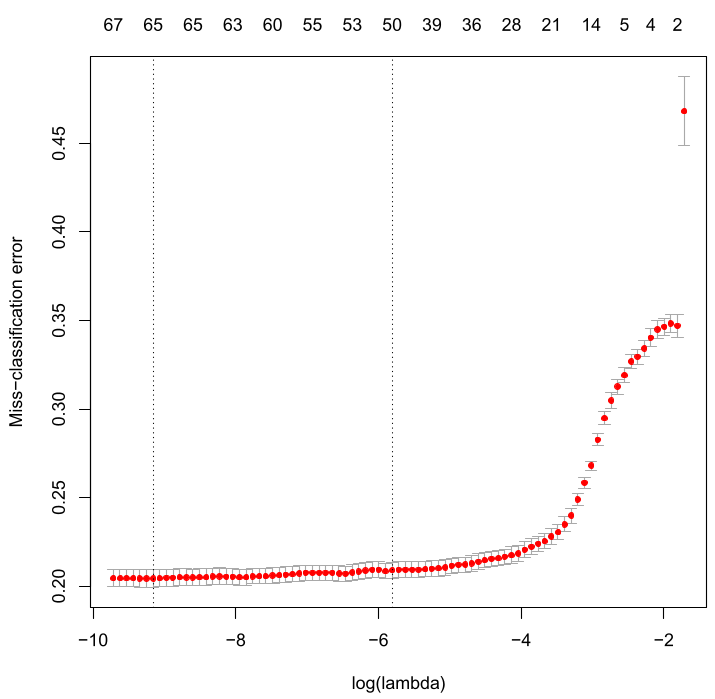 Figure 1: The Lasso model selecting features to predict autism blog posts.
Key Insights & Results
The findings paint a vivid picture of the ASD community's digital experience:
- Emotional Landscape: The Clinical group exhibited consistently lower valence. Post tags like "depressed," "angry," and "confused" were significantly more common than the "happy" or "excited" tags dominant in control groups.
- Linguistic Divergence: "Biological processes" (specifically health-related terms like clinic, flu, pill) were massive positive predictors.
- Social Nuance: Interestingly, while the clinical group often talked about "Family" and "Humans," they used the word "Friends" significantly less than the control group. This reflects the reality that for many with ASD, social support systems are often centered on immediate relatives rather than broader peer networks.
- Predictive Power: Topics were the most reliable signal (87.6% accuracy), followed by psycholinguistic styles.
 Table 1: Top discriminatory topics between Autism and Control communities.
Critical Analysis & Future Outlook
This study confirms that ASD is not just a clinical diagnosis but a distinct socio-linguistic identity. The ability to classify posts with nearly 90% accuracy suggests that machine learning could provide an "early warning system" for mood disorders within vulnerable populations.
Limitations: The study relies on LiveJournal, a platform with specific demographics that may not represent the modern "TikTok" or "Reddit" generation of ASD individuals. Furthermore, the reliance on pre-defined lexicons like LIWC can sometimes miss the subtle sarcasm or evolving slang used in digital spaces.
Takeaway: The future of mental health support is unobtrusive. By monitoring the "digital pulse" of online communities, researchers and caregivers can provide better-targeted support without the intrusive nature of traditional clinical surveys.