
Affective Social Network: Engineering Happiness into the Social Graph
Affective social network—happiness inducing social media platform
This paper introduces the "Affective Social Network," a framework that integrates Affective Computing with social media to build user emotion profiles and an Emotional Relationship Matrix (ERM). Using an Automatic Emotion Annotation (AEA) method and WordNet-based mapping, it provides a foundation for emotion-induced services like personalized media recommendations.
TL;DR
Most social networks are built on "who you know," but they rarely understand "how you feel." This paper proposes the Affective Social Network, a systemic approach to quantifying human emotion within social media. By decomposing affect into Personality, Mood, and temporary Emotion, and mapping these to a new Emotional Relationship Matrix (ERM), the authors demonstrate how platforms can transition from simple message carriers to active agents capable of inducing happiness through personalized recommendations.
Problem & Motivation: The Missing "Soul" in Link Analysis
For decades, we have viewed social networks through the cold lens of Graph Theory—measuring Degree Centrality, PageRank, and information diffusion. While effective for viral marketing, this approach ignores the fundamental driver of human interaction: Emotion.
The authors identify a critical gap: existing social media can sometimes make users feel worse (e.g., the "better life" perception bias). The motivation here is twofold:
- Human-Centric Socializing: Moving beyond topological links to understand the "impassioned nature" of user-generated content.
- Affective Service: Creating a mechanism where the network can detect "atrocious states" and provide "uplifting emotions" through curated media.
Methodology: Deciphering the Emotional Hierarchy
The core innovation lies in how the authors formalize the ephemeral nature of feelings into a computable framework.
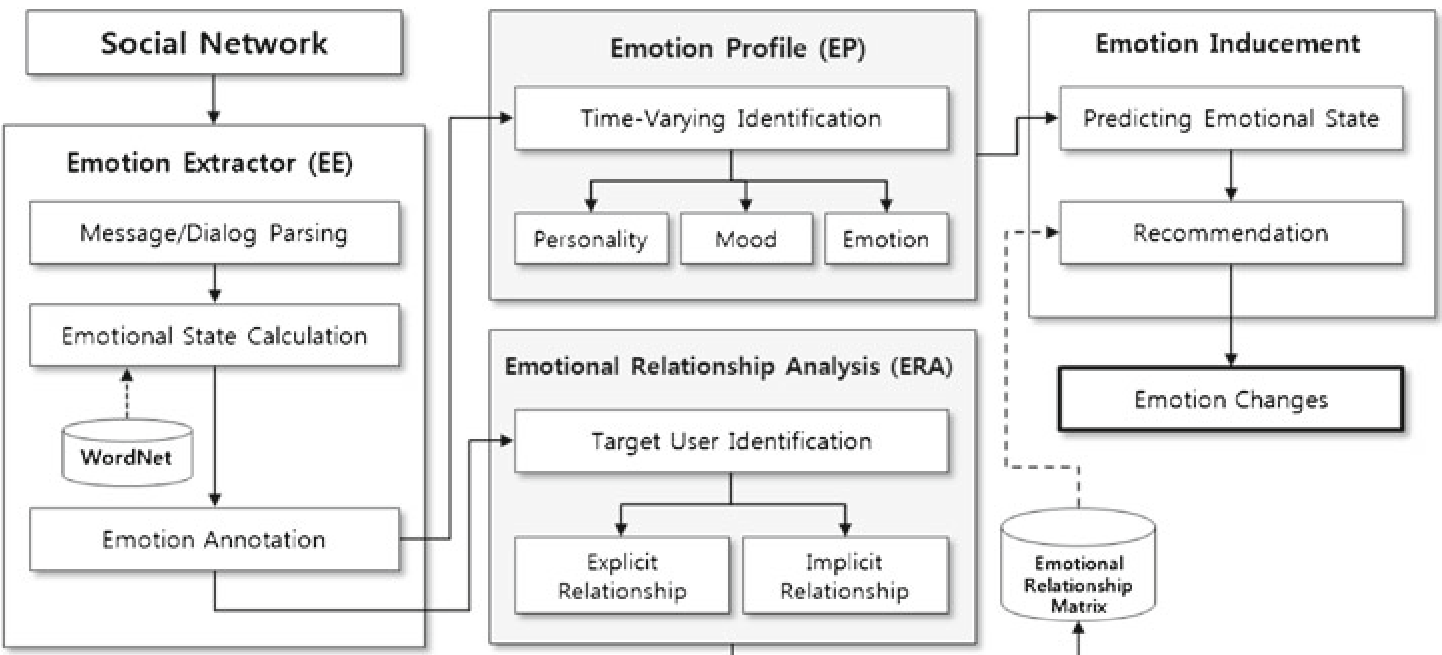
1. The Three Layers of Affect
The paper adopts a psychological tri-layer model:
- (Personality): The unchangeable, long-term behavior (analyzed across all user history).
- (Mood): A mid-term state influenced by external stimuli or circadian rhythms.
- (Emotion): The fleeting, immediate reaction found in a single post.
2. Automatic Emotion Annotation (AEA)
To turn text into data, the system uses a WordNet-based logic. It extracts nouns, verbs, and adjectives, then measures their semantic "conceptual distance" from 30 core emotional categories (e.g., Ecstasy, Calmness, Pathos).
3. The Emotional Relationship Matrix (ERM)
The authors distinguish between Explicit (mutual followers) and Implicit (mentions) relationships. The ERM quantifies the "Emotional Coherence" between two users, essentially asking: How much do these two individuals emotionally influence or resonate with one another?
Experiments: Do Relationships Drive Emotion?
Using a dataset of over 150,000 tweets, the study validated several key hypotheses:
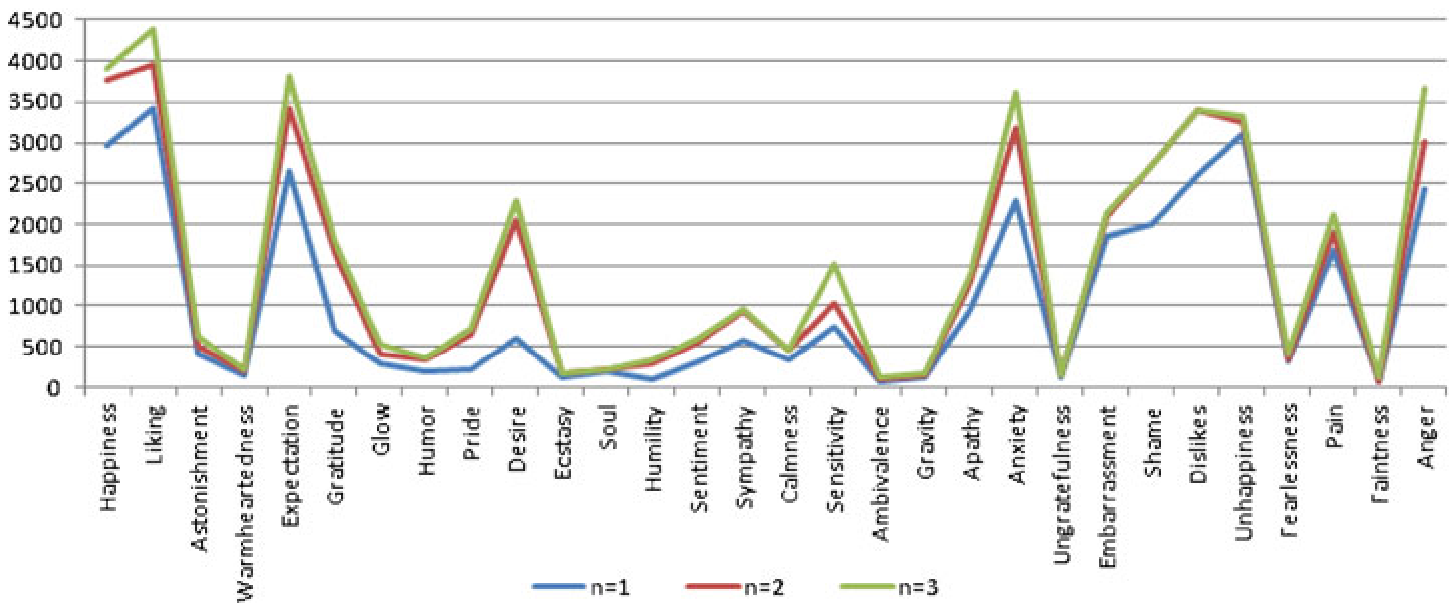
- Optimal Annotation Depth: The authors found that setting (the number of extracted emotion annotations) provides the best balance between data richness and computational performance.
- Relationship Intensity: Users in mutual relationships () exhibit the highest density of emotional words. Interestingly, "monologues" (posts with no recipients) ranked second, suggesting people use social media as an emotional outlet for self-reflection.
- Similarity Analysis: Personality traits were found to be remarkably similar among users with mutual ties, supporting the "birds of a feather" (homophily) theory in the affective domain.
Critical Analysis & Conclusion
The Takeaway
The Affective Social Network isn't just a classification tool; it's a blueprint for "Emotion Inducement." By calculating Euclidean distances between a user's current state and potentially "uplifting" media or users, the network can act as an emotional regulator.
Limitations
- Textual Constraint: The 2012 study focused primarily on text. In today's landscape of short-form video (TikTok/Reels), facial and auditory affect recognition would be vital.
- Subjectivity: Emotion is notoriously subjective; the paper relies on semantic distances which might miss sarcasm or cultural nuances.
- Real-Time Challenges: As the authors noted, the average user posts 1.45 tweets/day, which is often insufficient for real-time "Mood" tracking without broader cross-platform data.
Future Outlook
This work paved the way for modern "Mental Health AI" on social platforms. Future iterations of this model, powered by LLMs, could provide even more nuanced support, potentially identifying early signs of depression or anxiety through the evolution of a user's Emotion Profile over time.