
Affective Story-Morphing: Rewriting Frankenstein Through the Lens of AI Emotion
Affective Story-Morphing: Manipulating Shelley’s Frankenstein under Program Control using Emotionally Intelligent Agents
This paper introduces "Affective Story-Morphing," a theoretical framework and AI system called the Affective Reasoner for automating plot-consistent narrative generation. By utilizing a robust emotional model of 28 categories and ~400 expression channels, the system manipulates character temperaments and dispositions to transform a single plot (e.g., Mary Shelley's Frankenstein) into diverse, emotionally resonant stories.
TL;DR
What makes a story compelling isn't just what happens, but how the characters care about it. This paper presents the Affective Reasoner, an AI system capable of "Story-Morphing"—the process of taking a fixed plot and automatically generating hundreds of variations by manipulating the emotional dispositions and temperaments of its characters. By applying these techniques to Mary Shelley’s Frankenstein, the author demonstrates how a single scene can shift from a horror story to a tragedy of parental shame or even a dark comedy.
Background: The Emotion Fabric of Narrative
While most AI narrative research focuses on plot development or world-building, Clark Elliott argues that the "emotion fabric" is the essential structure of human cognition. We don't just remember facts; we remember episodes colored by feelings. The challenge in AI is that the "real world" is too complex to model symbolically. However, the logic of emotion is highly computable.
The core insight here is Orthogonality: we can keep the plot steps stagnant (The boy sits in the chair) while rotating the emotional axis (The boy feels guilty; The boy feels defiant) to create entirely new narrative meanings.
Methodology: The Affective Reasoner
The system relies on "Emotionally Intelligent Agents" that replace static characters. These agents operate via two primary mechanisms:
- Disposition: How an agent appraises an event based on their goals, principles, and preferences.
- Temperament: How an agent expresses the resulting emotion through ~400 somatic, behavioral, or verbal channels.
The Taxonomy of Feeling
The Affective Reasoner utilizes a refined version of the OCC model, categorizing emotions into groups like "Well-Being," "Fortunes-of-Others," and "Attribution."
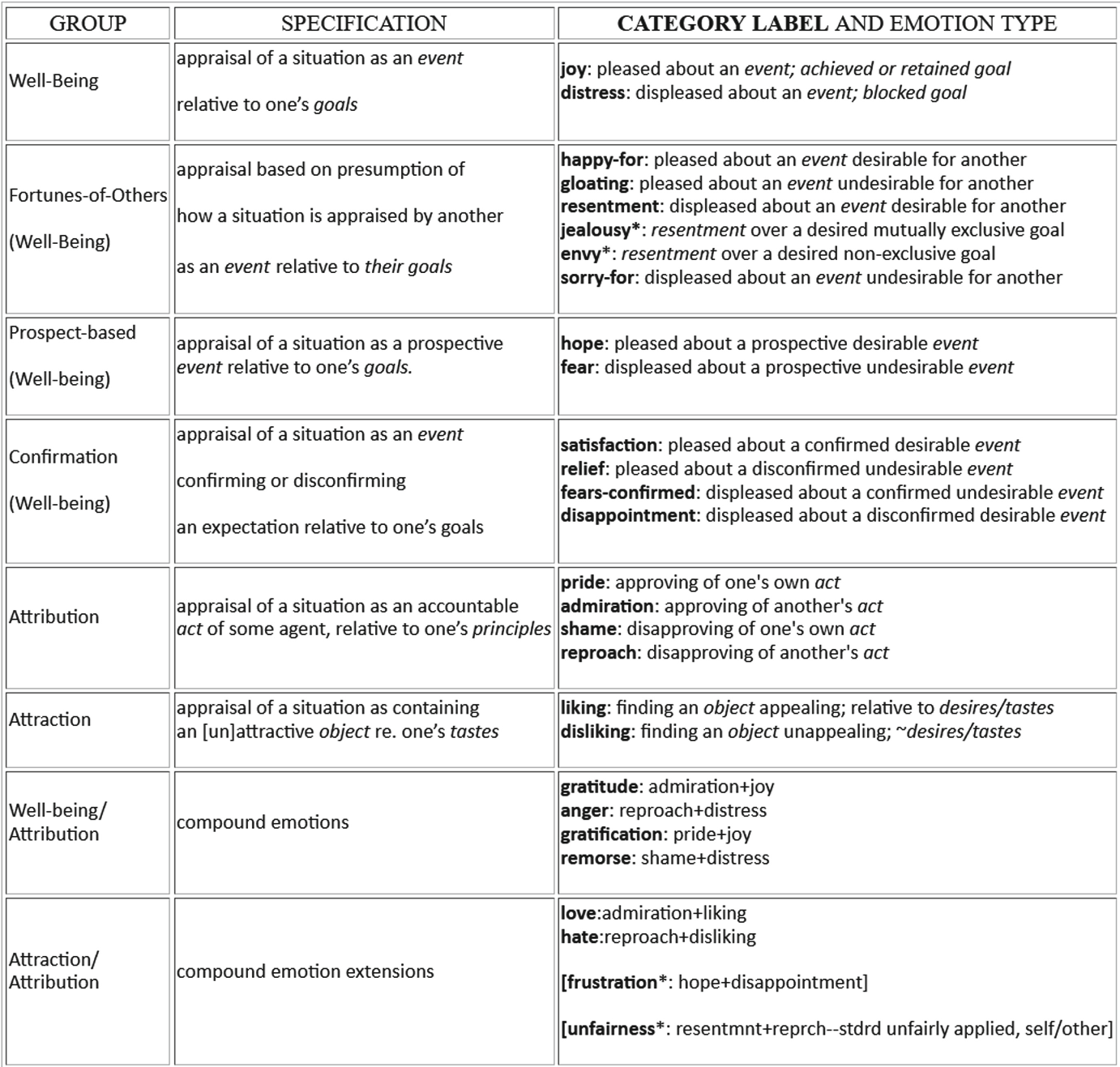
When an event occurs (a "sim-event"), the agent uses appraisal-frames to see if the event blocks a goal or violates a principle. If a match is found, an emotion is triggered with specific intensity variables (e.g., surprisingness, effort, or importance).
Case Study: Morphing the Monster
The paper’s most striking contribution is morphing Chapter Five of Frankenstein. In the original, Victor Frankenstein is disgusted by his creation. By tweaking the AI variables, the author generates fascinating alternatives:
- The Shame Morph: Victor feels a principle-based obligation to love his "child" but is somatically repulsed. He doesn't run away in fear, but in shame for his own lack of parental love.
- The Adversarial Morph: Victor is a sadist who created life specifically to mistreat it. He handles his disgust not as a failure, but as "gloating" because the monster's ugliness gives him more leverage for cruelty.
- The Humor Morph: Using a theory of humor based on violated standards, the monster perceives Victor’s failure to make him beautiful as a hilarious blunder by an "authority figure" and laughs at his creator.

Experiments & SOTA Insights
The paper moves beyond "Basic Emotions" (like Ekman’s six faces) to a cognitive model of 28 categories. The results show that:
- Intensity Matters: By manipulating 24 variables (like "deservingness"), the AI can make a character's "sorry-for" response range from mild pity to profound grief.
- Internal Consistency: Because the AI generates emotions based on a logical rule-set, the characters never act "out of character" within their defined morph, even if their behavior is radically different from the original text.
Critical Analysis & Takeaways
The beauty of Story-Morphing lies in its Human-Centricity. Humans are "abductive" storytellers—we are naturally forgiving and will find explanations for inconsistent behavior as long as there is an underlying emotional logic.
Limitations: The system currently lacks a robust linguistic engine. It focuses on the "underlying fabric" (the logic of the feelings) rather than the "surface string" (the actual prose). For a full product, this must be paired with an LLM or a sophisticated text generation system.
Future Outlook: This work holds immense potential for the Gaming Industry. By automating the "content bottleneck," developers can create NPCs that respond to player actions with deep, consistent emotional arcs rather than scripted dialogue trees. It moves AI from being a "plot generator" to an "empathy simulator."