
The Robot’s Pulse: Modeling Personality and Emotional Decay in Human-Robot Interaction
Affective transfer computing model based on attenuation emotion mechanism
This paper introduces an Affective Transfer Computing Model that integrates personality, mood, and emotion into a unified framework for humanoid robots. By utilizing the Five Factor Model (FFM) for personality and PAD space for mood, the authors develop a dynamic system that simulates human-like emotional decay and state transitions for facial expression synthesis.
TL;DR
Researchers have developed a dynamic affective computing model that doesn't just "feel" an emotion but understands how that emotion should fade over time. By mathematically linking Personality, Mood, and Emotion, the model enables robots to exhibit unique temperaments—where an "extroverted" robot recovers from a scare faster than an "introverted" one.
Context: Beyond "If-Then" Emotions
In the early days of Affective Computing, pioneered by the likes of Marvin Minsky and Rosalind Picard, the goal was simple: make machines recognize and express emotion. However, human psychology is rarely a simple "stimulus-response" loop. If you are startled, the fear doesn't vanish instantly; it lingers, decays, and is filtered through your base personality.
The authors of this paper argue that for robots to be truly harmonious social partners, they need a temporal attenuation mechanism. They shouldn't just switch from "Happy" to "Neutral"—they should "calm down."
The Architecture of Feeling
The paper proposes a hierarchical structure that mirrors classical psychological theories. It breaks down the affective state into three distinct timescales and dimensions:
- Personality (P): The constant. Using the Five Factor Model (FFM), it defines a stable vector (Openness, Conscientiousness, Extraversion, Agreeableness, Neuroticism).
- Mood (M): The medium-term state. Mapped into the PAD Space (Pleasure, Arousal, Dominance).
- Emotion (E): The short-term, high-intensity reaction. (Anger, Disgust, Fear, Happiness, Sadness).
The Secret Sauce: Attenuation Equations
The most significant contribution is the mathematical modeling of "forgetting" an emotion. Using differential equations, the authors define: Here, is the decay factor. Crucially, is not a random constant; it is a weighted sum of personality factors. This means the robot’s personality physically determines how fast its "mood" returns to its baseline ().
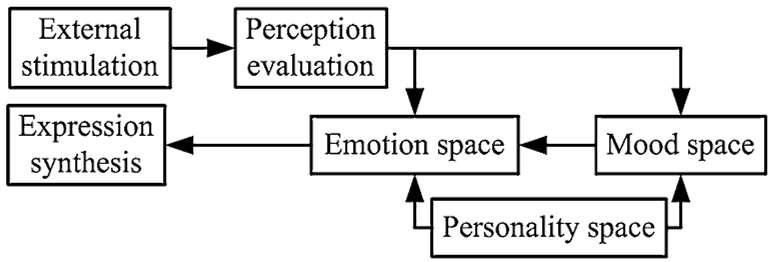 Figure: The structure of the emotional decision-making model showing the flow from external stimuli through personality filters to the final expression.
Methodology: Mapping the Mind
The model creates a bridge between these spaces using transition matrices.
- P to M: Personality determines your "default" mood.
- M to E: Your current mood acts as a "gain" for incoming emotional stimuli. If you are already in a "hostile" mood (-P, +A, +D), a minor annoyance is more likely to trigger an "Anger" emotion.
Experimental Insights: Introverts vs. Extroverts
The researchers tested their model using MATLAB simulations and a custom-built humanoid robot. The results revealed fascinating behavioral differences:
- Extroversive Profiles: Showed rapid, high-intensity emotional spikes but returned to baseline almost immediately. Their "emotional metabolism" is fast.
- Introversive Profiles: Showed lower peak intensities, but the emotion lingered significantly longer. Their mood was more "stable" but harder to shift once influenced.
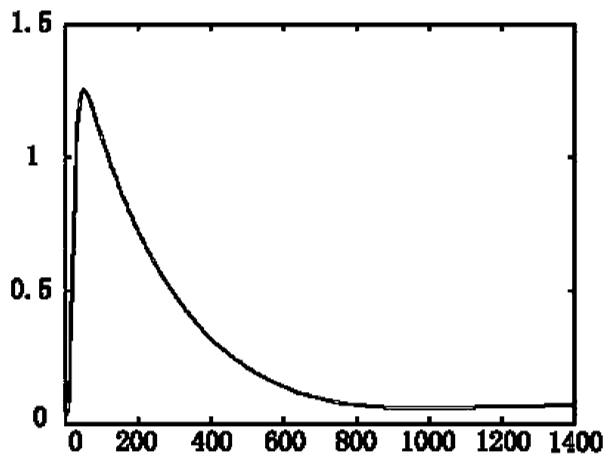 Figure: The changing process of emotion and mood. Note how the extroversive personality peaks quickly and returns to calm faster than the introversive counterpart.
Critical Analysis & Conclusion
This paper succeeds in moving artificial psychology away from discrete states and toward continuous dynamics. By treating emotion as a signal with decay, it allows for "lingering" moods that influence subsequent interactions—a key component of human-like behavior.
Limitations: While robust in its mathematical framework, the model relies on linear mappings between spaces which may oversimplify the complex, non-linear nature of human neurobiology. Additionally, the robot platform used for the experiment was limited to basic facial movements, potentially masking the subtle nuances the math was capable of producing.
Future Outlook: Integrating this "attenuation" logic with modern Large Language Models could solve one of AI's biggest hurdles: emotional memory. Imagine a GPT-based companion that doesn't just know you were angry five minutes ago but is "slowly cooling off" throughout the conversation.