
Beyond Parents: Leveraging Multi-Generational Affinity in Biological Data Mining
Study on the Impact of Affinity on the Results of Data Mining in Biological Populations
This study investigates the impact of genetic affinity on data mining results within biological populations, specifically focusing on Silesian horses. By utilizing Decision Trees (DT), Neural Networks (NN), and Association Rules (AR), the authors demonstrate that integrating data from extended ancestors (grandparents and great-grandparents) significantly improves the prediction accuracy of phenotypic traits like height.
TL;DR
Predicting the physical traits of offspring is a cornerstone of animal breeding. This paper explores whether looking further back in time—specifically to grandparents and great-grandparents—improves the accuracy of data mining models. Using a 50-year database of Silesian horses, the study confirms that "affinity-aware" models (using 16 ancestral features) significantly outperform those relying solely on mother/father data, pushing prediction accuracy to nearly 90%.
Background: The Breeder's Dilemma
In biological populations, the "value" of an individual is a cocktail of genetics and environment. While modern genomics allows for direct DNA analysis, historical populations (like horses bred 50 years ago) can only be analyzed indirectly through pedigree. Traditionally, breeders rely on the BLUP (Best Linear Unbiased Prediction) method, but as data mining enters the fray, a vital question arises: How much ancestor data is enough?
The Core Insight: Inductive Bias in Pedigrees
The researchers posit that standard data mining often ignores the deep "affinity" or genetic correlation inherent in populations. By restructuring the data to include not just parents, but also the girth, height, and bone circumference of ancestors up to the third generation, they introduce a powerful genetic context to the learners.
Methodology: From Parents to Great-Grandparents
The study analyzed 16,069 observations of Silesian stallions. They compared three different feature sets:
- M&F: Only Mother and Father data.
- 4F: The top 4 most influential ancestral attributes.
- 16F: The top 16 ancestral attributes based on feature scoring.
Model Architecture and Selection
The team utilized three primary algorithms via SQL Server 2008 R2: Decision Trees (DT), Neural Networks (NN), and Association Rules (AR).
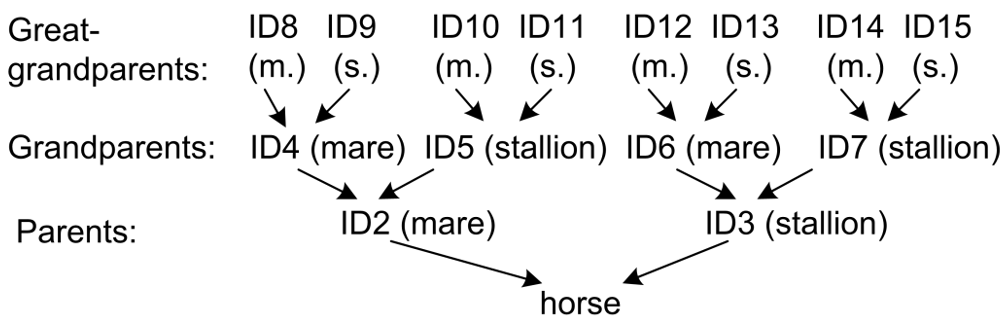 The image above illustrates the mapping of 15 distinct ancestral nodes used to build the extended feature set.
Experimental Battleground
Two primary tasks were set:
- Task 1 (Classification): Will the horse exceed the average height (159cm)?
- Task 2 (Regression): Can we predict the exact height within a 3cm margin?
Results Analysis
The results were clear: Ancestry matters. In the classification task, relying only on parents (M&F) yielded a 70.29% success rate with Decision Trees. By expanding to the 16F set (incorporating the extended pedigree), the accuracy soared to 89.52%.
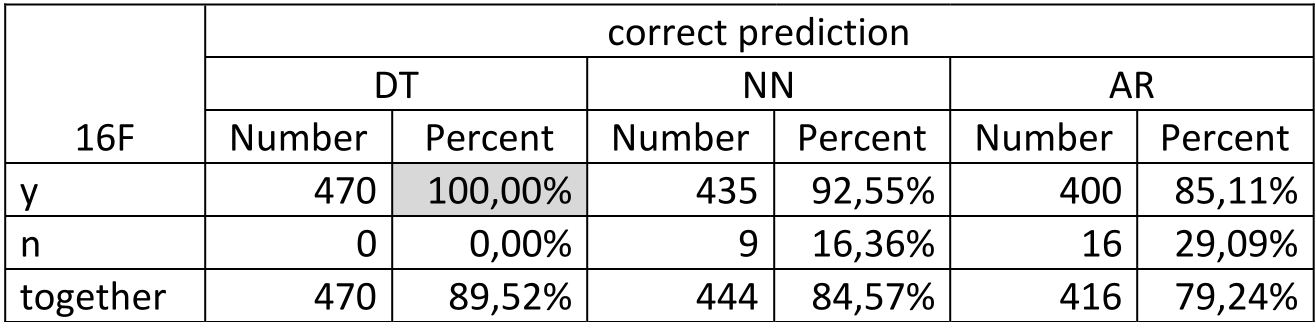 Table showing the superior performance of 16F models in the test set.
Interestingly, the study noted that "more is not always better." While 16 features usually helped, the Association Rules (AR) method occasionally saw a dip in performance with too many features, suggesting that some algorithms are more sensitive to the "curse of dimensionality" or the noise introduced by missing ancestral records (which accounted for ~25% of the data).
The "Time Travel" Problem: A Critical Analysis
A fascinating finding in Experiment 2 was that models sometimes struggled to predict the height of horses born after the year 2000. Why? Breeding drift. Over the decades, breeding standards changed, and horses gradually became taller than their ancestors. This highlights a classic ML problem: Data Drift. Even with perfect genetic data, shifting environmental "baselines" can decouple offspring from their ancestral patterns.
Conclusion
This research underscores that for biological datasets, "affinity" is not just a metadata field—it is the core signal.
- Takeaway 1: Including data up to great-grandparents improves ML accuracy in phenotypic prediction.
- Takeaway 2: Decision Trees proved more robust than Neural Networks in this specific context, likely due to the high volume of missing values in older pedigree records.
- Takeaway 3: Models must be periodically retrained to account for evolving breeding standards and environmental changes.
Future work in this domain would benefit from Graph Neural Networks (GNNs) which are natively designed to handle the tree-like structure of pedigrees more naturally than flat feature vectors.