
Reframing Affinity Propagation: Solving the Convergence Paradox in Biological Networks
Affinity Propagation on Identifying Communities in Social and Biological Networks
This paper investigates the performance of Affinity Propagation (AP) for community detection across social, artificial, and biological networks. It identifies that AP's previously reported failures in Protein-Protein Interaction (PPI) networks stem from improper similarity metrics and demonstrates that using regular equivalence-based similarity enables AP to achieve high efficiency and stability.
TL;DR
For years, the bioinformatics community believed Affinity Propagation (AP) was "unsuitable" for unweighted protein networks due to convergence issues. This paper debunks that myth, proving that AP’s failure was a matter of similarity representation, not algorithmic weakness. By shifting from simple adjacency to regular equivalence, AP becomes a high-speed, robust alternative to the standard Markov Cluster (MCL) algorithm.
The "Convergence Problem" Controversy
Identifying communities—clusters of nodes more densely connected to each other than the rest of the graph—is a cornerstone of network analysis. In 2007, Affinity Propagation (AP) emerged as a breakthrough "exemplar-based" clustering method. However, subsequent studies (Vlasblom & Wodak, 2009) reported that AP "exploded" with oscillations when applied to Protein-Protein Interaction (PPI) networks.
The authors of this paper noticed a contradiction: AP worked brilliantly on social networks (like Zachary’s Karate Club) but failed on biology. Why? They hypothesized that the issue lay in treating the raw adjacency matrix as a similarity matrix, which ignores the nuanced "structural equivalence" of nodes in complex biological systems.
Methodology: The Power of Structural Equivalence
The core innovation here isn't a change to the AP algorithm itself, but to the Input Similarity Index.
Beyond Adjacency
Many researchers simply set similarity if an edge exists. This paper argues for Regular Equivalence. This metric posits that node is similar to node if 's neighbors are themselves similar to . It computes a weighted count of all paths of all lengths between vertices, capturing the "global" topology rather than just local links.
The AP Message Passing Mechanism
AP operates by exchanging two types of messages between nodes until exemplars emerge:
- Responsibility (): Sent from node to candidate exemplar , reflecting how well serves as an exemplar for .
- Availability (): Sent from to , reflecting how "appropriate" it would be for to choose as its exemplar.

By applying a damping factor () and the refined similarity matrix, the authors eliminated the numerical oscillations that plagued earlier biological studies.
Experimental Showdown: AP vs. MCL vs. GN
The researchers tested three frameworks on artificial, social, and noisy PPI networks.
1. Artificial Benchmarks (The Discriminative Power)
Using the Girvan-Newman benchmark (128 nodes, 4 communities), the team varied (edges between communities).
- Finding: As the network became "fuzzier" (higher ), AP actually outperformed MCL. This suggests AP has a higher sensitivity for detecting weak communities that other algorithms might blur together.
2. Real-World Social Networks
On classic datasets like the Karate Club and American College Football, AP achieved near-perfect accuracy, matching or exceeding the Girvan-Newman (GN) baseline.
3. The PPI Robustness Test
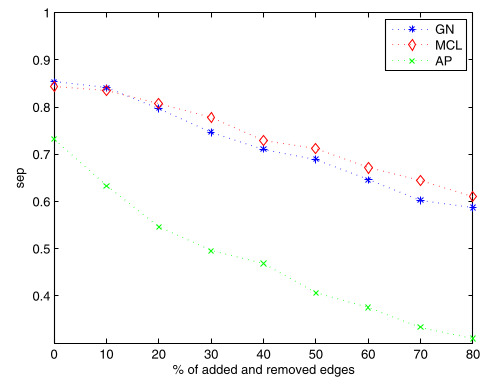
Testing on S. cerevisiae protein complexes with varying levels of noise (synthetic edge addition/removal):
- Accuracy: MCL remained slightly more accurate in biological functional mapping.
- Efficiency: AP was the clear winner in speed. In large-scale networks, AP ran several times faster than MCL.
- Stability: Contrary to previous claims, AP showed zero oscillations when the similarity matrix was properly defined.
Critical Insights & Takeaways
- The Similarity Trap: This paper serves as a warning for data scientists—an algorithm is only as good as the distance metric. AP did not fail on PPI networks because of its logic; it failed because the input was too "sparse" and lacked topological depth.
- Scalability: For massive biological networks where MCL or GN (which took 18+ hours in some tests) are too slow, a properly tuned AP is a formidable alternative.
- The Weak Community Advantage: AP’s ability to find exemplars makes it uniquely suited for identifying modules that are only subtly differentiated from the background.
Conclusion: AP is not "unsuitable" for biological networks. It is a powerful, high-speed tool that simply requires a sophisticated understanding of network topology to unlock its full potential.