
Decoding the European Digital Divide: Why Education and Age Outweigh Income
Assessing the Role of Age, Education, Gender and Income on the Digital Divide: Evidence for the European Union
This study assesses the domestic digital divide within the 28 EU member states using 2016 Eurostat data, employing factor analysis to identify two key dimensions: e-Services and Social Networks. The research reveals that while the EU is a developed region, significant socio-demographic disparities persist, with education and age acting as the primary drivers of digital inequality.
TL;DR
Is the "Digital Divide" still just about who has a laptop and who doesn't? Not in Europe. This study of all 28 EU member states reveals a strategic shift: the divide has moved from "Access" to "Usage Proficiency." While income was once the gatekeeper, Education is now the primary barrier to using essential e-Services, and Age remains the insurmountable wall for Social Network adoption.
Background: Beyond the Binary of "Have" vs. "Have Not"
For decades, the digital divide was seen as a simple binary. You either had an internet connection, or you were left in the dark. In 2026, looking back at the data from the late 2010s, we see that developed regions like the EU successfully bridged this "First-Order" divide. However, a "Second-Order" divide emerged—one based on skills, frequency, and the nature of use.
The authors argue that being "online" isn't enough; the real value lies in "Digital Dividends"—the ability to use e-banking, e-government, and e-health to improve one's quality of life.
Methodology: The Multivariate Lens
To capture the complexity of 28 different nations and 11 socio-demographic sub-levels, the researchers didn't just look at averages. They looked at Asymmetries.
- Factor Analysis: They identified two "hidden" dimensions from 14 disparate variables (like e-buying, privacy awareness, and VoIP use).
- e-Services: Functional, transactional activities (Banking, Govt, Health).
- Social Networks: Communication-heavy activities (UGC, Video calls, SNS).
- Oblique Rotation: Unlike many scholars who assume these dimensions are independent, this study used Promax rotation, acknowledging that if you are good at e-banking, you are likely good at social media too (a correlation of 0.63).
 Figure 1: Conceptual framework linking socio-demographic drivers to the two digital dimensions.
Key Findings: What Draws the Line?
1. Education is the new "Entrance Ticket"
In 23 out of 28 EU countries, education level was the greatest predictor of whether someone used e-Services. Why? Because e-government and e-health platforms are often complex and require a certain level of cognitive proficiency and English literacy.
2. Age is the Unanimous Barrier for Social Connectivity
Across every single EU member state, the gap between "Digital Natives" (Gen Y) and "Digital Immigrants" (Baby Boomers) was most pronounced in Social Networks. This isn't just about "tech-phobia"; it’s about a fundamental difference in how generations view privacy and online interaction.
3. The Sunset of the Gender and Income Divide
Surprisingly, in the EU, Gender no longer presents a statistically significant divide. Even Income, once the primary driver of all inequality, has taken a backseat. In a society where ICT is a commodity, having money doesn't automatically mean you have the skills to navigate the digital landscape.
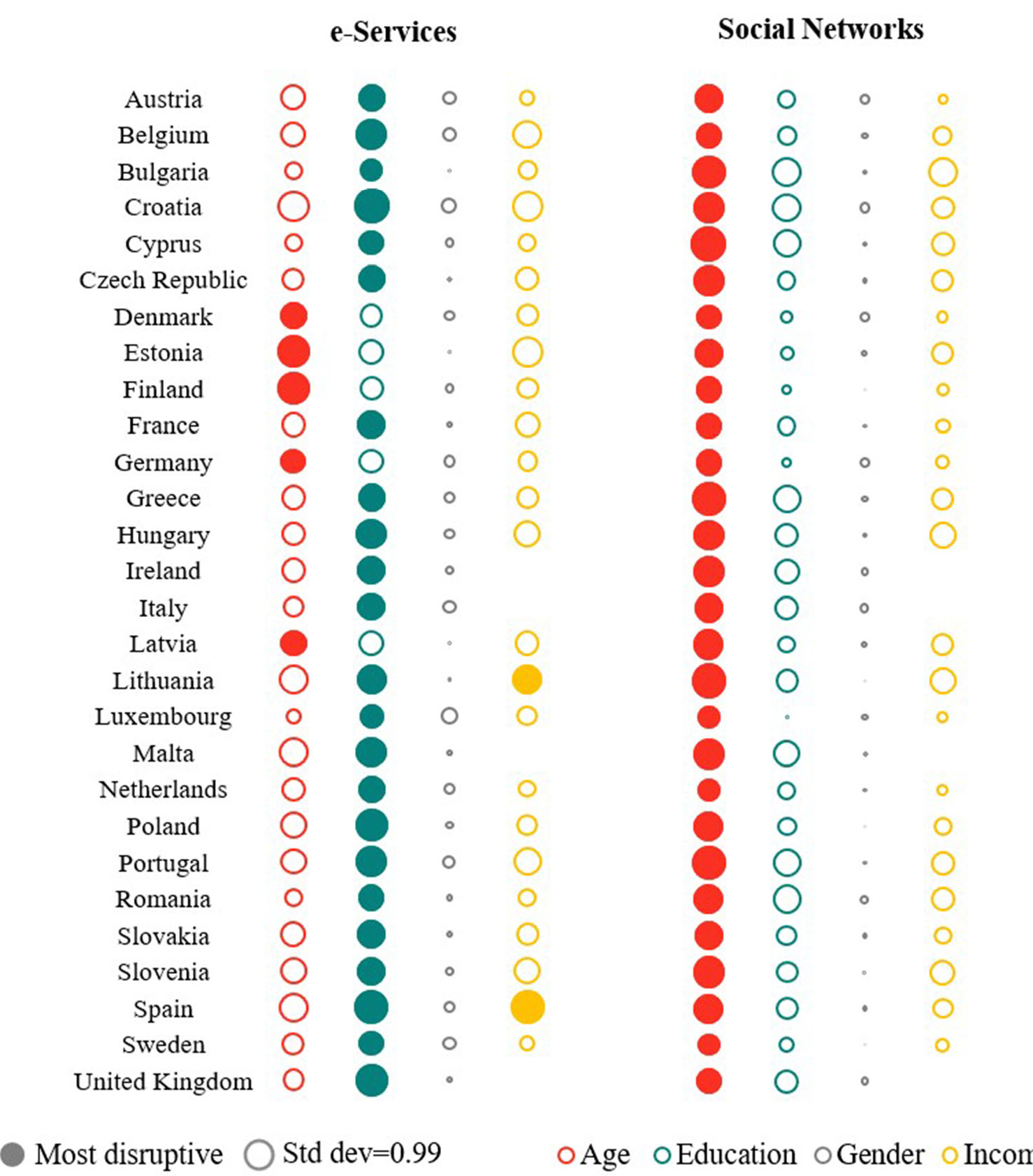 Table 1: Dominant drivers of asymmetry per country. Note the overwhelming prevalence of Education (e-Services) and Age (Social Networks).
Deep Insight: The Managerial Implication
If you are a policymaker in Brussels or a tech leader, the message is clear: Universal access is no longer the goal; digital literacy is.
- For e-Services: Efforts should focus on simplifying interfaces and providing adult education programs (e-inclusion).
- For Social Networks: Initiatives should aim to bridge the generational gap, perhaps through intergenerational mentoring, to combat social isolation among the elderly.
Conclusion
The digital divide is a moving target. As smartphones became "General Purpose Technologies" (GPT) akin to electricity, the barrier shifted from the wallet to the mind. This study serves as a critical reminder that "connecting the world" is a matter of human education, not just fiber-optic cables.
Limitations: The study relies on 2016 data. Since the COVID-19 pandemic, many "Baby Boomers" were forced into e-Services for survival, likely narrowing some of these gaps while potentially widening the "skills" divide even further.