
Deciphering Demographics through Motion: AdaBoost-Based Age and Gender Recognition from Gait
Determination of Age and Gender Based on Features of Human Motion Using AdaBoost Algorithms
This paper presents an automated system for age and gender classification based on human gait analysis. It utilizes 2D Discrete Wavelet Transformation (DWT) and Fast Fourier Transformation (FFT) for feature extraction and employs Adaptive Boosting (AdaBoost) algorithms, specifically the Modest AdaBoost variant, to achieve high-accuracy identification.
TL;DR
Can the way you walk reveal your age and gender to a camera from a distance? This study proves it can. By capturing the "shape-width" of human silhouettes and processing them through advanced AdaBoost machine learning algorithms, researchers achieved over 94% accuracy in distinguishing between age groups and genders, even in low-resolution video sequences where facial features are invisible.
Problem & Motivation: The Distance Biometric
Most biometric systems (fingerprints, iris, face) require the subject to be close to the sensor. However, for pedestrian safety or automated surveillance, we need to understand human attributes from a distance.
The core challenge lies in the "Prior Work" limitations:
- Static vs. Dynamic: Many methods use static images (like chest or hip size) which fail to capture the rhythmic nuances of motion.
- Model Complexity: Model-based approaches (tracking individual joints) are computationally expensive and sensitive to camera angles.
- Attribute Neglect: While "Gait Recognition" (identifying who someone is) is a well-studied field, "Attribute Classification" (identifying what someone is—male/female, young/old) remains a complex frontier due to the subtle biological variations in movement.
Methodology: From Silhouettes to Signal
The authors propose a "Looking at People" pipeline that prioritizes efficiency and robustness.
1. Shape-Width Extraction
Instead of modeling the skeleton, the system extracts the silhouette width. This vector tracks the distance between the left and right-most boundary pixels of a person's contour throughout a walking cycle. This captures both the structural body shape and the dynamic swing of arms and legs.
2. Frequency Domain Transformation
To find patterns in the messy raw data, the authors applied:
- 2D Fast Fourier Transform (FFT): Captures global periodicities in the walk.
- 2D Discrete Wavelet Transform (DWT): Captures local discontinuities and sharp spikes in movement data (e.g., a sudden push-off from the ground).
3. Boosting the Classifier
The study compares two versions of the Adaptive Boosting algorithm: Gentle AdaBoost and Modest AdaBoost. AdaBoost works by combining "weak learners" (simple classification rules) into a "strong learner" by focusing on the "hard" examples that previous steps got wrong.
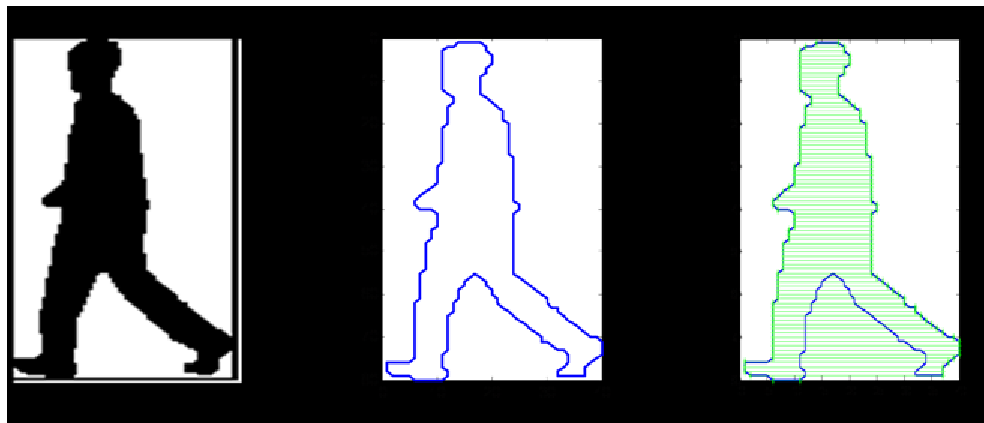 Figure 1: The process of isolating the silhouette and extracting the width vector as a representation of human motion.
Experiments & SOTA Results
The researchers tested their system on a database of 53 subjects (Young vs. Elderly; Male vs. Female).
Key Performance Highlights:
- Modest AdaBoost Superiority: Across almost all tests, the "Modest" variant outperformed "Gentle" AdaBoost. This is attributed to its higher resistance to overfitting, a common pitfall in high-dimensional feature spaces.
- Wavelets vs. Fourier: DWT features generally yielded higher peak accuracy (94.3%) compared to FFT (92.5%), suggesting that the localized time-frequency info in wavelets is better for catching age-related gait signatures (like reduced stride length).
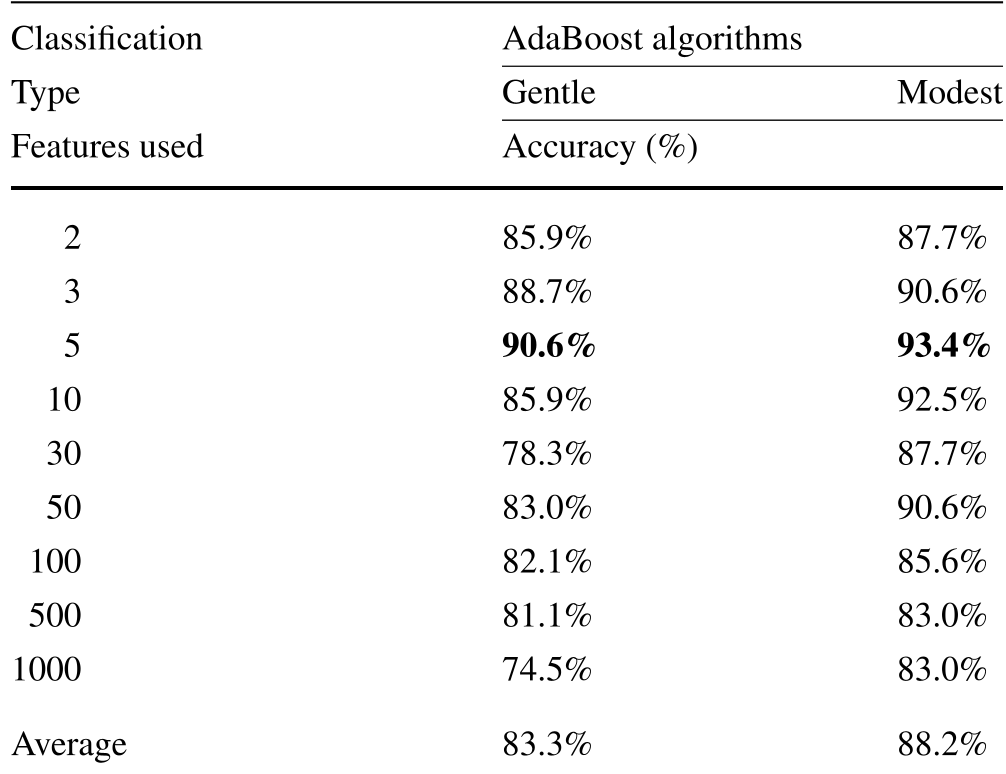 Figure 2: Performance comparison—note how classification accuracy peaks with specific feature counts.
Error Analysis (Why the system fails)
The authors observed "missed" classifications that provide fascinating psychological insights. For instance, some elderly subjects were classified as "Young" because they remained remarkably healthy and athletic, maintaining a gait pattern that lacked the traditional "degenerative bone" signatures associated with aging.
Critical Analysis & Conclusion
The Takeaway: This work demonstrates that spatiotemporal features—specifically those processed in the frequency domain—contains enough Inductive Bias to accurately categorize human demographics without needing high-resolution facial data.
Limitations:
- Binary Age Groups: The study uses "Young" (20-37) and "Elderly" (56-80), leaving a significant gap (37-56) unexplored.
- Camera Angle: While more robust than model-based methods, silhouette width is still somewhat dependent on the oblique angle of the camera.
Future Outlook: The next logical step for this research is the implementation of Hierarchical Processing: first classifying gender and then using gender-specific models to refine age estimation. As we move toward smarter cities, such gait-based "soft biometrics" will be essential for creating adaptive safety systems that can recognize vulnerable pedestrians (like the elderly) and adjust traffic signal timings in real-time.