
Demographic Mirroring: Inferring Age and Location through Social Circles
Age and Geographic Inferences of the LiveJournal Social Network
This paper explores the predictability of user demographics—specifically age and geographic location—within the LiveJournal social network. By analyzing a dataset of over 4 million users, the authors demonstrate that an individual's personal attributes can be inferred with high precision based solely on the self-reported data of their "friends" list.
TL;DR
Can your friends betray your secrets? This paper analyzes the LiveJournal social network to prove that an individual's age and location can be predicted with startling accuracy—up to 98% for age within a 5-year window—simply by looking at the people they follow. It establishes a near-perfect linear relationship between a user’s age and the average age of their social circle.
Background & Motivation
In the mid-2000s, the explosion of the "blogosphere" created massive, unstructured datasets of human interaction. However, many users chose to remain anonymous or provided incomplete profiles. The authors, MacKinnon and Warren, posited that users are not isolated islands; their choice of "friends" reflects their own identity. The core objective was to quantify this "homophily" to fill in the blanks of missing demographic data.
Methodology: The Logic of Connection
The researchers crawled LiveJournal to collect data on approximately 4.1 million users. The methodology focused on two primary pillars:
1. Age Correlation (Linear Regression)
The authors calculated the mean age and standard deviation of a user's friends. By splitting the data and applying a linear regression classifier, they found that the mean age of the social network is an almost perfect proxy for the user's age.
- The "Slope of Identity": The calculated slope of 0.992 suggests that for every year a user ages, the average age of their friend group shifts by almost exactly one year.
2. Geographic Probability
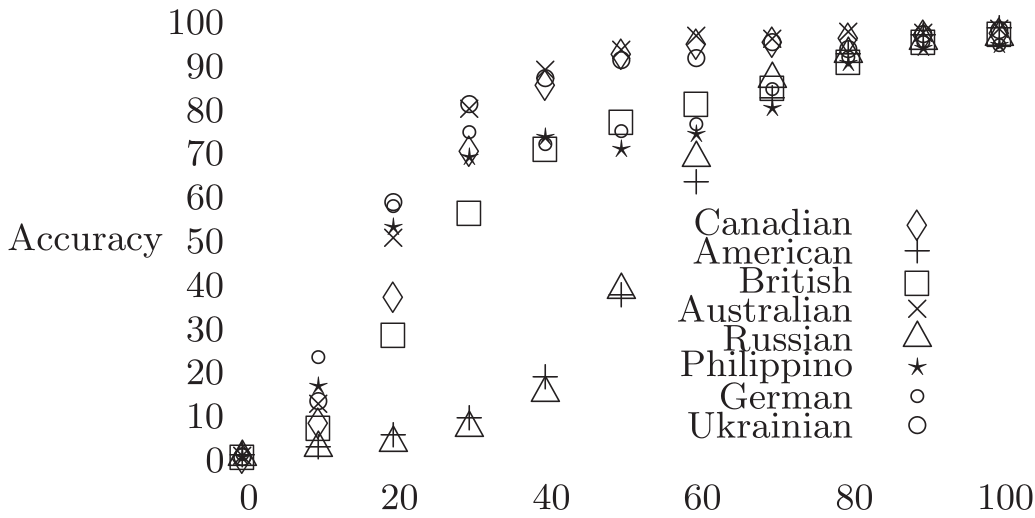
To infer location, they built lookup tables to answer the question: "If X% of your friends are from Country A, what is the probability that you are also from Country A?"
Key Insights and Results
The findings confirm that social networks are highly segregated by both age and geography.
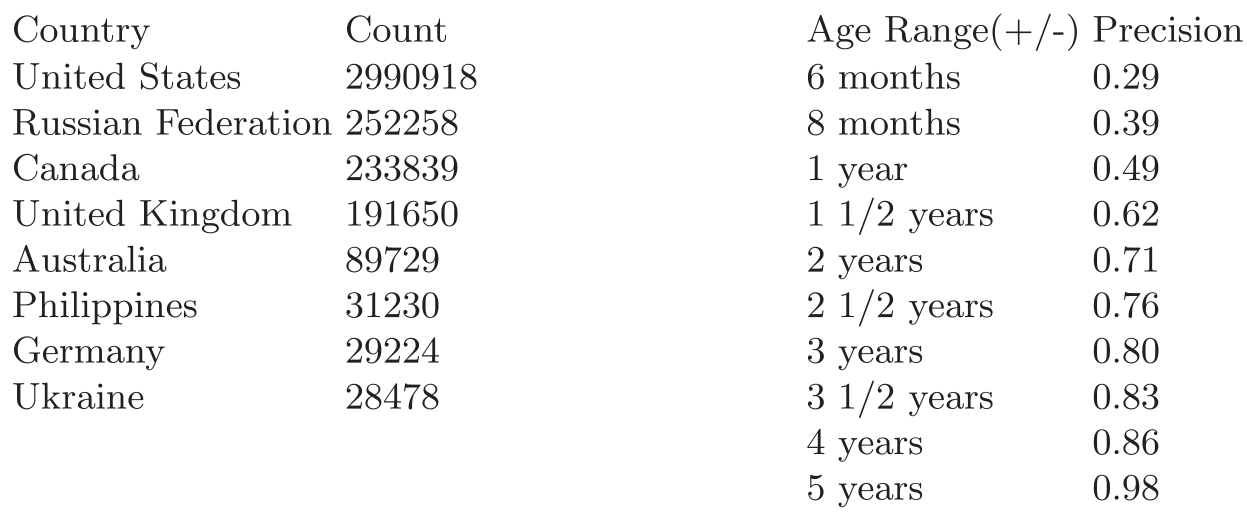
- Age Precision: As shown in the benchmarking table, the precision improves as the "prediction interval" widens. Predicting an exact age is difficult (29% precision within 6 months), but guessing within a 5-year bracket reaches nearly 100% accuracy (98%).
- The "Large Network" Exception: A fascinating discovery was that as users gain more friends, the geographic prediction model becomes less accurate. This suggests that "power users" or social butterflies tend to transcend national boundaries, acquiring a more globalized friend list compared to the average user.
- National Outliers: Russian and American users displayed different probability curves than other nations. This indicates that these countries act as "cultural hubs"—many people who are NOT Russian or American still maintain a significant number of friends from these regions.
Critical Analysis & Conclusion
Takeaway
This work serves as a foundational proof of concept for Proxy-based Inference. It demonstrates that in any sufficiently dense network, privacy is a collective property rather than an individual one. If your friends disclose their information, they have effectively disclosed yours.
Limitations
The study relies on the assumption that "friends" in 2005 LiveJournal represent meaningful social connections. In the modern era of "follow" cultures (Twitter/X, TikTok), these bonds are often much weaker, which might dilute the accuracy of the linear regression models used here.
Future Outlook
While this paper used simple linear regression and lookup tables, it paved the way for modern Graph Neural Networks (GNNs). Today, these same principles are used for everything from targeted advertising to detecting "Sybil" (fake) accounts by identifying anomalies in the expected demographic clusters of their peer groups.