
Spirometry as a Biometric: Unlocking Identity through Breath
14292_Age group classification and gender detection based on forced expiratory spirometry.
This paper proposes using Forced Expiratory Spirometry (FES) as a novel physiological biometric for gender detection and age group classification. Utilizing Gaussian Mixture Models (GMM) and Support Vector Machines (SVM), the study achieves SOTA-level accuracy, exceeding 99.3% for gender and 96.8% for age group identification.
TL;DR
Researchers have successfully demonstrated that your breath's "exhaust profile"—measured via Forced Expiratory Spirometry (FES)—is unique enough to identify your gender and age group with near-perfect accuracy. By applying GMM and SVM algorithms to lung volume and flow data, the study achieved over 99% accuracy in gender detection, marking a significant milestone for "emerging biometrics."
The Rise of Emerging Biometrics
While fingerprints and facial recognition dominate the market, the search for "emerging biometrics" is driven by a need for systems that are harder to spoof and reflect internal physiological health. This paper investigates whether the way we exhale—specifically during a clinical FES test—contains enough individual variance to serve as a biological signature.
The challenge lies in the noise: How do you distinguish between age-related physiological changes and the impact of lung diseases like COPD?
Methodology: From Lung Curves to Feature Vectors
The researchers focused on two primary clinical visualizations:
- Volume-Time Curve: Measuring how much air you move over seconds.
- Expiratory Flow-Volume Loop: Correlating the speed of airflow against the volume remaining in the lungs.
Feature Engineering
The study compared three feature sets. Feature Set-III was the most comprehensive, including 13 distinct points such as:
- FVC (Forced Vital Capacity): Total air exhaled.
- PEF (Peak Expiratory Flow): The "burst" speed at the start of the exhale.
- FEFx: Flow rates at specific volume intervals (e.g., 25%, 50%, 75% of capacity).
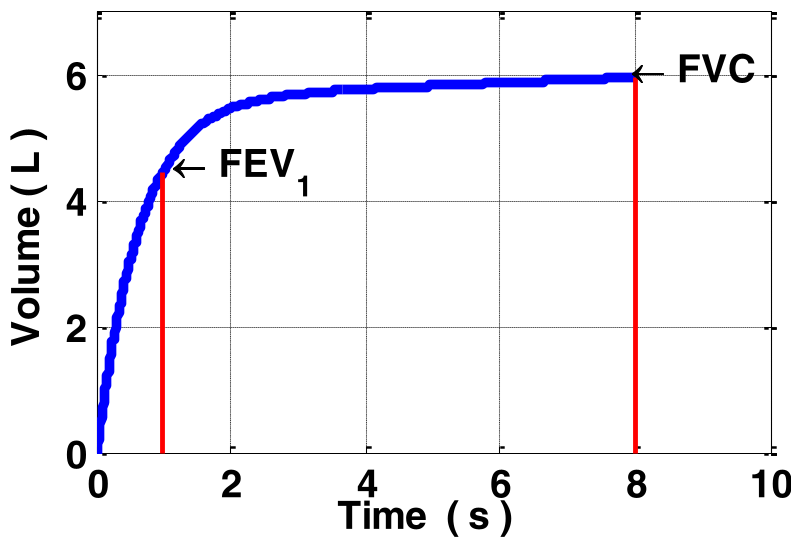 Fig 1: The morphology of (a) Volume-Time and (b) Flow-Volume curves used for feature extraction.
Classification Engines
The authors employed two heavyweights in statistical learning:
- GMM (Gaussian Mixture Models): Used to model the probability density of different groups.
- SVM (Support Vector Machines): Utilized RBF kernels to project features into a higher-dimensional space, creating an optimal hyperplane for classification.
Experimental Results: Breath-Taking Accuracy
The study utilized a massive longitudinal database of 14,517 measurements.
1. Gender Detection
The system was nearly flawless. SVM achieved a Correct Classification Rate (CCR) of 99.3%. Interestingly, the presence of obstructive lung disease slightly lowered the accuracy for gender but did not break the model, suggesting that "biological sex" signatures in lung capacity are incredibly resilient.
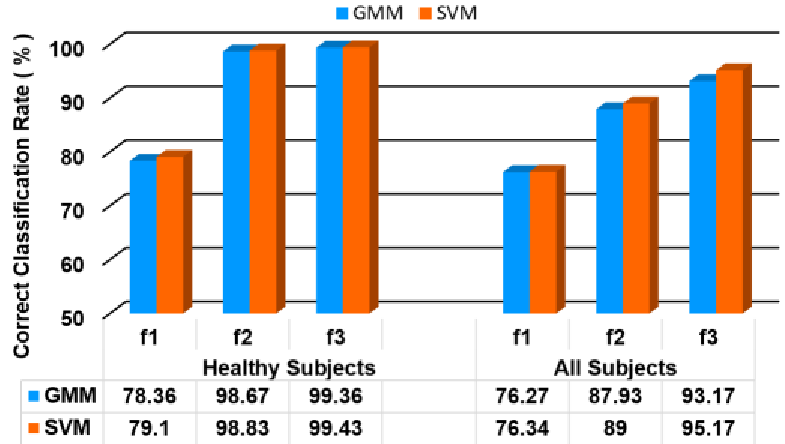 Fig 2: Comparison of GMM and SVM across different feature sets for gender detection.
2. Age Grouping
The model divided subjects into Young (18-29), Adult (30-54), and Senior (55+).
- Average Accuracy: 96.8%.
- Key Insight: Unlike gender, age classification was not negatively affected by lung disease, indicating that the aging process of the pulmonary system follows a distinct trajectory regardless of impairment.
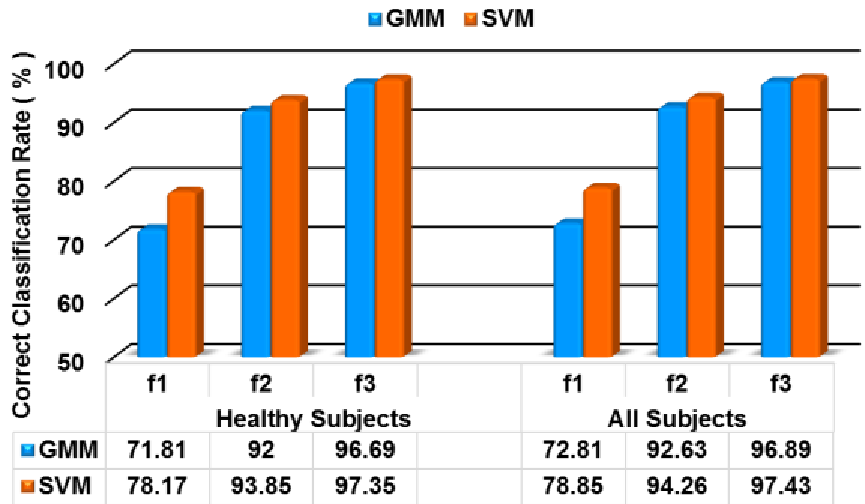 Fig 3: Age group classification performance, showing Feature Set-III as the clear winner.
Critical Insight: Why Does This Matter?
The high performance of Feature Set-III proves that the "fine details" of the flow-volume loop (FEF25-FEF90) are not just medical indicators—they are markers of individual geometry (airway diameter, lung elasticity, and thoracic power).
Limitations & Future Outlook
While the accuracy is impressive, FES is a "forced" behavioral biometric. It requires subject cooperation and effort. Future research might look into passive respiration (normal breathing) to see if these same biometrics can be captured via wearable devices without the need for a clinical "forced" maneuver.
Conclusion
This work elevates FES from a diagnostic tool to a viable biometric modality. With a classification rate exceeding 99% for gender, the "breath signature" is now a scientifically backed candidate for multi-factor authentication systems, especially in healthcare and forensic environments.