
Bridging the Age Gap: Deep Learning for Precision Sentiment Analysis in Social Networks
Age Groups Classification in Social Network Using Deep Learning
This paper proposes a Deep Learning-based approach to classify social network users into "teenager" and "adult" groups to enhance sentiment analysis. Using a Deep Convolutional Neural Network (DCNN), the model leverages writing styles and profile metadata, achieving a high classification precision of 0.95 and significantly improving sentiment intensity metrics (eSM).
TL;DR
Social media sentiment is often skewed by who is talking. This paper introduces a Deep Convolutional Neural Network (DCNN) model that identifies whether a user is a teenager or an adult based on their writing style and profile behavior. By accurately predicting age groups (reaching 0.95 precision), the authors significantly reduced errors in sentiment intensity measurement, proving that age-aware AI is the key to understanding the "true" emotion behind a tweet.
Problem & Motivation: The Missing Demographic Piece
Sentiment analysis isn't just about counting positive and negative words; it’s about context. A "beautifulllllll" posted by a 15-year-old carries a different intensity and intent than a formal recommendation from a 40-year-old.
The core problem is data scarcity. Most social network users (especially on Twitter) do not disclose their age. Previous attempts to fill this gap relied on simple keywords or small dictionaries, which lacked the robustness needed for diverse social media language. The authors realized that to get sentiment right, we must first guess the user's age group correctly.
Methodology: Capturing Behavioral Fingerprints
The authors moved beyond mere word counts, selecting 13 specific parameters across two categories:
- Writing Characteristics: Use of slang, punctuation (emoticons), URLs for media sharing, and character counts.
- User Metadata: Number of followers, following count, and total post history.
Why DCNN?
While shallow models like Decision Trees (J48) or SVMs are common in text classification, they often fail to capture the holistic semantic structure of a sentence. This research utilizes a Deep Convolutional Neural Network (DCNN). Unlike recursive models that might over-weigh the end of a sentence, the DCNN utilizes convolutional layers to refine the internal representation of the text, identifying patterns in slang and punctuation better than traditional methods.
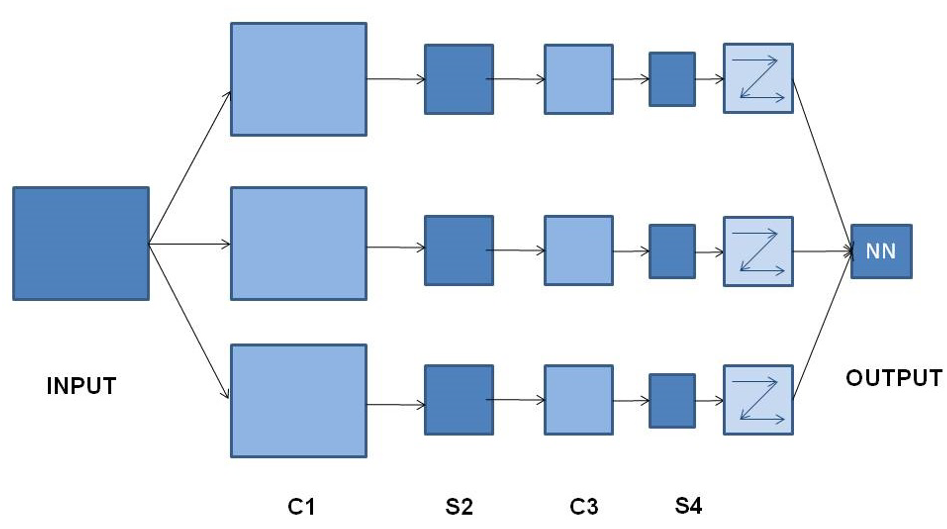 Figure 1: The DCNN topology used for feature extraction and age group classification.
Experiments & Results: Precision Meets Sentiment
The researchers tested four major algorithms. The DCNN emerged as the clear winner, particularly in identifying adults (0.956 precision).
Key Numerical Insight:
The real "aha!" moment came when this age classifier was plugged into the enhanced Sentiment Metric (eSM).
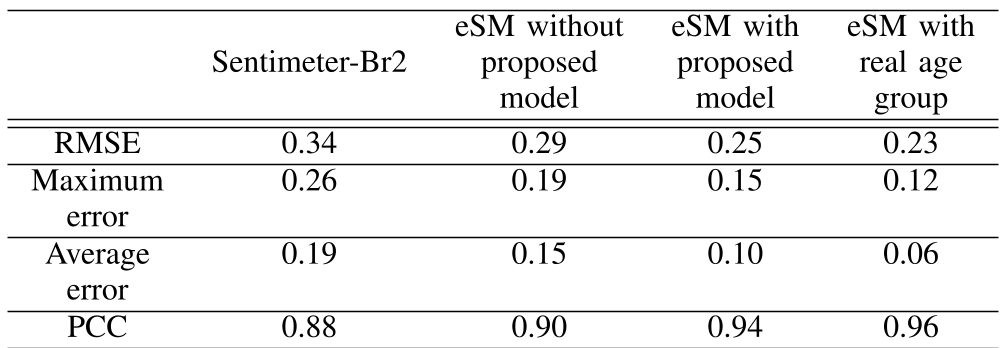 Figure 2: Performance of the eSM metric when augmented with the proposed DCNN age model.
- RMSE (Lower is better): Improved from 0.34 (base) to 0.25 (with DCNN).
- PCC (Higher is better): Increased from 0.88 to 0.94.
This proves that knowing if a user is a teenager or an adult is almost as good as knowing their exact biological age for the purposes of emotional analysis.
Critical Analysis & Conclusion
Takeaway
The study successfully correlates specific digital behaviors with life stages. For instance, adults share more URLs (news/media), while teenagers use more punctuation and slang. These "behavioral fingerprints" are robust enough for AI to classify age even when the user profile is empty.
Limitations & Future Outlook
While the binary classification (Teenager vs. Adult) is highly effective, it may struggle with "transitional" users (aged 19-21) who exhibit overlapping behaviors. Future work could benefit from:
- Granular Age Groups: Moving from 2 to 4 or more age brackets.
- Cross-Platform Validation: Testing if these behaviors hold true on Instagram or LinkedIn, where user intent differs.
In conclusion, this work provides a vital blueprint for age-aware sentiment analysis, offering major implications for marketing, political forecasting, and mental health monitoring online.