
Agent-Based Electronic Market: Bridging Semantic Gaps via Ontology Negotiation and Social Trust
Agent-Based Electronic Market With Ontology-Services
The paper introduces a semantic information integration framework for agent-based electronic markets, combining the Multi-Agent simulator (ISEM) and the Mapping FRAmework (MAFRA). It proposes a novel "ontology-services" model that utilizes semi-automatic ontology mapping and social network trust relationships to achieve interoperability between buyers and sellers using heterogeneous vocabularies.
TL;DR
This research addresses the "Tower of Babel" problem in electronic marketplaces—where buyer and seller agents speak different conceptual languages. The authors propose a decentralized model that uses Ontology Mapping Negotiation and Social Network Services to allow agents to "agree on what they are talking about" without forcing a single global standard. By combining the ISEM market simulator with the MAFRA mapping toolkit, they enable semi-automatic interoperability that reduces human overhead.
Background: The Ontology Problem in E-Negotiations
In an efficient e-market, agents must negotiate over complex attributes like quality, features, and delivery terms. However, a "Buyer" agent might define a product using one set of attributes, while a "Seller" agent uses another. This is the Ontology Problem: without a shared vocabulary, meaningful bilateral contracting is impossible. Existing solutions often demand rigid standards that are too brittle for the fluid nature of modern e-commerce.
The Core Innovation: "Ontology-Services"
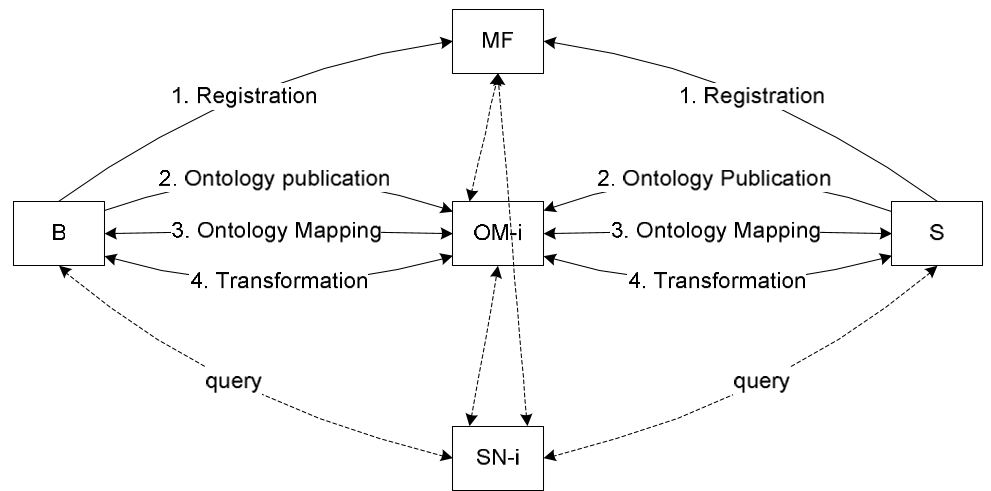
The authors move away from static mapping to a service-oriented architecture. They introduce two critical new roles to the standard Market Facilitator (MF) model:
- Ontology Mapping Intermediary (OM-i): Acts as the "translator," identifying and executing semantic relations between private ontologies.
- Social Networks Intermediary (SN-i): Acts as the "reputation coach," sourcing trust information and historical mapping success data to help agents decide which translations are reliable.
The Methodology: Mapping as Negotiation
Instead of a one-size-fits-all match, the paper treats ontology alignment as a negotiation process. Each agent uses a Utility Function to assign confidence values to "semantic bridges" (links between concepts).
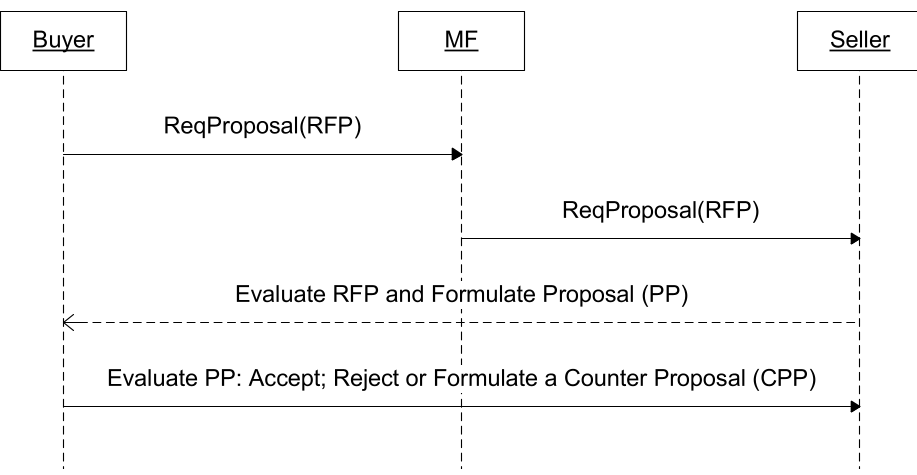
The process follows a sophisticated multi-stage protocol:
- Phase 1: Registration & Publication: Agents declare their roles and "externalize" their private ontologies.
- Phase 2: Mapping Exploration: The OM-i generates candidate semantic bridges.
- Phase 3: The Negotiation: Bridges are classified into four categories based on thresholds: Mandatory, Proposal, Negotiation, and Rejected.
- Phase 4: Transformation: Once an agreement is reached, messages are translated in real-time between the buyer’s (O1) and seller’s (O2) vocabularies.
Mathematical Intuition: The Convergence Effort
Why would an agent accept a mapping it isn't 100% sure about? The authors introduce the concept of Meta-Utility. If a mapping is required for a lucrative deal, an agent calculates a "Convergence Effort": This represents the "cost" of relaxing their semantic standards. The agent maintains a global Balance; they will accept a slightly weaker semantic match if the overall profit from the transaction outweighs the "loss" in semantic precision.
Evidence and Experiments
The authors tested the approach by calculating the alignment between two disparate ontologies (O1 and O2). In their example, initially conflicting semantic bridges (like concept mismatches between product categories) were resolved by the OM-i using a "flooding algorithm." This algorithm propagates confidence from high-certainty bridges to neighboring, more ambiguous ones.
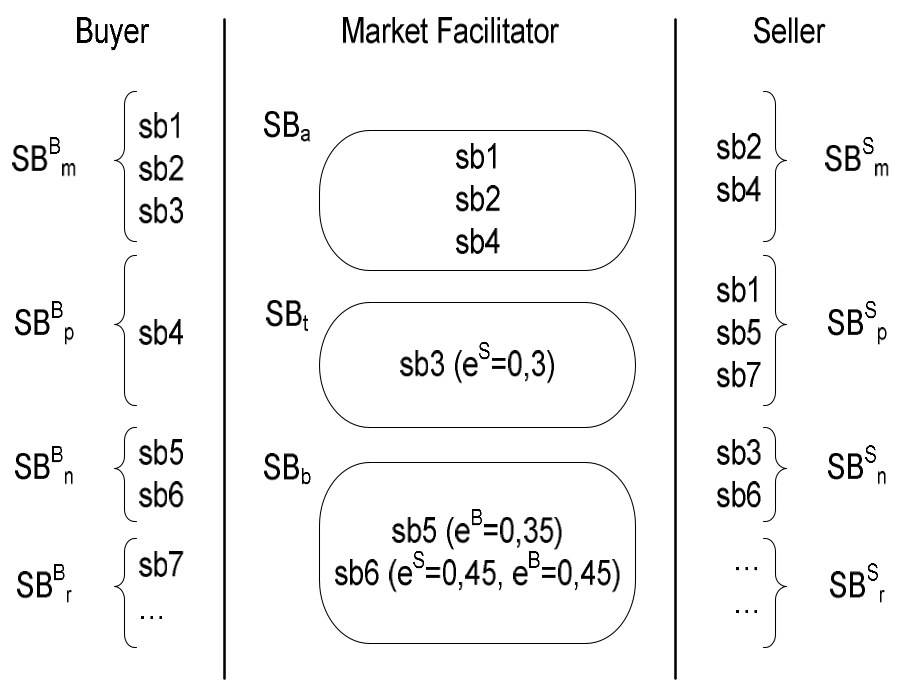
The result is a Perfect Ontology Mapping (Fig 7) achieved not by manual coding, but through automated multi-agent consensus.
Critical Insight & Future Outlook
The true value of this paper lies in its holistic view of trust. By treating ontologies as "socially evolving artifacts," the authors acknowledge that meaning is not fixed—it is negotiated through interaction.
Takeaway: Future e-commerce will move beyond simple keyword matching toward "Knowledge-Based Communities" where the Market Facilitator (MF) actively manages a "Web-of-Trust" to facilitate complex, multi-attribute deals.
Limitations: The primary bottleneck remains the configuration of the Meta-Utility functions, which are currently complex for human administrators to set up. The authors point toward using Social Network data to automate this "evolution task" in future iterations.