
Beyond Viral Spikes: The Science of Influence Maintenance in Social Networks
Agent-based Influence Maintenance in Social Networks
This paper introduces an Agent-based Influence Maintenance (AIM) model designed to achieve sustainable, long-term impact in social networks. By shifting focus from one-shot influence maximization to periodic seed selection, the authors demonstrate that distributed investment strategies significantly outperform traditional "viral" spikes in maintaining brand awareness.
TL;DR
In the world of social media, "going viral" is often a flash in the pan. This paper proposes a shift from Influence Maximization (short-term spikes) to Influence Maintenance (long-term sustainability). By utilizing Agent-Based Modeling (ABM) and a distributed budget strategy, the researchers prove that steady, periodic "drip" investments retain social influence far longer than a single massive launch.
Background: The Short-Term Trap
Most research in social influence focuses on the "Initial Seed" problem: how to pick the best users to trigger a cascade. While effective for a 24-hour trend, this ignores the Last-Post-First-Read reality of modern feeds. As new content arrives, your message sinks to the bottom of the stack, its "timeliness" decaying until it disappears from user consciousness.
The Core Insight: Timeliness & Agent-Based Perspective
The authors argue that traditional models like Independent Cascade (IC) are too "binary" (a user is either active or not). Instead, they introduce:
- Timeliness Degree (): A variable representing how relevant or "visible" a message is in a user's repository.
- Global Cumulative Timeliness Degree (GCTD): The new North Star metric. It doesn't just measure how many people saw a post, but how long it remained prominent across the network.
The Methodology
The authors developed an Agent-Based Influence Diffusion model where individuals don't just pass a spark; they interact with a repository.
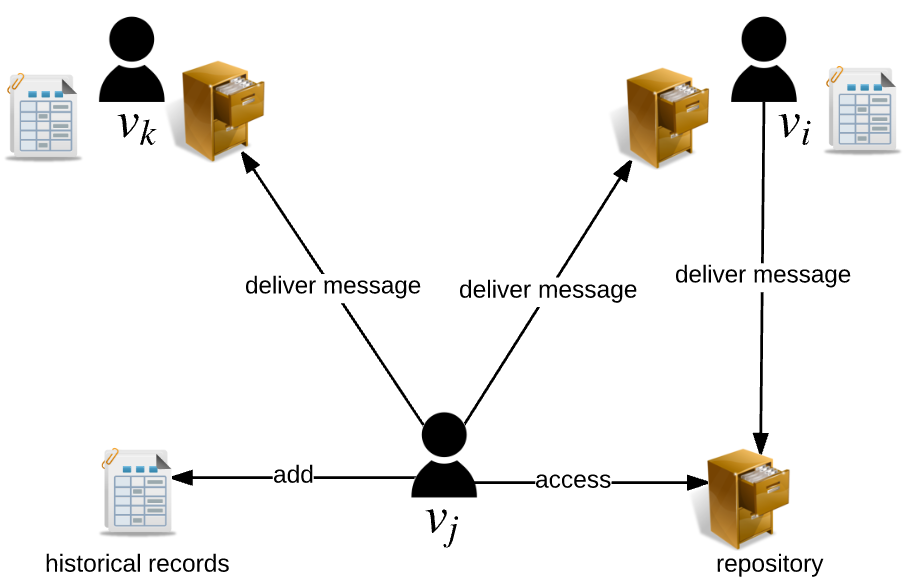 Figure 1: Micro-level interactions drive macro-level evolutionary patterns.
The problem is reformulated as a budget allocation task over time steps . Given a budget , do you spend it all at , or spend every steps?
Experimental Battle: One-Shot vs. Multi-Time
Using the Ego-Facebook dataset (4,039 users, 88,234 edges), the authors tested three investment strategies:
- 1 x 25 (One-Shot): The traditional viral marketing approach.
- 5 x 5 (Balanced): Periodic small injections.
- 25 x 1 (Consistent): Constant "drip" of influence.
Results: The Tortoise Beats the Hare
The findings were definitive. While the "1 x 25" strategy had the highest initial Global Timeliness Degree (GTD), its decay was brutal.
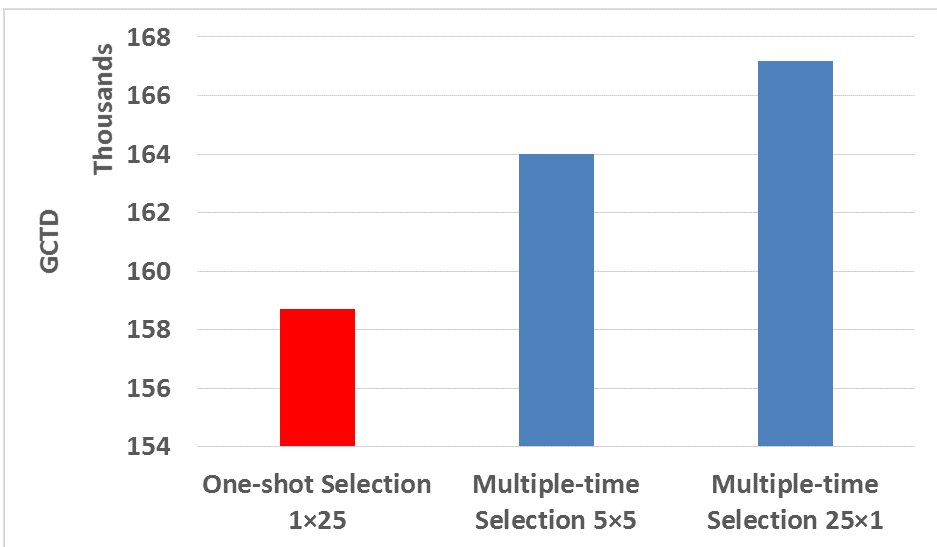 Figure 2: GCTD comparison showing that the 25x1 strategy (constant investment) maintains significantly higher cumulative influence.
By spreading the budget, the 25 x 1 strategy effectively "refreshed" the timeliness of the message across the network, preventing it from ever falling into the "long tail" of forgotten content.
Academic Insight & Value
This paper bridges the gap between Multi-Agent Systems (MAS) and Viral Marketing. Its primary value lies in the formalization of the Influence Maintenance problem—a much more realistic objective for brand building than simple maximization.
Key Takeaways for Researchers:
- Architecture Matters: ABM allows for more nuanced "state-based" influence than traditional graph-probabilistic models.
- Dynamic Budgeting: The timing of seed selection is just as important as the location of the seeds themselves.
Critical Analysis & Future Work
While the paper proves the superiority of multi-time selection, the seed selection was based on a simple Rank-based (Degree) algorithm. Future research could investigate whether adaptive selection (changing seeds based on real-time network state) could further optimize the GCTD. Additionally, the model assumes a fixed decay rate; in reality, "virality" might slow decay through social proof—an element that could be integrated into the timeliness function .
Main Reference: Li, W., Bai, Q., Nguyen, T. D., & Zhang, M. (2017). Agent-based Influence Maintenance in Social Networks.