
JAMPS: Breaking Centralized Shackle with Agent-Based Mobile P2P Social Networks
An Agent-based Mobile Social network
JAMPS (Java and Agent-based Mobile P2P Social network) is a decentralized social networking system for mobile devices designed to facilitate message and multimedia sharing among physically co-located users. It utilizes a Peer-to-Peer (P2P) architecture powered by the JADE-LEAP agent framework, achieving high scalability and independence from centralized servers.
TL;DR
JAMPS is a decentralized social network for mobile devices that eliminates reliance on central servers. Built on the JADE-LEAP agent framework, it allows users to discover peers and share multimedia files in local areas. By treating every device as an autonomous software agent, JAMPS achieves impressive scalability, maintaining sub-second response times even as the user count grows to 100 peers.
Back to the Edge: Why P2P Social Networking?
While giants like Facebook and Twitter dominate the social landscape, they share a fundamental "DNA": a Client-Server architecture. This dependency means that without a stable internet connection or if the central server fails, the social experience halts.
The authors identify a niche yet vital use case: physical co-location. When users are in the same building or park, why should their data travel to a distant data center just to reach a person ten meters away? JAMPS addresses this by shifting the logic from the cloud to the mobile edge, leveraging Agent-Oriented Programming (AOP) to handle the complexity of distributed coordination.
Methodology: The Anatomy of a Mobile Agent
The core innovation lies in the use of software agents. Unlike traditional objects, agents are autonomous and proactive. In JAMPS, every user's phone hosts an MSNAgent.
The Networked Architecture
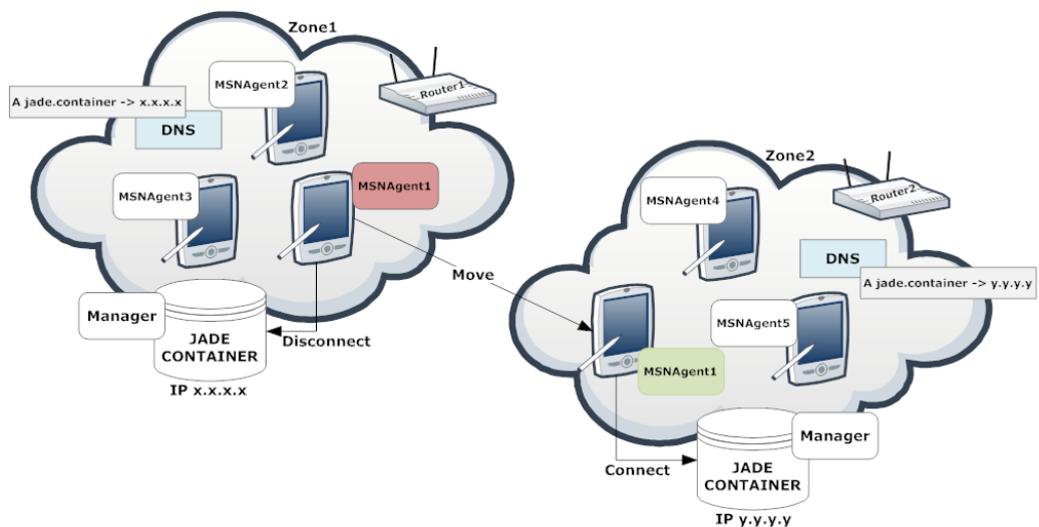
The system divides the network into "Zones" managed by a Local Area Coordinator. This coordinator handles the "presence" of users (Join/Leave events), while the actual data—profiles, wall posts, and files—is exchanged directly between phone-based agents.
Overcoming Technical Hurdles
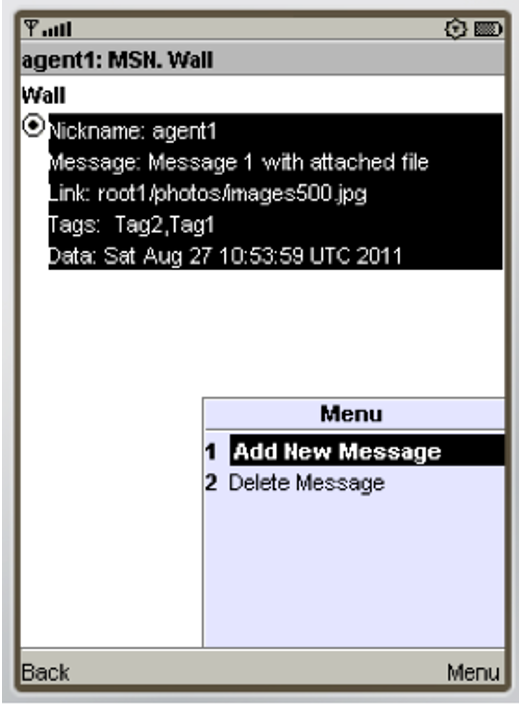
- Memory Constraints: By using RecordStore in J2ME and mapping it to Java Beans, JAMPS manages local databases for friends and wall posts efficiently.
- Message Limits: The Agent Communication Language (ACL) often has packet size limits. JAMPS implements a
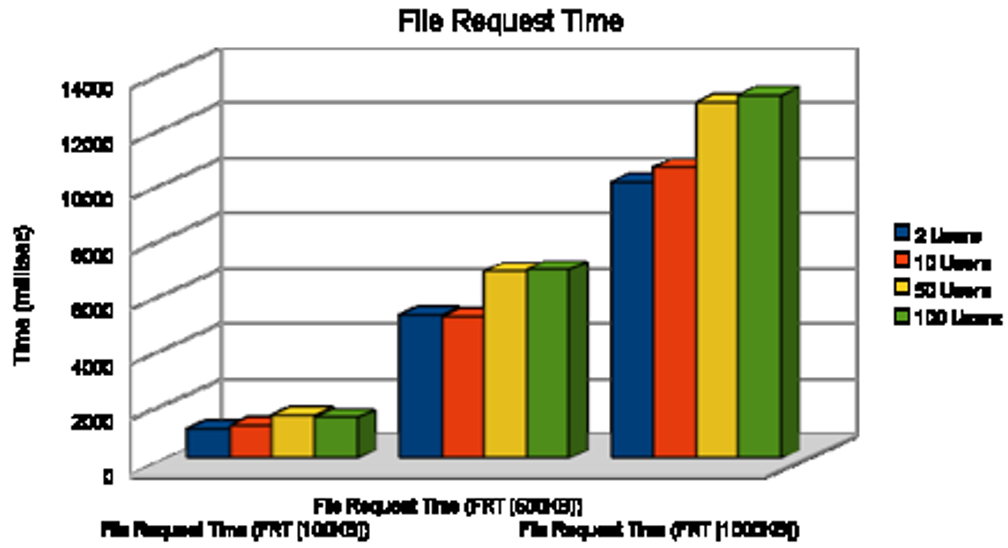
MessageTicketsystem that splits files into 100KB chunks, allowing for reliable transfer of high-resolution images and videos across devices.
Performance: Can It Scale?
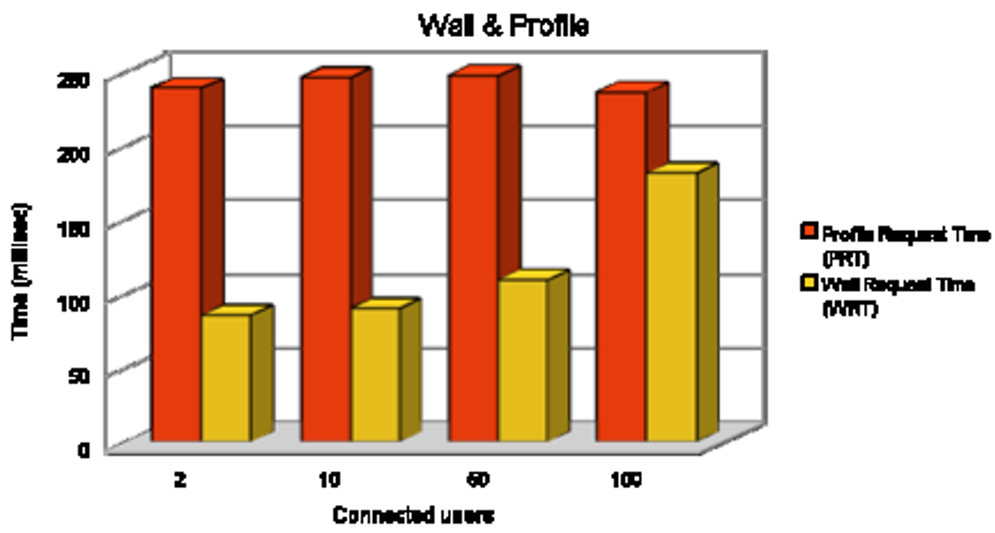
A common criticism of P2P systems is that they become sluggish as more nodes join. The authors tested JAMPS across four scenarios: No load (2 users), Low (10), Medium (50), and High (100).
The results, as seen in the Performance Summary Chart, indicate that while systemic access time grows slightly due to larger user lists being broadcast, the actual interaction times (Profile/Wall requests) stay remarkably flat.
Key findings from the experiments:
- System Access Time (SAT): Grew from 142ms to 849ms as the network scaled to 100 users—still well within the limits of human-perceived "instant" response.
- File Transfer: Effectively handled proportional delays—transferring a 1000KB file took roughly 13 seconds regardless of how many other users were merely present in the network.
Critical Insight & Future Outlook
JAMPS proves that the Agent-Oriented paradigm is a natural fit for P2P social networks. It abstracts the "who is where" and "how to send data" into autonomous behaviors (Access, Send, Receive).
Limitations: The current implementation still relies on a "Local Area Coordinator" (a semi-centralized router/manager) to facilitate entry into a zone. A truly "ad-hoc" version would likely require shifting this coordinator role to a dynamically elected "Super-Peer" among the mobile devices themselves.
The Future: As we move toward more privacy-conscious and local-first software, JAMPS offers a blueprint. Future iterations incorporating Android support and Semantic Search could transform how we interact in crowded environments like music festivals, conferences, or emergency zones where centralized infrastructure is unavailable.
Conclusion
JAMPS is more than just a social app; it's a demonstration that mobile devices are now powerful enough to act as both clients and servers. By leveraging JADE-LEAP, the authors have created a framework where social interaction is limited only by physical proximity, not by server availability.