
BOND: Unmasking Fraudulent Agents through Economic Network Analytics
An Agent-Based Model for Detection in Economic Networks
2018-01-01
Summary
Problem
Method
Results
Takeaways
Abstract
This paper introduces BOND (Behavioral Observation for Network Detection), an Agent-Based Model (ABM) designed to simulate complex economic networks and identify fraud-prone agents. By combining synthetic data generation via social network analysis with machine learning classifiers like Random Forests and Bayesian Networks, the system effectively predicts fraudulent behavior based on transaction patterns.
## TL;DR
Traditional fraud detection is often like looking at a single puzzle piece; BOND (Behavioral Observation for Network Detection) looks at the whole picture. By simulating an entire economic ecosystem using **Agent-Based Modeling (ABM)**, the researchers created a high-fidelity synthetic environment to train machine learning models. The result? A system that doesn't just flag a "weird" transaction, but identifies the "fraud-prone" personality behind it with over **97% AUC accuracy**.
## Problem & Motivation: The "Blind Spot" of Transaction Monitoring
In the world of financial crime, "complex transactions" are the smokescreen of choice. Fraudsters rarely transfer $1,000,000 in one go; they use **layering**—splitting the sum into hundreds of sub-$10,000 transfers through shell companies to stay under the radar of regulatory reporting.
Prior work often focused on **point-in-time detection**, which misses the forest for the trees. The authors argue that fraud is a **behavioral trait** and a **structural phenomenon**. To solve this, they needed a way to observe how agents interact over time within a network, but real-world financial data is notoriously hard to obtain due to bank secrecy laws.
## Methodology: Building a Virtual Economy
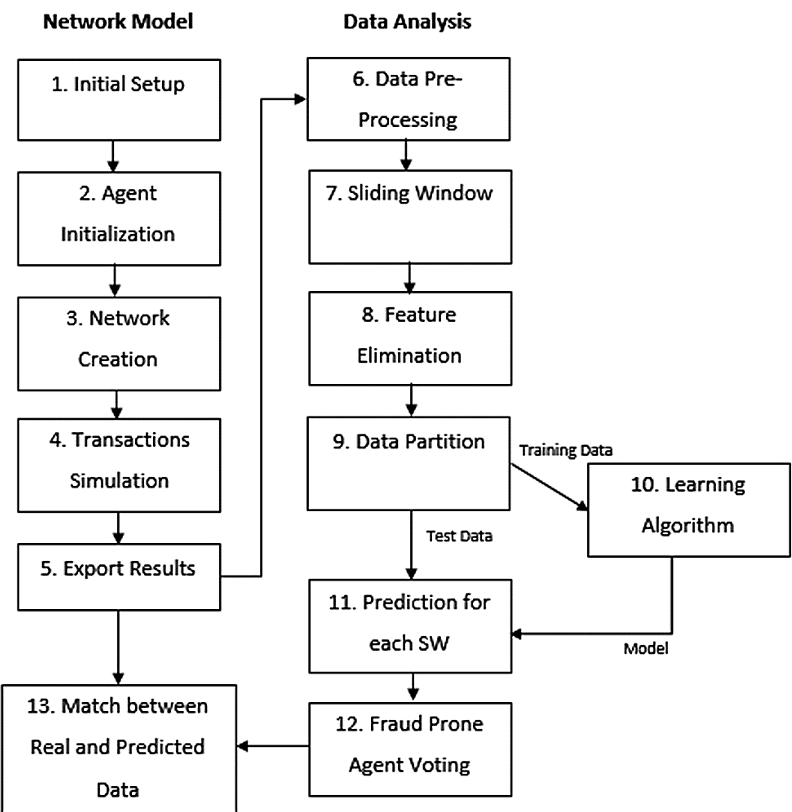
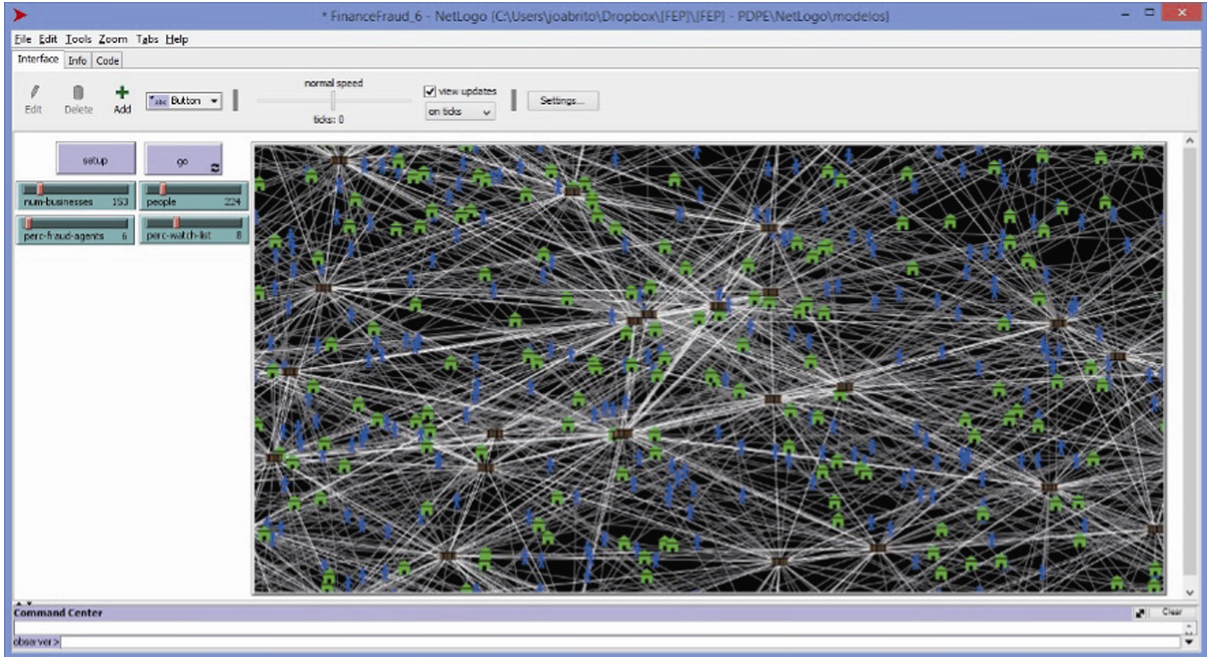
The authors developed **BOND**, a simulation built in NetLogo. The methodology is split into two distinct phases:
### 1. The Synthetic Network (BOND)
The model populates a world with three types of agents:
* **Individuals & Businesses**: The primary transactors. Notably, businesses include "Trusts" and "Shells"—entities with no real assets, often used for laundering.
* **Financial Intermediaries**: The banks and payment gateways.
* **Network Logic**: Agents with a high "fraud predisposition" ( >60%) are algorithmically programmed to connect with Shell companies and other high-risk agents, mimicking the "birds of a feather" reality of criminal networks.
### 2. Detection via Sliding Windows
Instead of analyzing a single row of data, BOND uses a **Sliding Window (SW)**. It aggregates an agent's activity over 30 days. This allows the model to see **Frequency, Centrality, and Variance**—the three horsemen of financial fraud.
## Experiments & Results: Random Forest Reigns Supreme
The researchers tested three heavy-hitters in machine learning: **Bayesian Networks, Neural Networks, and Random Forests**.
The data was put through a "voting" system. If the classifier flagged multiple windows for an agent as suspicious, that agent was voted "Fraud Prone."
| Algorithm | ROC AUC (Window) | Voting Accuracy (Agent) |
| :--- | :--- | :--- |
| **Random Forest** | **0.9712** | **89.88%** |
| Bayesian Network | 0.9619 | 0.8972% |
| Neural Networks | 0.8988 | 0.8818% |
**Key Insight from Feature Selection:**
The "Backward Feature Elimination" process proved that you don't need 100 data points to catch a criminal. The most predictive features were:
1. **Centrality**: How "connected" is the agent to the rest of the network?
2. **Interaction with Trust/Shells**: Does the agent frequently move money through "paper" companies?
3. **Variance Coefficient**: Is the transaction behavior erratic or suspiciously consistent?
## Critical Analysis & Conclusion
BOND represents a significant shift from **Detection** (What happened?) to **Profiling** (Who is likely to do it?).
**Strengths:**
* Incorporates **Graph Theory** (Centrality) into traditional ML features.
* Successfully simulates the "complex transaction" (layering) behavior used by real-world money launderers.
**Limitations:**
The model currently has a high rate of **False Negatives**. In a real-world scenario, a "False Negative" means a criminal gets away. The authors suggest that future iterations need to adjust the "cost function" of the classifiers to prioritize finding fraud over avoiding false alarms.
**Future Outlook:**
As we move toward real-time financial monitoring, the BOND framework could be implemented by regulators to assign "Risk Scores" to nodes in a live economic network, updating their status on "Watch Lists" dynamically as their network centrality and transaction shapes evolve.