
AEMOS: Bridging the Semantic Gap in E-Commerce via Socially-Aware Agent Networks
Agent Mediated Electronic Market Enhanced with Ontology Matching Services and Emergent Social Networks
This paper introduces AEMOS, an Agent-mediated Electronic Market system that integrates Ontology Matching services and Emergent Social Networks (SN). By utilizing a multi-agent architecture, it enables automated negotiation between buyers and sellers who use heterogeneous domain conceptualizations, achieving seamless semantic interoperability.
TL;DR
The AEMOS (Agent-based Electronic Market with Ontology Services) system tackles the "Tower of Babel" problem in automated e-commerce. It uses Ontology Matching to let agents with different definitions of "products" talk to each other, and Social Network Analysis (SNA) to ensure they select the most reliable translation alignments based on past market performance.
Background & Motivation: The Semantic Heterogeneity Trap
In the vision of fully automated e-commerce, software agents represent buyers and sellers to negotiate deals. However, the Web is messy. A "Buyer Agent" might define a laptop by its "CPU Speed," while a "Seller Agent" lists "Processor Frequency."
While Ontology Matching aims to bridge these gaps, it is inherently subjective. A "high-coverage" matching (one that maps many attributes) might actually be semantically incorrect, leading to disastrous deals. The authors of AEMOS realized that technical matching isn't enough; agents need social proof—a way to know which mappings have actually worked in the past.
Methodology: The AEMOS Architecture
AEMOS introduces a sophisticated multi-agent model consisting of Business Agents (Buyers/Sellers) and Support Agents. The "secret sauce" lies in two specific intermediaries:
1. The Ontology Matching Intermediary (OM-i)
Instead of hard-coding definitions, the OM-i suggests alignments. It acts as a semantic translator, using tools like the MAFRA Toolkit to transform message content in real-time once both parties agree on a mapping.
2. The Social Network Intermediary (SN-i) - The Innovation
The SN-i observes the market like a "reputation bureau." It builds a graph based on:
- Agent-To-Agent Proximity: Do these agents have similar profiles or successful past interactions?
- Alignment Adequacy: Has this specific ontology mapping led to high satisfaction ratings for other agents?
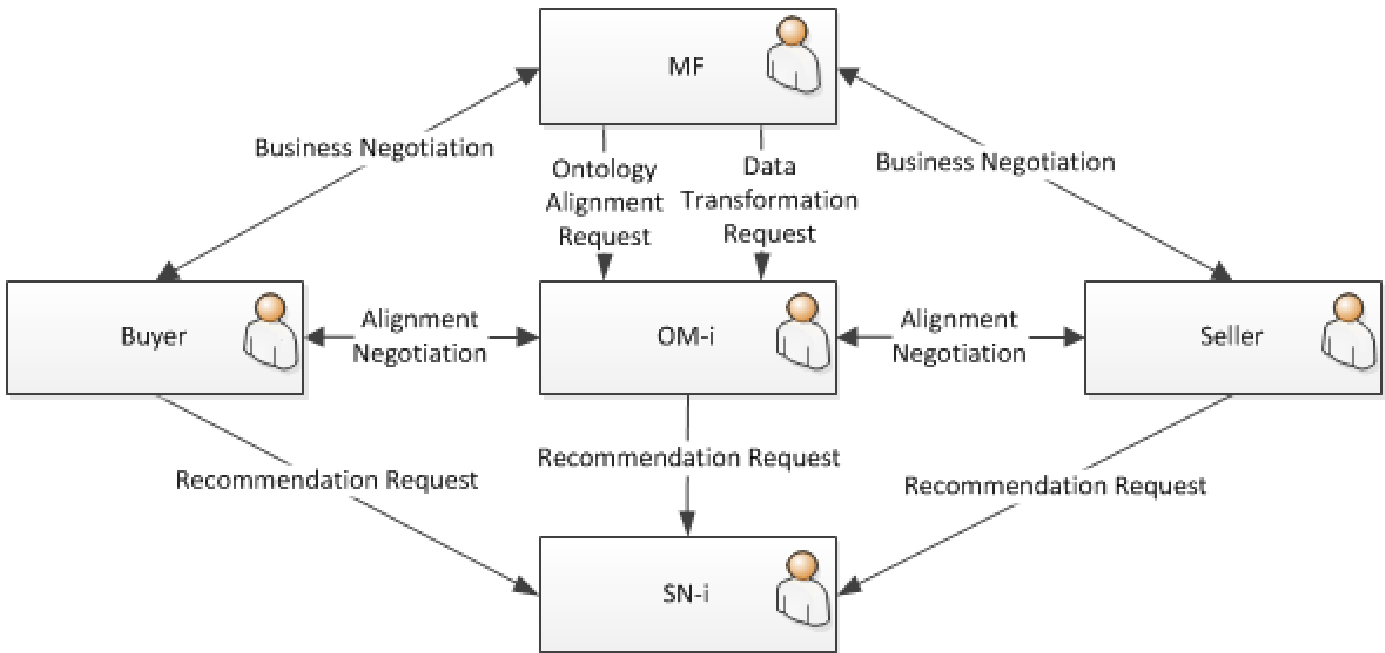 Figure 1: The interaction flow where MF, OM-i, and SN-i collaborate to facilitate a cross-ontology negotiation.
Experiments: Proving the Value of Social Context
The researchers tested four scenarios to isolate the impact of their modules. The most telling result came from Scenario 3 vs. Scenario 4.
In Scenario 3, agents had access to many ontology alignments but no social guidance. They often fell for "high coverage" alignments that were technically flawed, dropping satisfaction to a low 0.52. In Scenario 4, with SN-i support turned on, agents learned to navigate the noise, boosting satisfaction back to 0.62.
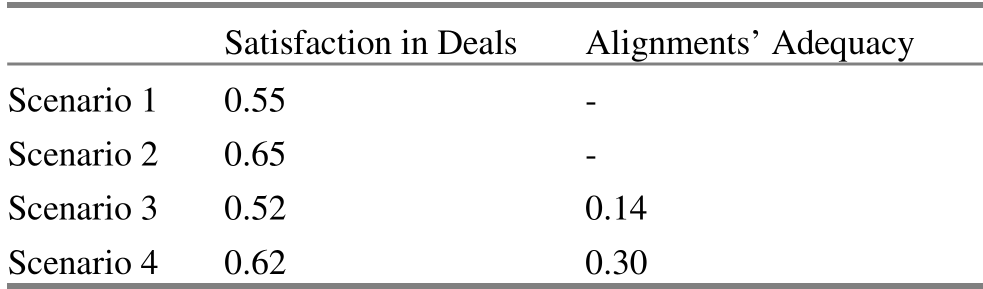 Table 1: Comparison of satisfaction levels across different system configurations.
Critical Insight: Why This Matters for the Future of AI Agents
AEMOS demonstrates that interoperability is not just a data problem; it is a trust problem.
By treating the choice of "how to translate" as a social decision supported by historical data, AEMOS moves closer to a resilient, autonomous marketplace. The system implies that as AI agents become more prevalent, they will need "Social Networks" for metadata just as much as humans need them for social validation.
Limitations & Future Work
While robust, the current model assumes a relatively static market where ontologies don't change daily. Future iterations would likely need to incorporate Deep Reinforcement Learning to navigate more volatile environments where product categories evolve rapidly.
Summary
AEMOS succeeds by combining the rigor of ontologies with the intuition of social networks. It provides a blueprint for how heterogeneous AI systems can collaborate effectively in an increasingly fragmented digital economy.