
Modeling the Social Lifeline: How Agents Predict Support Preferences in Depression
An Agent Model for a Human's Social Support Network Tie Preference during Depression
This paper presents a computational agent model that simulates how individuals suffering from depression select between strong-tie (close family/friends) and weak-tie (acquaintances) social support networks. Using the Weak Tie/Strong Tie Support Network Theory, the model integrates personality traits, stress levels, and relationship dynamics to predict social disengagement or support preferences, validated through simulation and mathematical equilibrium analysis.
TL;DR
Why do some people pull away from loved ones during a depressive episode while others thrive on the advice of mere acquaintances? This paper introduces a computational human-agent model that formalizes the Weak Tie/Strong Tie Support Network Theory. By simulating internal psychological states like "Relational Dissatisfaction" and "Stress-Buffering," the model predicts whether an individual will seek help or descend into social withdrawal.
The Motivation: The Burden of Being "Close"
In the realm of psychology, it is well-known that social support acts as a buffer against stress. However, the type of support matters.
- Strong Ties (Family, Spouses) provide emotional depth but carry heavy "Role Obligations."
- Weak Ties (Colleagues, Aquaintances) provide informational diversity and lack the baggage of history.
The authors' primary insight is that for a depressed person, the perceived "Relational complication" of asking a spouse for help can sometimes outweigh the benefit, leading to Social Disengagement. This paper seeks to turn these qualitative observations into a mathematical engine that can power therapeutic software agents.
Methodology: The Anatomy of a Human-Agent Model
The model is constructed through a series of interlinked differential and instantaneous equations. It distinguishes between Short-term Stress (StS) (triggered by negative events) and Long-term Stress (LtS) (the accumulated depressive state).
1. The Preference Engine
The decision to seek a "Close Social Preference" (CSP) or an "Expanded Social Preference" (ESP) is driven by:
- Goal Orientation: Does the user need emotional comfort (Emotional Goal) or a solution to a problem (Future Goal)?
- Trust and Mutual Interest: Especially critical for weak ties where shared experience (ESS) replaces history.
2. The Relationship Erosion Process
This is the model's most critical "feedback loop." If the "Expected Amount of Support" (EAS) is too high relative to the "Intimate Relational History" (IRH), it generates Relational Dissatisfaction (RD). This dissatisfaction feeds into Social Disengagement (ScD), which effectively "mutes" the stress-buffering effect of any incoming help.
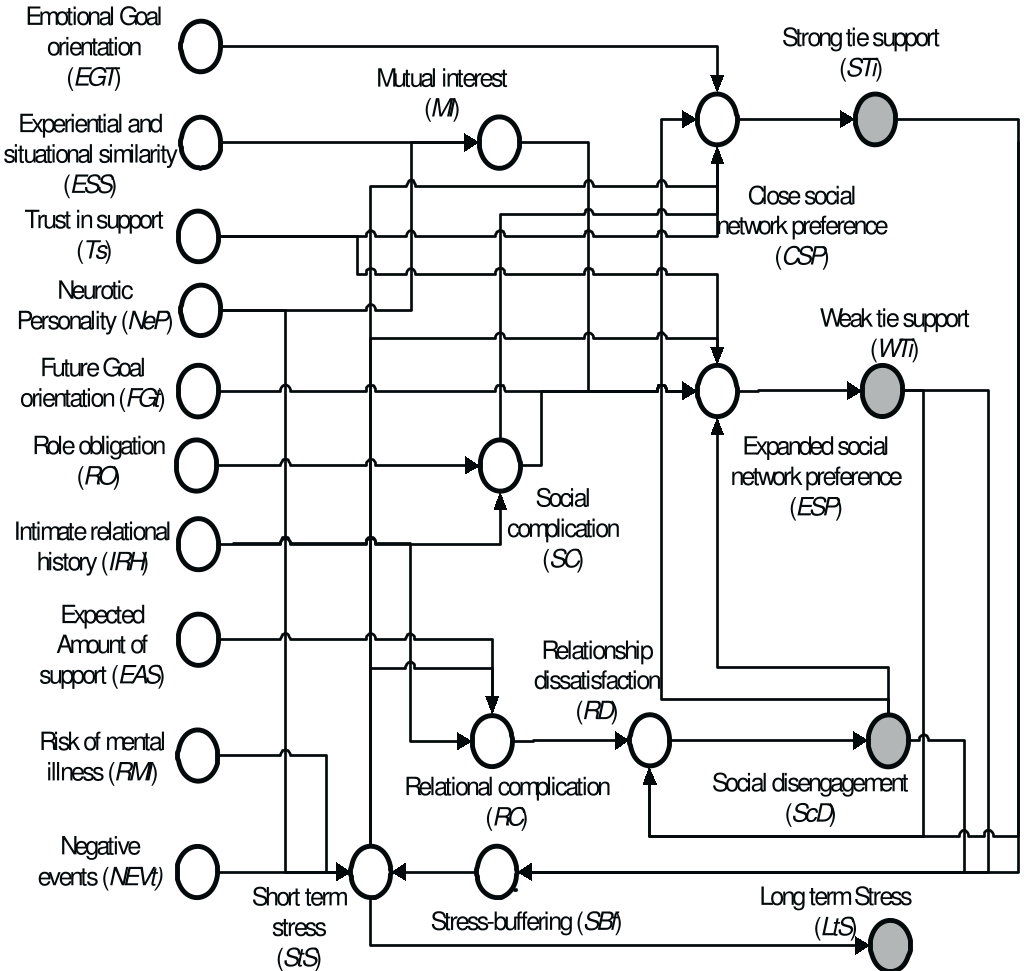 Figure 1: The global relationship of variables, showing the interaction between stressors, personality, and network choice.
Experiments: Three Faces of Depression
The researchers simulated three distinct profiles (Individuals A, B, and C) under prolonged and fluctuating stressors.
- Individual A (The Withdrawer): High neuroticism and high expectation. In the simulation, even when stress events fluctuate, this individual develops a pattern of social withdrawal. The model shows that their internal "Relational Dissatisfaction" grows so high that they eventually stop seeking support entirely.
- Individual B (The Informational Seeker): Moderate neuroticism but a preference for future-goal orientation. This individual relies more on Weak Ties, which allows them to maintain a lower long-term stress level because they avoid the emotional "burden" of strong-tie obligations.
- Individual C (The Balanced Profile): Low neuroticism and moderate expectations. This individual effectively utilizes both ties, showing a stable "Buffering Effect" that leads to stress reduction.
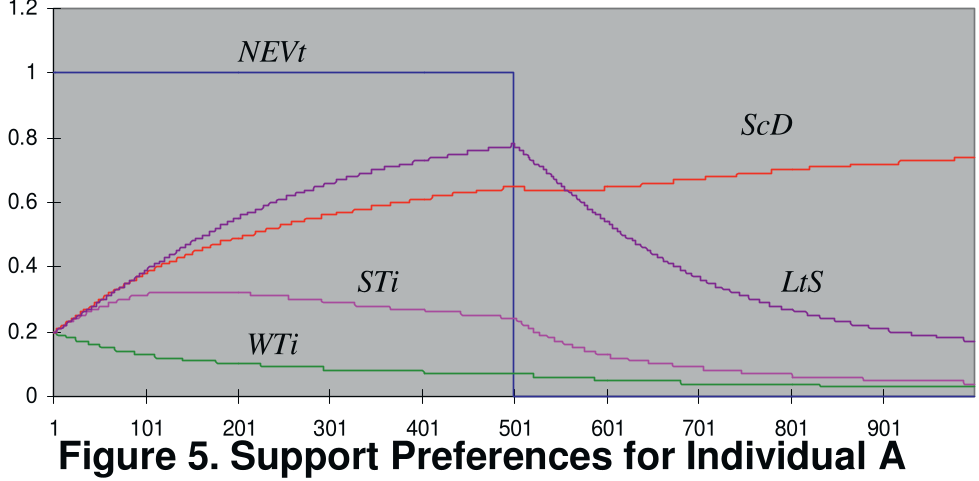 Figure 2: Simulation results for Individual A, illustrating how Support Preference (Sti/Wti) crashes as Social Disengagement (ScD) rises, leading to persistent Long-term Stress (LtS).
Critical Analysis: Stability vs. Reality
The paper's mathematical analysis is rigorous, identifying the "Equilibria" where the system stabilizes. It proves that social disengagement (ScD = 1) is a dominant stable state—a mathematical representation of the "sink" that chronic depression can become.
Strengths:
- Formalization of Intuition: It converts abstract social theories into a testable, computational framework.
- Predictive Power: By adjusting just a few parameters (Neuroticism, Trust), the model replicates widely observed clinical patterns.
Limitations:
- Binary Support Assumption: The model assumes all support received is "positive." In reality, bad advice or over-bearing family members can actually increase stress.
- Static Traits: Traits like "Neuroticism" are treated as constants, whereas therapeutic interventions aim to change these variables over time.
Conclusion and Future Outlook
This agent model isn't just a theoretical exercise. It serves as a blueprint for Ambient Intelligent (AmI) systems. Imagine a personal AI assistant that knows you’re having a bad week; instead of just suggesting "talk to someone," it analyzes your current stress trajectory and suggests: "You're feeling overwhelmed by family expectations right now; maybe a quick chat with your old colleague (a weak tie) would provide the perspective you need."
By understanding the math of human ties, we can build technology that respects the delicate balance of the human social network.