
Empowering the Fields: LoRa-Driven Edge Computing for Precision Agriculture
Agriculture Management Based on LoRa Edge Computing System
This paper introduces an energy-efficient greenhouse monitoring system that integrates LoRa communication with Edge Computing and Machine Learning. By deploying a Random Forest classifier at the edge layer, the system enables real-time greenhouse state prediction while significantly reducing data traffic to the cloud.
TL;DR
To address the dual challenges of remote connectivity and high latency in smart farming, this research proposes a decentralized monitoring system. By combining LoRa (Long Range) communication with Edge Computing and Random Forest classification, the system processes 50% of data locally, reducing cloud traffic by 3x and ensuring rapid response times for critical greenhouse management.
Problem & Motivation: The Connectivity Gap in Modern Farming
Agriculture is no longer just about soil and water; it is a data-driven industry. However, most agricultural lands are located in remote areas where stable high-speed internet is a luxury. Traditional IoT models—which pump every bit of raw data from the field to a distant cloud server—face three massive hurdles:
- High Latency: Waiting for a cloud response to trigger an irrigation pump can lead to delayed actions.
- Bandwidth Costs: Sending continuous raw streams of humidity, temperature, and CO2 data is expensive and inefficient.
- Fragility: A single server outage in the cloud can render the entire farm's monitoring system useless.
The authors' insight is to stop treating the gateway as a simple "pass-through" and start treating it as a brain (The Edge).
Methodology: Intelligence at the Edge
The system utilizes a four-layer architecture:
- Sensor Layer: Uses TTGO LoRa32 (ESP32 + SX1276) nodes to collect 5 key metrics: Temperature, Air Humidity, CO2, Soil Moisture, and Light.
- Edge Layer (The Core): This is where the magic happens. Instead of forwarding all data, the gateway performs:
- Dynamic Filtering: Simple averaging to remove sensor noise.
- Local Inference: A Random Forest Classifier is deployed here to identify four greenhouse states: Soil without water, Correct environment, Too hot, or Very cold.
- Cloud & Application Layers: Used for long-term storage, deep trend analysis, and the user dashboard.
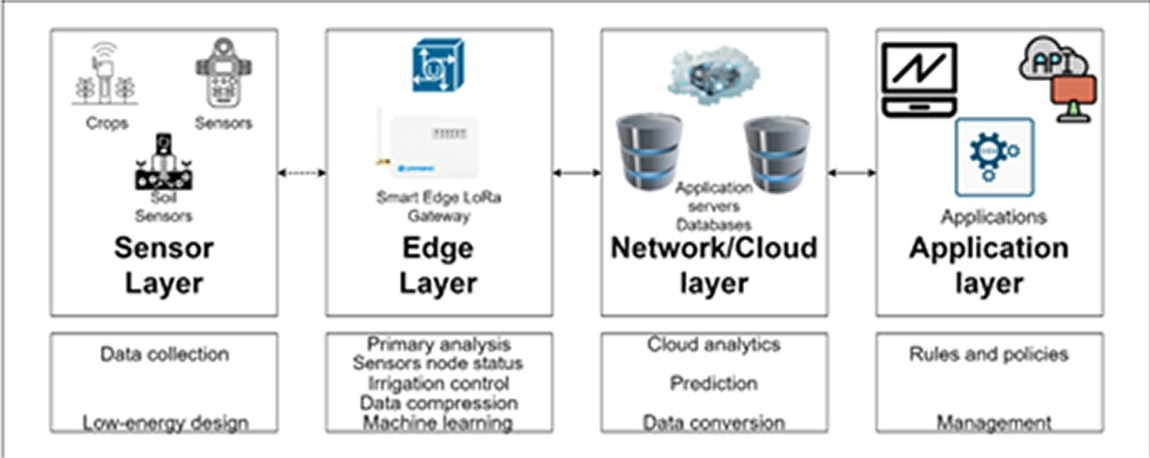 Figure: The 4-layer architecture showing the integration of Edge and Cloud computing.
The choice of Random Forest is a strategic one. For resource-constrained edge devices, it provides the "wisdom of the crowd" through ensemble decision trees, offering high accuracy without the massive computational overhead of Deep Learning.
Experiments & Results: Efficiency Gains
The research utilized simulation and full-scale experiments to validate the approach.
- Latency Reduction: The delay in the edge-enabled system is significantly lower than the traditional cloud-only model. Because data is maintained locally, the "wait time" for processing is slashed.
- Traffic Optimization: The edge layer successfully services up to half of the traffic internally. This means the system can handle three times more data globally compared to architectures without edge capability.
- Feature Importance: Through training, the model identified Soil Humidity as the most critical factor influencing the greenhouse state prediction.
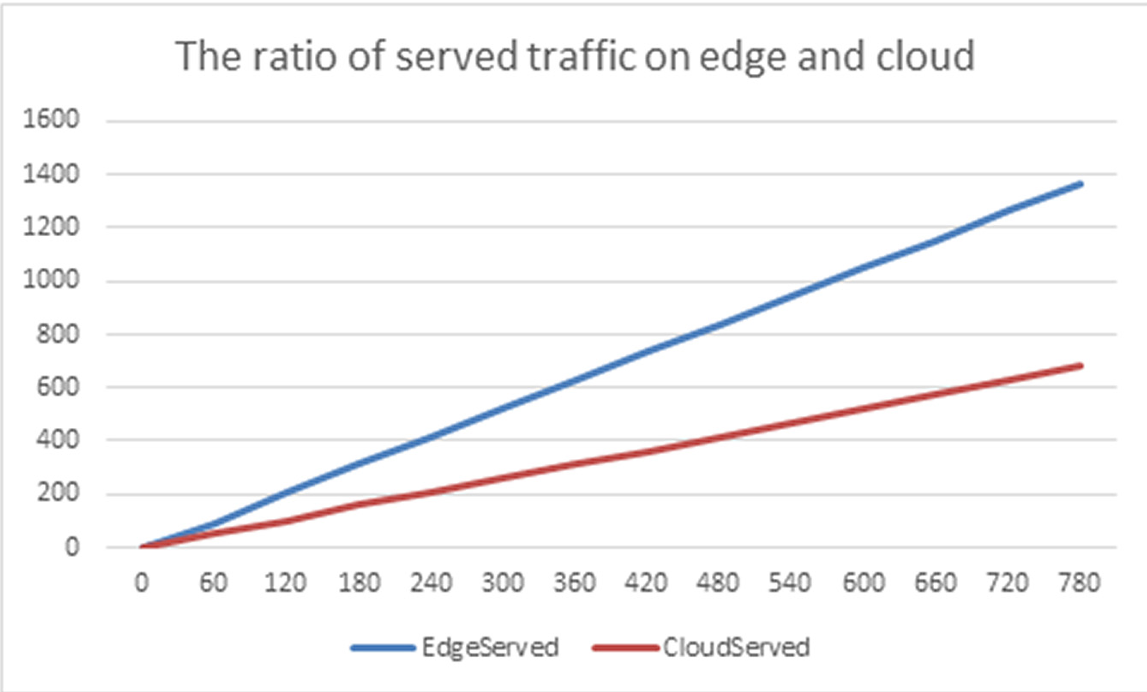 Figure: The ratio of traffic serviced at the edge vs. the remote cloud, showing the massive offloading achieved.
Critical Analysis & Conclusion
Takeaway
The integration of LoRa and Edge Computing represents a shift towards "Autonomous Farming." By reducing the dependency on the cloud, the system becomes more resilient (fault-tolerant) and significantly cheaper to operate.
Limitations
While Random Forest is efficient, the paper doesn't deeply explore the on-device training aspect; the model appears to be pre-trained and then deployed. In a real-world scenario, environmental drift might require the edge model to update itself without cloud intervention.
Future Outlook
This architecture is a blueprint for "Smart Cities" and "Industry 4.0." Beyond greenhouses, the logic of LoRa + Edge ML can be applied to any scenario where distance is long and bandwidth is short—from forest fire detection to deep-sea oil rig monitoring.