
Strategizing E-Learning Outreach: An AHP Approach to Academic Social Network Selection
Online Academic Social Networking Sites (ASNSs) Selection Through AHP for Placement of Advertisement of E-Learning Website
The paper utilizes the Analytical Hierarchy Process (AHP) to solve the Multi-Attribute Decision Making (MADM) problem of selecting the most effective Academic Social Networking Site (ASNS) for e-learning advertisements. Focusing on a case study for Coursera, it identifies ResearchGate as the top-ranking platform among alternatives like Academia.edu and SlideShare.
TL;DR
With the digital landscape crowded by niche social platforms, where should an e-learning giant like Coursera place its ads? This research applies the Analytical Hierarchy Process (AHP) to evaluate Academic Social Networking Sites (ASNSs). By decomposing the decision into a hierarchy of site quality, information integrity, and audience reach, the study identifies ResearchGate as the premier choice, emphasizing that for academic users, Information Quality outweighs all other factors.
The Advertiser's Dilemma: Complexity in Choice
In the modern digital economy, visibility is not just about being "online"—it is about being in the right context. For e-learning providers, the challenge is twofold:
- Platform Overload: There are too many types of SNSs (multimedia, professional, hobby-based).
- Conflicting Metrics: Should an advertiser prioritize a site with a high "Impression Score" (quantity) or one with high "Information Accuracy" (quality)?
Previous works have used various Multi-Attribute Decision Making (MADM) tools, but few have specifically targeted the Academic Social Networking (ASNS) niche, which serves a highly critical and information-sensitive demographic.
Methodology: The AHP Framework
To solve this, the authors utilize AHP, a methodology that excels at converting subjective human judgments into a rigorous mathematical hierarchy.
1. The Hierarchical Structure
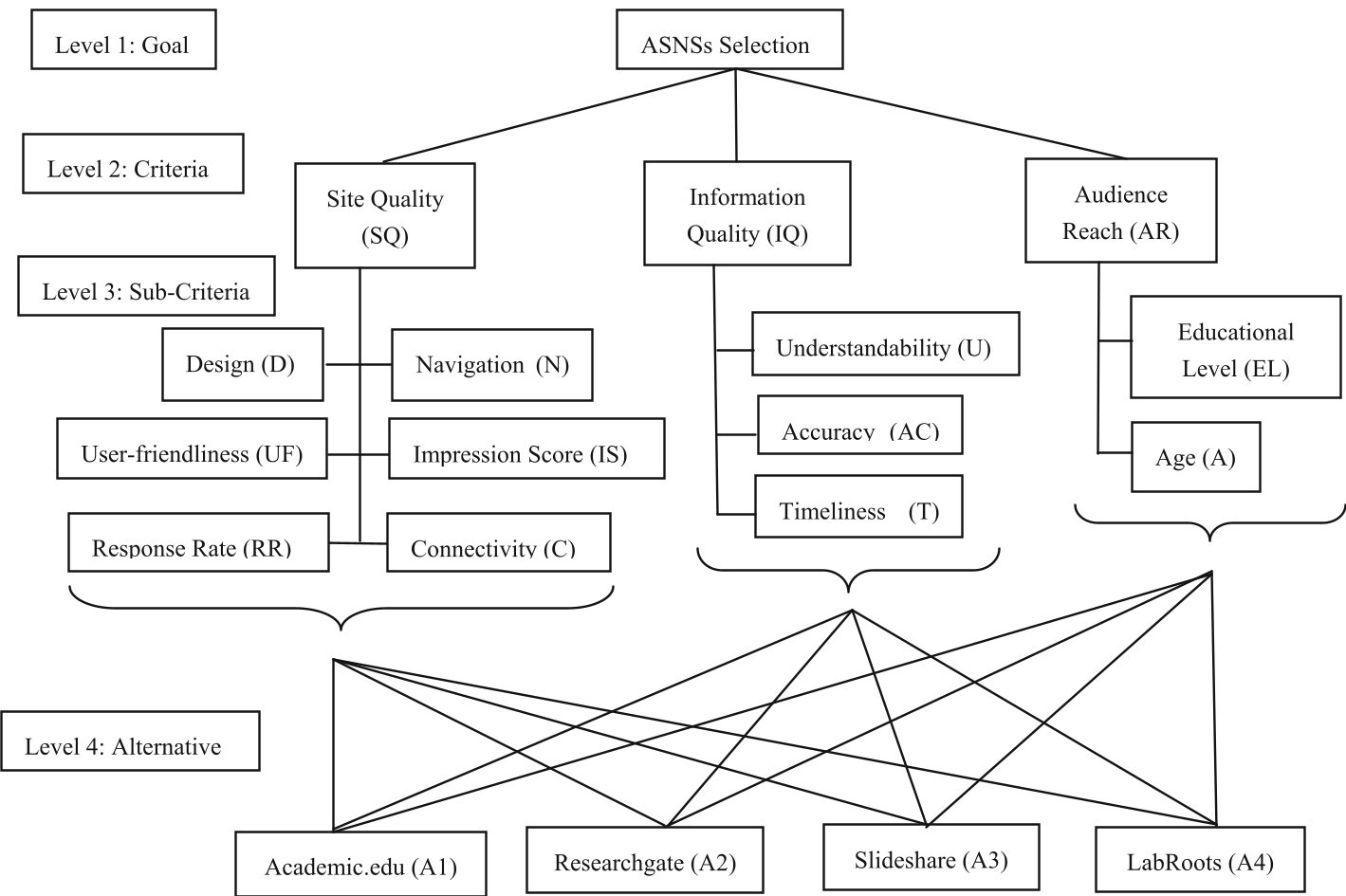
The problem is broken into four distinct levels:
- Level 1: The Goal (Selecting the best ASNS).
- Level 2: Main Criteria (Site Quality, Information Quality, Audience Reach).
- Level 3: 11 Sub-criteria (ranging from Response Rate to Educational Level).
- Level 4: The Alternatives (Academia.edu, ResearchGate, SlideShare, and LabRoots).
2. Mathematics of Subjectivity
The core of the methodology relies on a Pairwise Comparison Matrix. Using a 1–9 scale, experts compare attributes against each other. The model then calculates the Consistency Ratio (CR). If the CR is less than 0.1, the judgments are considered logically consistent, preventing the "circular logic" trap common in human decision-making.
Key Results: Quality Over Glitz
The findings provide a clear blueprint for educational marketers.
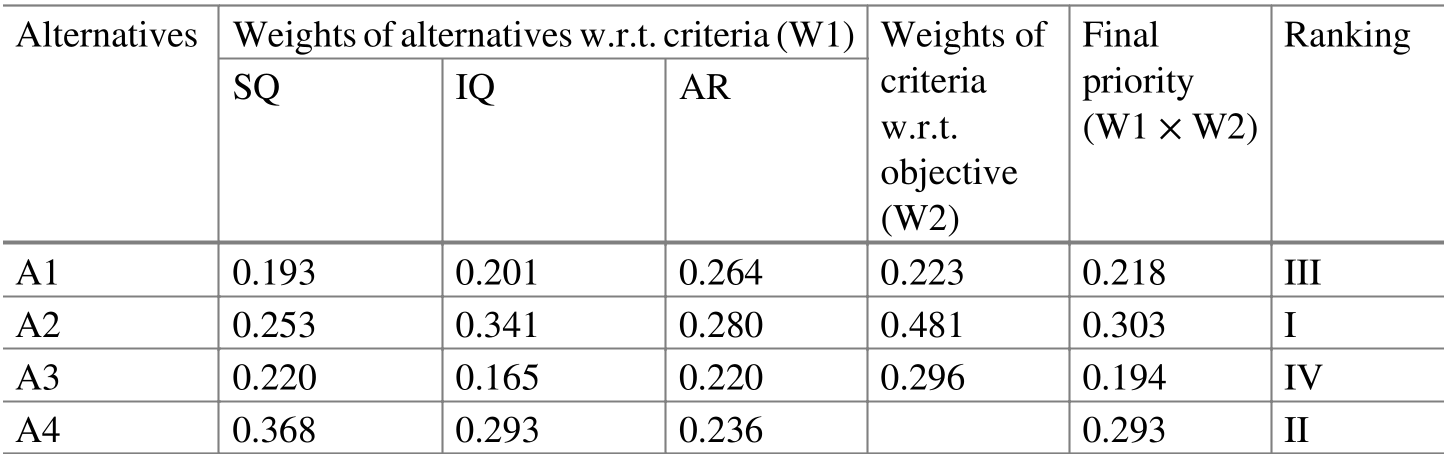
- The Winner: ResearchGate (A2) secured the #1 rank (30.3%).
- The Runner-up: LabRoots (A4) followed closely (29.3%).
- The Deciding Factor: Information Quality was the dominant criterion, holding nearly 48.1% of the total weight. Within that, Accuracy was deemed the most vital sub-attribute.
| Criteria | Weight | Sub-Criteria Priority |
|---|---|---|
| Information Quality | 0.481 | Accuracy (0.411) |
| Audience Reach | 0.296 | Educational Level (0.561) |
| Site Quality | 0.223 | Impression Score (0.219) |
Deep Insight: Why ResearchGate?
While LabRoots (A4) scored higher in Site Quality (0.368), ResearchGate (A2) dominated in Information Quality (0.341). This tells us that academics are willing to tolerate a less "flashy" interface if the data provided is accurate and relevant. The connectivity of the site—how it links to other social networks—also played a secondary but significant role in expanding reach.
Critical Analysis & Conclusion
This paper successfully bridges the gap between marketing strategy and mathematical optimization. However, it is important to note a few limitations:
- Static Data: Pairwise comparisons are based on expert committees at a single point in time. As platforms update their algorithms, these weights may shift.
- Subjectivity: Despite the AHP’s logic checks, the initial "Intensity of Importance" is still human-derived.
Future Outlook: The next logical step for this research is the integration of Fuzzy AHP (FAHP) to handle the "vague" nature of human language (e.g., when an expert says something is "moderately better" rather than a hard "3"). Furthermore, combining AHP with real-time web traffic data could create a dynamic recommendation engine for digital marketers.
Takeaway: In the academic world, content is king. If you are selling knowledge, your advertisement must be placed where accuracy is the highest priority.