
Beyond Utility: Why We Forgive Chatbots Even When They Fail
AI in the Workplace: Exploring Chatbot Use and Users’ Emotions
This study investigates the emotional drivers of Chatbot adoption in the workplace using a qualitative case study of "Omilia." It identifies that beyond traditional IT metrics, users' emotional responses—specifically empathy and excitement—play a critical role in sustained use even when the AI fails.
TL;DR
Why do employees keep using internal chatbots that often get things wrong? This study reveals that it isn't just about efficiency; it's about empathy. By analyzing a real-world corporate chatbot deployment, researchers found that users treat AI as a "developing colleague" rather than a broken tool. This emotional cushion—built on excitement, hope, and social presence—allows AI to survive its early, error-prone stages in the workplace.
The "Missing Link" in AI Adoption
For decades, we’ve measured technology success through the lens of "Usefulness" and "Ease of Use" (the Technology Acceptance Model). But AI is different. Unlike a static spreadsheet, a chatbot talks back, learns, and occasionally "hallucinates."
Traditional research focuses on Computer Anxiety as the main barrier. However, this study argues that the emotional landscape is far more complex. The primary bottleneck isn't just "Does it work?" but "How do I feel when it fails?"
Methodology: Peering into the Employee Mind
The researchers conducted a deep-dive into Omilia, a global organization that replaced some of its IT helpdesk functions with an AI chatbot. Through 28 in-depth interviews, they mapped user experiences to a specialized emotional framework.
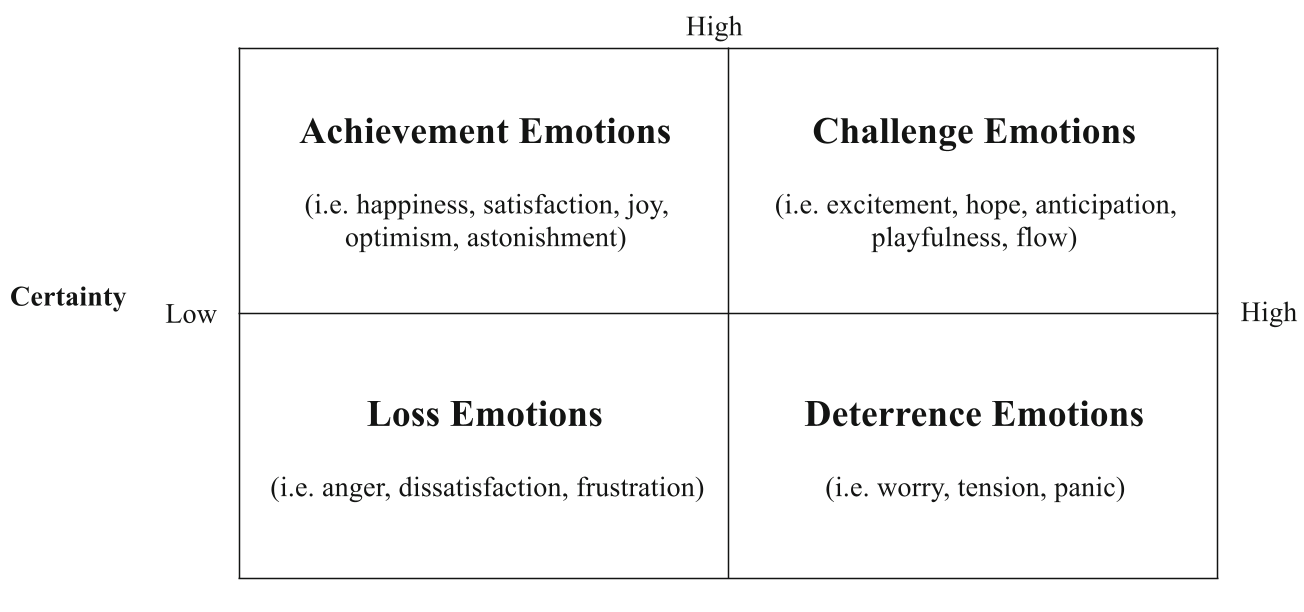 Figure 1: The framework used to categorize user emotions, ranging from achievement to deterrence.
The "Empathy" Breakthrough
The most striking finding was a new category not found in standard IT literature: Empathy Emotions.
When the chatbot failed, users didn't just feel "Loss" (anger or frustration). Instead, they felt:
- Sorrow: "I’m not mad at the bot, I just feel sorry for it."
- Self-Reflection: Users wondered if they had typed the wrong thing, rather than blaming the system.
- Parental Hope: Users viewed the chatbot as a "learning agent," believing their continued use was a form of "training" that would help the bot grow.
Key Results: The Emotional Buffer
The study categorized findings into five emotional pillars:
- Achievement: Feeling satisfied when a ticket is created quickly.
- Challenge: The "Playfulness" of testing a new AI's limits.
- Loss: The frustration when a bot doesn't understand a complex query.
- Deterrence: Panic or tension leading to abandonment after one bad experience (the minority of cases).
- Empathy: The "Social Presence" that makes users forgive technical flaws.
Why Empathy Wins
The researchers found that the Social Presence of the chatbot—its conversational nature—triggers a "Flow" state. This turns a boring administrative task into a playful interaction. Because users see the bot as "human-like," they apply social norms of forgiveness that they would never extend to a static software application.
Critical Insight & Future Outlook
This paper offers a vital lesson for AI product managers: Design for the "Learning Journey."
If a chatbot is marketed as a perfect "Oracle," errors lead to Deterrence. But if it is marketed as a "Learning Assistant," errors lead to Empathy and Hope. To ensure successful AI integration, organizations should:
- Highlight the "Learning" aspect: Let users know their feedback helps the AI grow.
- Foster Social Presence: Use natural language that evokes a collaborative partnership.
Limitations: The study is qualitative and based on one organization. As AI becomes more ubiquitous, this "novelty-driven" empathy might wear off, leading to higher expectations and lower tolerance for errors.
Conclusion
The workplace of the future isn't just about human-tool interaction; it's about Human-AI Collaboration. By understanding that employees bring their hearts (and their forgiveness) to the chat window, we can design AI systems that are more resilient to the inevitable "growing pains" of machine learning.