
DataLex: Democratizing Legal Expertise through AI and the Commons
Utilising AI in the legal assistance sector—Testing a role for legal information institutes
The paper outlines the strategy of the Australasian Legal Information Institute (AustLII) to integrate AI into the legal assistance sector via the DataLex platform. It introduces a "sustainable legal advisory system" that leverages rule-based reasoning and large-scale legal data to support free legal advice through collaborative, low-cost "commons of expertise."
TL;DR
This paper explores how Legal Information Institutes (LIIs) can move beyond providing static documents to offering active "Intelligent Assistance" (IA). Using the DataLex platform, the authors propose a sustainable model for the legal assistance sector that combines rule-based AI with massive open-access legal databases, enabling lawyers to build "expert systems" without needing a computer science degree.
The Motivation: Why AI in Law often Fails the Public
While the legal industry is buzzing with AI hype, actual deployment in the pro bono and community legal sectors is hindered by a "resource gap." Commercial AI tools are too expensive, and complex Machine Learning (ML) models are often "black boxes" that cannot provide the rigorous, source-based justification required in law.
The authors argue for a "commons of legal expertise"—a collaborative environment where legal rules are encoded into reusable software modules, much like Open Source Software (FOSS) or Wikipedia.
Methodology: The DataLex Architecture
The core contribution of this work is the DataLex platform. Unlike general-purpose AI, DataLex is specifically designed to follow the logic of legislation.
1. The Inferencing Engine
DataLex uses backward-chaining logic. For instance, if a user wants to know if a work is protected by copyright, the system "works backward" from that goal, asking only the necessary questions based on the rules.
2. Isomorphic Rule Representation
One of the biggest hurdles in legal AI is the gap between "legalese" and "code." DataLex solves this by using a syntax that resembles English.
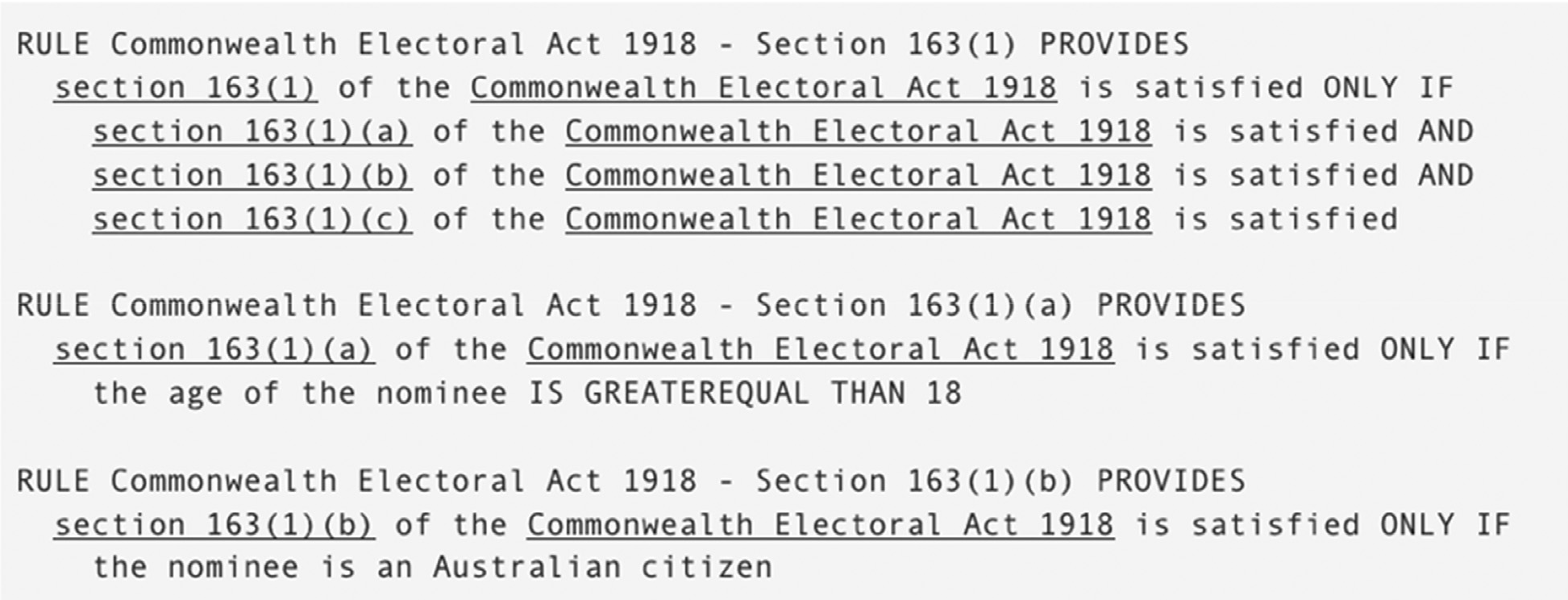 Figure: An extract of a DataLex rulebase showing the near-natural language structure.
3. Integration with the "Legal Commons"
Instead of being a standalone app, the system is integrated with:
- SINO: A specialized search engine.
- LawCite: An automated citator that tracks the history of millions of cases. This ensures that if a user encounters a term like "foreign power," they can immediately jump to the relevant case law.
Experiments & Real-World Application: The Tenancy Law Project
To test this approach, AustLII partnered with a major law firm (King & Wood Mallesons) and the Redfern Legal Centre. They developed a decision-support system for NSW Tenancy Law.
The workflow is a blueprint for the future:
- AustLII provides the AI platform.
- Pro bono lawyers act as "knowledge engineers" to encode the law.
- Community Legal Centres use the tool to triage and advise clients.
- University Researchers evaluate the outcome.
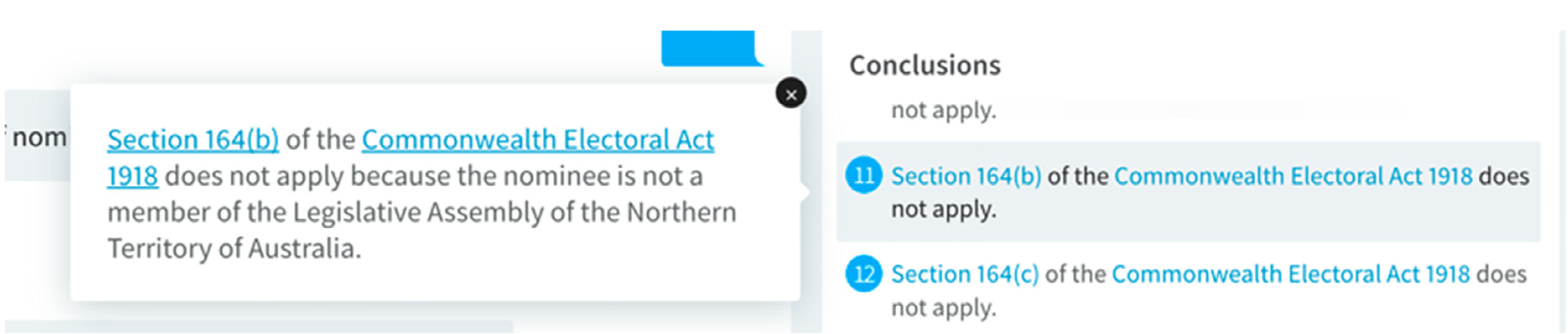 Figure: The DataLex user interface providing a "How" explanation, showcasing transparency in AI reasoning.
Critical Analysis: The Future of "Rules as Code"
The paper makes a compelling case that LIIs should not build the KBs themselves—they should provide the infrastructure. The success of this model depends on "Sustainability Guidelines":
- Openness: Systems must be integrated with hypertext and primary sources.
- Maintainability: Domain experts, not programmers, must be able to update the rules as the law changes.
- Triage over Replacement: The goal isn't to replace lawyers but to provide a "triage" mechanism to handle common legal queries efficiently.
Limitations
While the rule-based approach is excellent for legislation, it struggles with highly discretionary areas of law where human "judgment" or "empathy" is paramount. Furthermore, the model relies heavily on the continued voluntary participation of pro bono lawyers to maintain the "Knowledge Commons."
Conclusion
The DataLex project proves that AI in law doesn't have to be a multi-million dollar corporate asset. By leveraging the principles of the "Legal Commons," we can turn complex legislation into interactive tools that empower both the legal assistance sector and the public.