
Culturally Responsive AI: Localizing Ethics Education for K-12 Students in Japan
Contextualizing AI Education for K-12 Students to Enhance Their Learning of AI Literacy Through Culturally Responsive Approaches
The paper introduces a framework for contextualizing AI literacy in K-12 education, specifically adapting the MIT "AI Ethics for Middle School" curriculum for Japanese students. It leverages Culturally Responsive Pedagogy (CRP) to ensure AI concepts are relatable to local societal norms and technological landscapes.
TL;DR
As AI becomes ubiquitous, K-12 literacy is no longer optional. However, importing "one-size-fits-all" curricula from the US to other nations often fails due to cultural and technological disconnects. This paper explores a collaborative project to contextualize MIT’s AI Ethics curriculum for Japanese middle schoolers, emphasizing Culturally Responsive Pedagogy (CRP) and the integration of local robotics to bridge the gap between abstract algorithms and everyday life.
The Localization Challenge: Why Translation Isn't Enough
While AI is a global phenomenon, our interaction with it is deeply local. A curriculum designed in Cambridge, Massachusetts, might use YouTube or Netflix as primary examples of recommendation engines. However, in Japan, students might be more familiar with Yahoo! Japan or local e-commerce platforms.
The authors argue that "educating students out of context will not be relevant or even meaningful." For a subject as complex and potentially "foreign" as AI Ethics, the lack of cultural resonance acts as a barrier to mastery. The problem is twofold:
- Technological Context: Different countries use different AI-enhanced tools and devices.
- Pedagogical Context: Western curricula often rely on high-intensity "active learning" (discussions, Socratic seminars), which may clash with the more guided, step-by-step instructional traditions in Japanese classrooms.
Methodology: The Culturally Responsive Strategy
The research team adapted the "Five Big Ideas in AI" framework (Perception, Representation, Learning, Interaction, and Impact) using three main strategic pivots:
1. Tool Substitution
The original MIT curriculum's "YouTube Scavenger Hunt" was replaced with Yahoo! Japan. This ensures students are investigating algorithms on platforms they actually use daily, making the concept of "Data Awareness" concrete rather than theoretical.
2. Integration of Local Robotics
Japan has a unique relationship with social robotics. To increase engagement, the authors proposed using hardware familiar to the Japanese education system, such as:
- Pepper: A social humanoid robot used in many Japanese public schools.
- HuskyLens with Micro:Bit: AI vision sensors for hands-on machine learning.
- Zumi: A programmable self-driving car to illustrate navigation and vision.
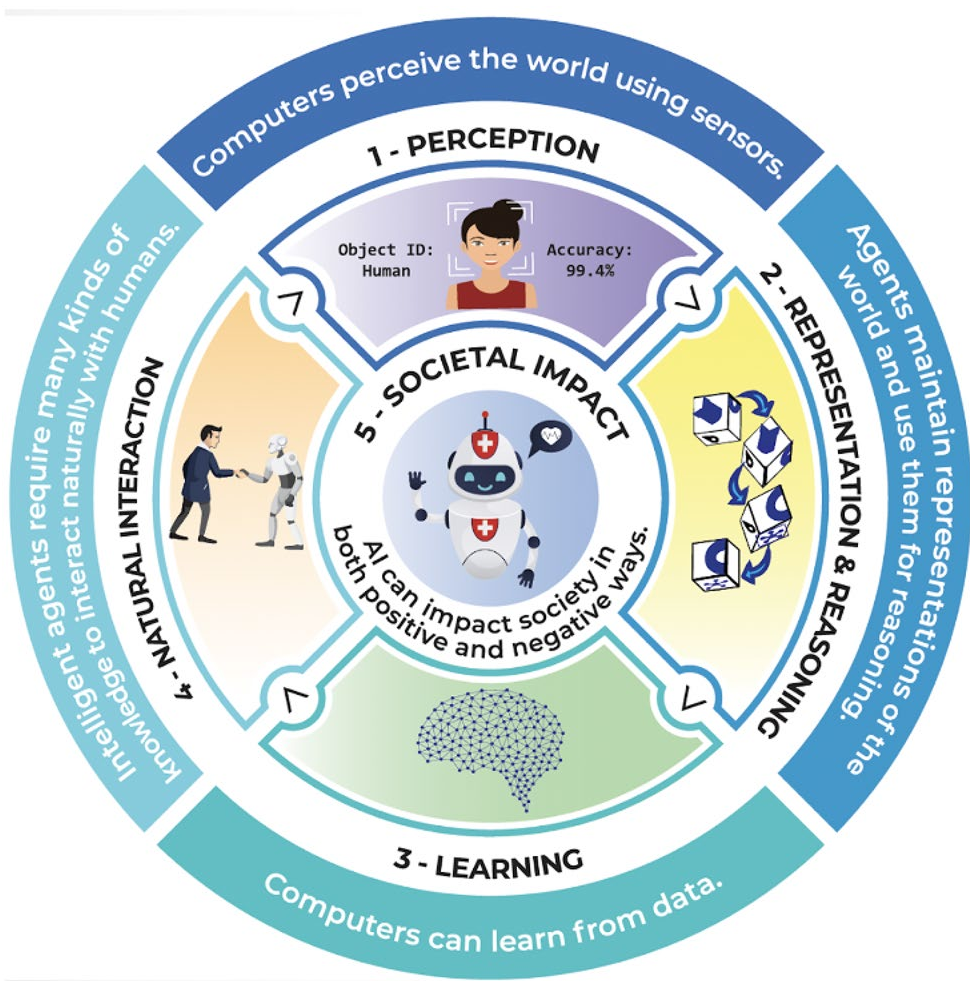 Figure: The Five Big Ideas in AI that form the foundation of the K-12 curriculum.
3. Structural Alignment with National Goals
The curriculum was mapped to the Sustainable Development Goals (SDGs), which are already a high-priority part of the Japanese national educational policy. By framing AI Ethics within the SDGs, the authors provided a familiar "schema" for students to build upon.
Methodology & Hardware Integration
The methodology moves beyond "unplugged" activities to include "AI-enhanced devices" that co-exist with people in Japanese society—from AI-enabled microwaves to service robots in airports.
 Figure: Hardware like Zumi allows students to visualize the "Perception" and "Learning" aspects of AI in a tangible, physical environment.
Experiments & Teacher Readiness
The paper highlights a critical implementation gap: while Japan mandated computer science in 2020, 70% of teachers felt uncertain about its delivery. The researchers addressed this by:
- Simplifying Materials: Consolidating separate PowerPoint slides and manuals into unified, easy-to-read "main curriculum documents" for teachers.
- Hybrid Delivery: Modifying activities to work as both independent tasks (for remote learning during COVID-19) and group-based collaborations.
Critical Analysis & Takeaways
The core insight of this work is that AI Literacy is a socio-technical skill, not just a technical one. Using the theory of Constructionism (Papert, 1993), the authors demonstrate that if new AI knowledge isn't built upon the cultural "schema" a child already possesses, the learning is fragile.
Key Insights:
- Inductive Bias of Curricula: Every curriculum carries the cultural bias of its creators. Acknowledging this is the first step toward effective global education.
- Hardware as a Hook: In cultures with a high affinity for robotics (like Japan), physical agents like Pepper serve as powerful "objects-to-think-with" for teaching AI ethics.
- Flexibility is Key: Modifying active-learning components to include options for independent work respects local pedagogical norms while still striving for student mastery.
Conclusion
This project serves as a blueprint for "Contextualized AI Education." It demonstrates that to prepare a K-12 population for an AI-driven future, we must look beyond the code and consider the cultural, societal, and pedagogical landscape of the classroom. As AI continues to evolve, our educational strategies must be as adaptable as the algorithms we teach.