
Airbnb and the Invisible Tax: The High Price of "Professional Smiles" in Havana
Airbnb and the Costs of Emotional Labor in Havana, Cuba
This paper explores "Airbnb and the Costs of Emotional Labor in Havana, Cuba," using ethnographic methods to analyze how the digital platform intensifies the "Professional Smile" requirement. It identifies that the platform's rating systems and the unique socio-technological constraints of Cuba force both hosts and non-host locals to perform taxing emotional regulation.
TL;DR
Airbnb's arrival in Havana in 2015 promised a financial lifeline for many Cubans, but it came with a hidden cost: Emotional Labor (EL). This ethnographic study reveals how the platform forces locals—both hosts and their neighbors—to perform a curated version of "Cuban hospitality." From managing "Superhost" status despite poor internet to feeling like "toys in a playground," the research exposes how the gig economy commodifies human feelings and public spaces.
Problem & Motivation: Beyond the Digital Facade
In the world of the gig economy, we often focus on the "gig"—the room rented or the car driven. However, the work of an Airbnb host in a place like Havana is far more complex than just changing bedsheets.
The authors argue that existing CSCW (Computer-Supported Cooperative Work) literature hasn't sufficiently addressed how platforms like Airbnb intensify working practices in developing regions. In Cuba, where home internet is a luxury and the "Superhost" badge is a survival tool, the pressure to "put on a smile" creates a profound psychological burden. The motivation of this study is to uncover the costs of this invisible labor—not just for those getting paid, but for the community at large.
Methodology: High-Touch Ethnography
To capture these nuances, the research team utilized a longitudinal ethnographic approach across three years (2015–2018).
- Participant Base: 51 individuals, including a mix of Airbnb hosts, non-host locals, and tourists.
- Context: Focused on Central Havana, a high-density area undergoing rapid transformation.
- Theoretic Framework: The study leans on Hochschild’s concept of Emotional Labor, defined as inducing or suppressing feelings to sustain an outward countenance that satisfies others.
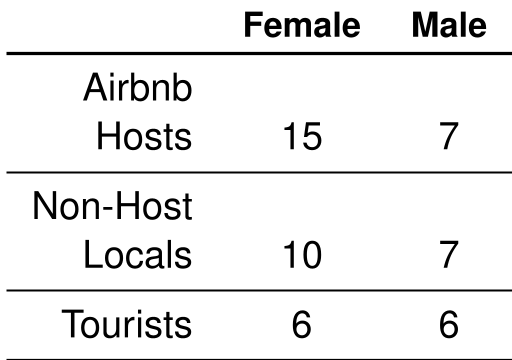 Table 1: The diverse pool of participants allowed the researchers to cross-reference the experiences of hosts with the perceptions of tourists and neighbors.
Methodology & Analysis: The "Superhost" Trap
The study identifies two distinct "cost centers" for emotional labor:
1. The Host’s Burden: Managing Infrastructure and Expectations
Because internet in Cuba is expensive and scarce, hosts live in fear of losing their "Superhost" status due to slow response times. This creates a state of constant stress where hosts feel "estranged from their own smiles."
- The Explainer Role: Hosts reported spending hours daily answering tourists' curious (and sometimes invasive) questions about Cuban life.
- The Buffer Role: When things go wrong (e.g., tourists getting in trouble with local police), hosts must manage the situation with "extreme patience," suppressing their own frustration to ensure a 5-star review.
2. The Non-Host’s Burden: Living in an "Amusement Park"
Perhaps the most striking finding is how Airbnb affects those not using the platform. The rapid proliferation of rentals has turned residential streets into tourist hubs.
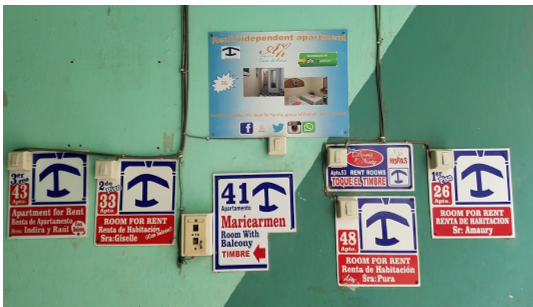 Figure 1: The visual density of rental signs on a single building in Center Havana illustrates the "Airbnb-ification" of the neighborhood.
Non-hosts like Judith (45) described feeling like "characters in an amusement park," where tourists treat her as part of the scenery. Even though she receives no payment from Airbnb, she feels obligated to "put on a smile" and help tourists to prevent the world from seeing Cubans as "rude."
Critical Insight: The Alienation of Space
The research concludes with a sobering thought: Neighborhood alienation. Locals no longer recognize their own parks or shops. They see tourists speaking foreign languages at their traditional domino tables and feel they "have to hold themselves back." This is the ultimate cost—the loss of the "private" in the city's public life.
Conclusion & Takeaways
The study serves as a critical warning for the design of future platforms:
- Platform Responsibility: Rating systems do not exist in a vacuum; they interact with local social dynamics and digital divides.
- Invisible Enrollment: Platforms can "enroll" people into labor regimes even if they never sign up for an account.
- The Cost of "Authenticity": When a platform sells "authentic experiences," it essentially commodifies the daily lives and emotions of an entire population.
Future Outlook: As Airbnb continues to expand in the Global South, we must ask: how can we design systems that reward hosts without demanding their emotional exhaustion, and how can we protect the social fabric of the neighborhoods they occupy?