
AITSteg: Stealthy Communication via Invisible Unicode Metadata in Social Media
AITSteg: An Innovative Text Steganography Technique for Hidden Transmission of Text Message via Social Media
This paper introduces AITSteg, an innovative text steganography technique designed for end-to-end secure communication over SMS and social media. By leveraging Unicode Zero-Width Characters (ZWCs) and a Gödel-based encoding function, it achieves high-capacity data hiding that remains completely invisible to the human eye and robust against common cyber-attacks.
TL;DR
AITSteg is a breakthrough in text steganography that allows users to hide confidential messages inside plain social media posts using "invisible" Unicode characters. By combining Gödel numbering with dynamic symmetric keys, it achieves a high-capacity, robust, and completely imperceptible hidden channel that bypasses Man-In-The-Middle (MITM) attacks and service provider surveillance.
Problem & Motivation: The Plaintext Vulnerability
Most smartphone users assume their "private" chats are secure, but messages sent via SMS or many social media apps are often stored as plaintext on database servers. This exposes sensitive data—like banking credentials or private identities—to Message Disclosure (MD) and Man-In-The-Middle (MITM) attacks.
Current steganography (hiding data in data) fails in text because:
- Low Capacity: You usually need a massive paragraph to hide just a few words.
- Visibility: Adding extra spaces or weird emoticons looks suspicious to human readers.
- Fragility: If a user deletes a word, the hidden message is often destroyed.
The authors of AITSteg recognized that modern social media apps support the Unicode standard, which includes "Zero-Width Characters" (ZWCs). These characters have no physical width or symbol but are processed by systems—making them the perfect "cloak" for secret data.
Methodology: The Gödel-Unicode Bridge
AITSteg doesn't just hide bits; it re-encodes language itself. The process follows a sophisticated three-stage pipeline.
1. Gödel Encoding
Instead of standard ASCII, the system uses the Gödel function to map characters to pairs of numbers . This provides a mathematical layer of abstraction that is far harder for attackers to reverse-engineer than simple character substitution.
2. Dynamic Hashing
To prevent "dictionary attacks" where an attacker might guess the ZWC pattern, the system uses a symmetric key based on the sending/receiving time. Even if you send the word "Hello" twice, the resulting invisible bitstream will look completely different both times.
3. Invisible Mapping
The hashed bits are mapped into four specific ZWCs as shown below:
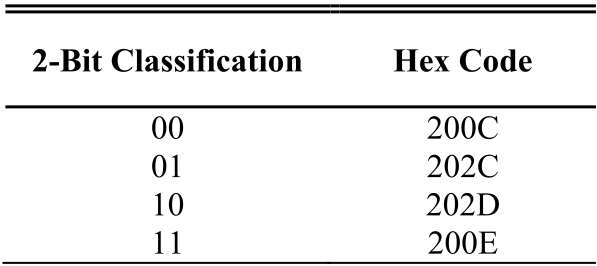
These characters are placed in front of a normal "Cover Message" (e.g., "How are you?"). To the app and the human user, only the cover message is visible; the ZWCs remain hidden in the metadata.
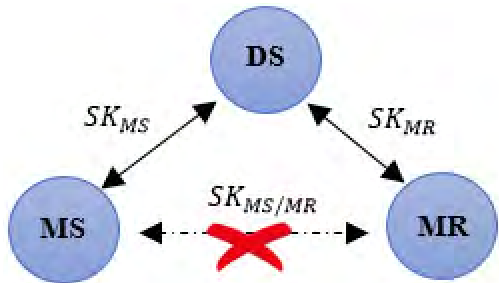
Experiments & Results: Putting the "Secret" in Social Media
The researchers tested AITSteg across 15 different apps, including WeChat, WhatsApp, and Gmail.
Key Findings:
- Invisibility: In 13 out of 15 apps, the secret message was 100% invisible. (Only Telegram and Twitter failed due to their exclusive character re-encoding).
- Embedding Capacity (EC): AITSteg can hide up to 5,000 characters in a single WhatsApp message—dramatically higher than prior methods like UniSpaCh.
- Robustness: Even if a reader interacts with or modifies the visible part of the message, the hidden data (placed at the start) has a 97%+ probability of surviving.
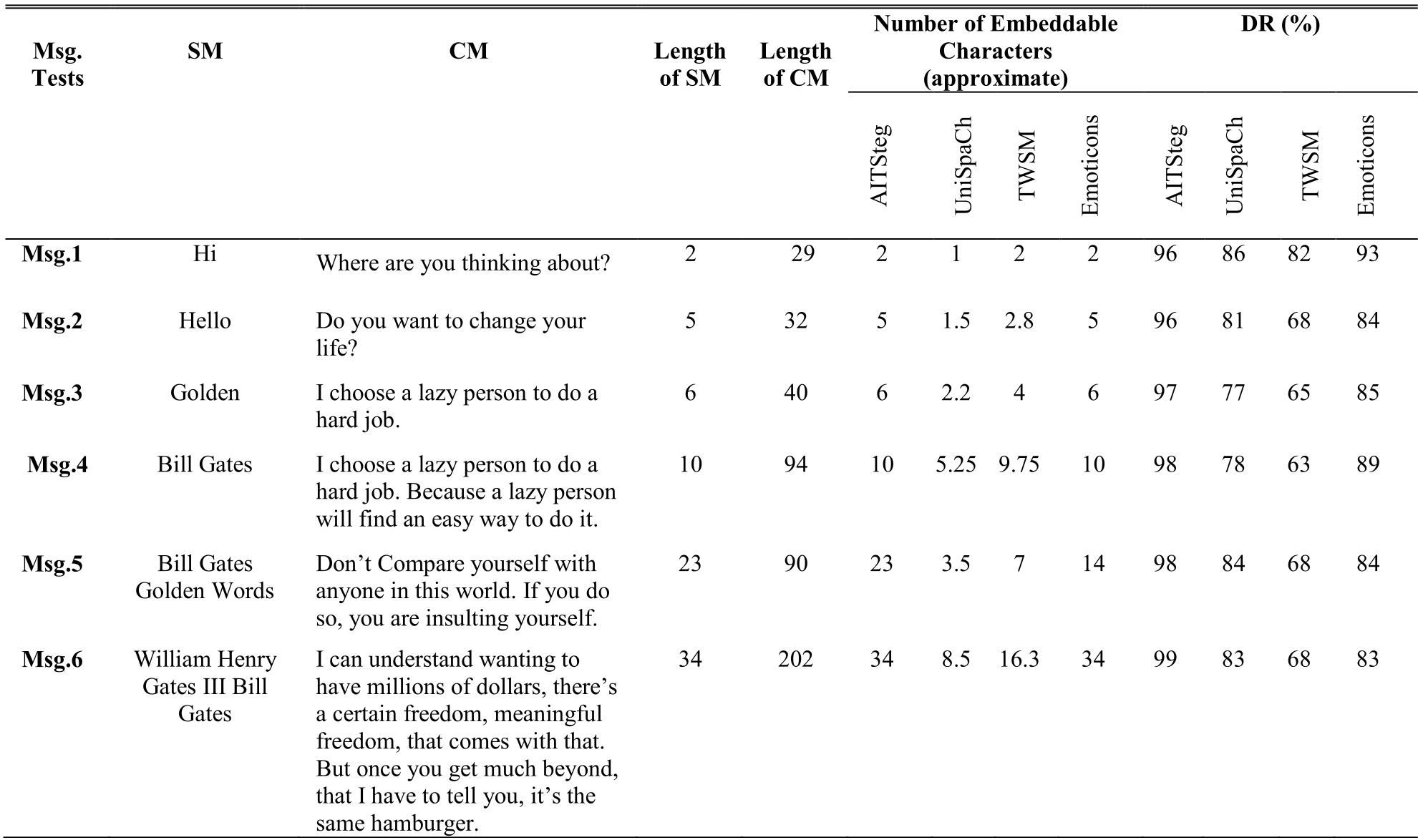
In the comparison table above, AITSteg clearly outpaces existing SOTA techniques (UniSpaCh, TWSM) in "NCRES" (the number of cover characters required to embed one secret character), maintaining a virtually 1:1 ratio.
Critical Analysis & Conclusion
AITSteg represents a significant shift from "visual" steganography to "protocol-aware" steganography. By exploiting how Unicode is handled by mobile OS (Android/iOS), it creates a secure channel that is native to the platforms we use every day.
Limitations:
- Dependency on Unicode Support: As seen with Telegram and Twitter, if a platform "cleans" or re-orders secret Unicode characters during message processing, the link is broken.
- App-Specific Steganalysis: While invisible to humans, a statistical check for ZWC density could theoretically flag these messages.
Future Outlook:
The authors suggest this technique could move beyond chat into Version Control Systems (VCS) like GitHub to protect open-source code from reverse engineering by embedding watermarks directly into the source text. For anyone needing high-grade privacy in an age of mass surveillance, AITSteg offers a powerful, "hidden in plain sight" alternative.