
GT-UCB: Decoupling Influence Maximization from Graph Topology
19035_Algorithms for Online Influencer Marketing.
The paper introduces GT-UCB, a diffusion-independent algorithm for Online Influencer Marketing with Persistence (OIMP). It treats influence maximization as a multi-armed bandit problem, utilizing a Good-Turing estimator to adaptively select influencers and maximize cumulative spread without requiring knowledge of the underlying social graph or diffusion model.
TL;DR
Maximizing social influence usually requires a map of the network and complex math. GT-UCB flips the script: it doesn't need to see the graph. By using the Good-Turing estimator—a tool once used to crack the Enigma code—it predicts which influencers have the most "untapped" audience left, making it 100x faster than traditional methods while maintaining SOTA performance.
The Problem: The "Dark" Social Graph
Most academics treat Influence Maximization (IM) as a geometry problem: "If I know every connection in this graph, which nodes start the biggest fire?"
In reality, marketers face three major hurdles:
- Unknown Topology: We rarely have the full social graph of Twitter or Facebook.
- Model Mismatch: Real human behavior doesn't perfectly follow "Independent Cascade" or "Linear Threshold" models.
- The Persistence Trap: Once a user buys a product, they are "activated." Reseeding the same influencer yields diminishing returns as their audience becomes exhausted—a property known as persistence.
Methodology: The Good-Turing Insight
Instead of estimating probabilities for every edge, the authors estimate the Remaining Potential () of an influencer.
How do you estimate what you haven't seen? The authors use the Good-Turing Estimator. In this context, they look at Hapaxes: users who have been activated exactly once by a specific influencer.
- If an influencer keeps hitting the same users (high overlap), hapaxes are few, and their potential is low.
- If an influencer keeps hitting new, unique users, hapaxes are high, suggesting a large untapped "support" base.
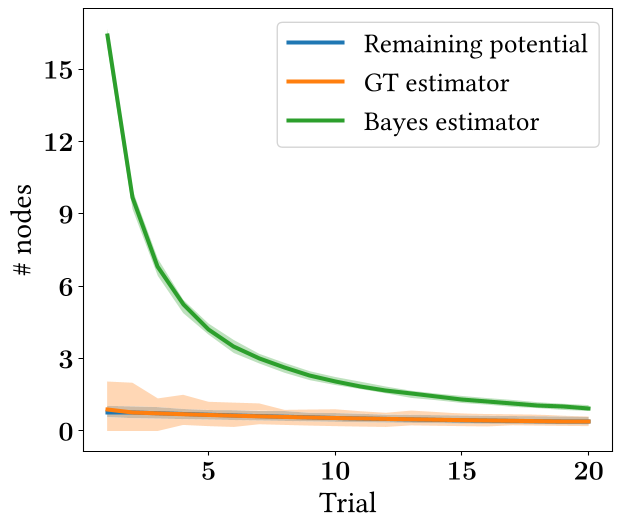 Figure 1: The Good-Turing estimator (red) converges to the true potential significantly faster than traditional Bayesian methods (blue), which struggle with high-dimensional uncertainty.
The GT-UCB Algorithm
The algorithm follows the Optimism in the Face of Uncertainty principle. It calculates an upper bound () for each influencer: It then picks the influencer with the highest . This ensures the agent "exploits" known high-performers but "explores" influencers whose potential is still uncertain.
Handling "Influencer Fatigue"
A significant contribution of this paper is Fat-GT-UCB. Real influencers lose impact if they post too often (weariness). The authors introduce a weariness function that discounts the probability of activation over time, re-weighting the Good-Turing statistics to account for this decay.
Experiments and Results
The authors tested GT-UCB on Twitter logs (11.6M nodes) and collaboration graphs.
1. Speed
Because GT-UCB doesn't simulate cascades on a graph, its per-step computation is nearly zero. While "Oracle" methods (which know the graph) take seconds or minutes per decision, GT-UCB is instantaneous.
2. Performance
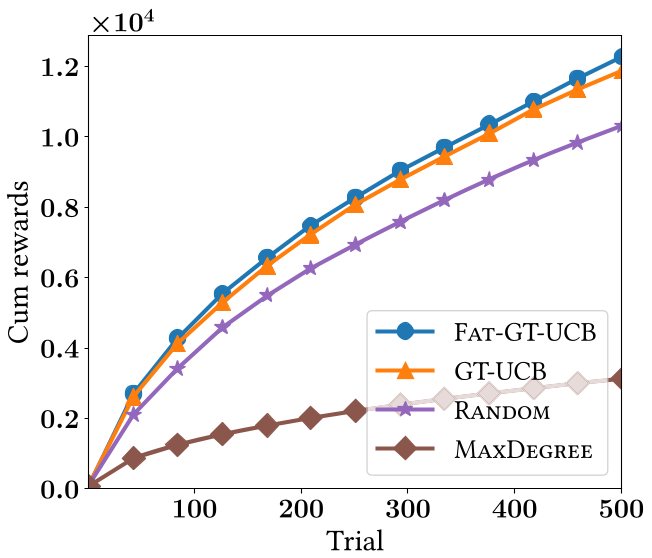 Figure 2: Fat-GT-UCB (red) outperforms standard GT-UCB and Random baselines in scenarios where influencer fatigue is present, proving its adaptability to realistic social dynamics.
On the DBLP and HepPh datasets, GT-UCB consistently matched or outperformed the EG (Exponentiated Gradient) algorithm, which is the previous state-of-the-art for online IM but requires a known graph.
Critical Analysis & Conclusion
Takeaway
The genius of this work lies in its philosophical shift. By abandoning the attempt to "solve the graph," it provides a robust, statistical shortcut that is actually usable in production environments.
Limitations
- Cold Start: The algorithm requires an initial "round-robin" phase where every influencer is played at least once. If (number of influencers) is very large relative to the budget , this initialization eats up the entire campaign.
- Attribution: The model assumes we can attribute which influencer activated which user, which may be tricky in multi-touch attribution scenarios.
Future Work
The next frontier is Contextual OIMP. Can we use the content of a tweet (e.g., politics vs. fashion) as a "context" vector for the Multi-Armed Bandit? Integrating NLP features with the Good-Turing estimator could further refine these "blind" influence predictions.