
All Circuits Lead to Rome: The Death of the "Unique Mechanism" Myth in LLMs
All Circuits Lead to Rome: Rethinking Functional Anisotropy in Circuit and Sheaf Discovery for LLMs
The paper introduces "Overlap-Aware Sheaf Repulsion" (OASR), a method to discover multiple, structurally distinct, yet functionally equivalent subgraphs (circuits/sheaves) within LLMs. It achieves SOTA identification of diverse mechanisms on benchmarks like IOI and BLiMP, proving that tasks are supported by a "plethora" of mechanisms rather than a single canonical one.
Executive Summary
TL;DR: For years, the community assumed that if we looked closely enough at an LLM, we would find the specific circuit responsible for a task. This paper shatters that "Functional Anisotropy Hypothesis." By introducing Overlap-Aware Sheaf Repulsion (OASR), the authors prove that a single task (like Indirect Object Identification) can be performed by dozens of nearly disjoint circuits, each being simultaneously faithful and sparse.
Academic Context: This work is a "paradigm-shifter." It moves mechanistic interpretability from a reductionist search for a single "ground truth" sub-graph to a distributed view of competing, redundant mechanisms.
The Core Conflict: Why "One Circuit" is a Mirage
Prior work in Circuit and Sheaf Discovery (CSD) operated on the Functional Anisotropy Hypothesis: the belief that model functions are localized to unique internal mechanisms. If you found a circuit, you found the explanation.
However, the authors noticed a problem. If they changed the random seed or slightly tweaked the prompt (e.g., changing "John and Mary" to "Alice and Bob"), the discovered circuits changed. Was the math wrong? No—the model's internal structure is simply more redundant than we gave it credit for.
Methodology: Overlap-Aware Sheaf Repulsion (OASR)
To prove that multiple mechanisms coexist, the authors didn't just look for a sheaf; they looked for another one that didn't look like the first.
Evolution of the Objective Function
Standard sheaf discovery (like DiscoGP) optimizes for Fidelity (task performance) and Sparsity. The authors added a Repulsion Term:
This loss specifically penalizes the reuse of edges found in previous runs. By iteratively applying this, they "pushed" the discovery process into unexplored parts of the computation graph.
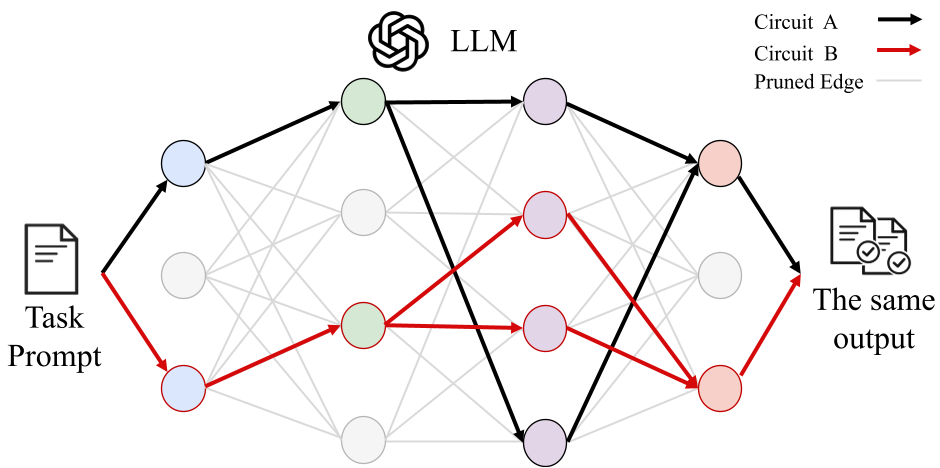 Figure 1: Conceptual illustration showing that the same task can be solved by multiple, non-overlapping internal pathways.
The "Distributive Dense Circuit" Hypothesis
The paper offers a profound theoretical insight: Subset-Sum Collisions. In a high-dimensional space (the LLM's residual stream), many different combinations of sparse edges can sum up to the same "readout" vector. Because LLMs operate in Superposition, there is a combinatorial explosion of possible subgraphs that result in the same output logit.
The authors proved that under mild assumptions:
- There exist multiple low-overlap circuits that are -faithful.
- Even in ultra-sparse settings (a 3-edge sheaf!), no single component is truly indispensable.
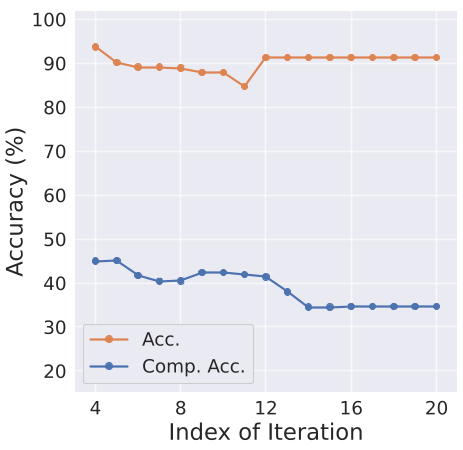 Figure 2: The vanishing intersection of discovered sheaves. As the number of discovered mechanisms (Runs) increases, the shared "core" (E_intersection) shrinks to nearly zero.
Critical Results: The 3-Edge Paradox
One of the most striking experiments involved the Indirect Object Identification (IOI) task:
- They identified an ultra-sparse 3-edge sheaf that achieved 86.7% accuracy.
- The Twist: If you remove any of these three "essential" edges, the model still finds high-quality alternative sheaves.
- This suggests that "indispensability" is an illusion caused by our search constraints, not a fundamental property of the model.
| Task | Sheaf A Acc. | Sheaf B Acc. | IoU (Overlap) |
|---|---|---|---|
| IOI | 100% | 100% | 4.1% |
| BLiMP | 96.8% | 92.6% | 5.1% |
Critical Analysis & Takeaways
The Good:
This work provides an "Existence Theorem" for redundancy. It explains why mechanistic interpretability often feels unstable: we were trying to find a unique solution to a problem with infinite solutions.
The Limitations:
- Zero Ablation: Most results rely on zero-ablating unused edges, which can push the model off its natural activation manifold.
- Task Granularity: The "non-indispensability" of edges varies when tasks are decomposed into finer sub-templates (e.g., BABA vs ABBA).
Future Outlook:
Interpretability research must stop asking "What is the circuit?" and start asking "What is the manifold of mechanisms?" This suggests that LLM robustness isn't just a byproduct of scale but a fundamental feature of its high-dimensional, distributive architecture.
Final Takeaway: Just like all roads lead to Rome, in an LLM, a plethora of distinct circuits lead to the correct prediction.