
CRFs and Lexico-Syntactic Patterns: Solving the Thai Tourism Ontology Population Puzzle
An alternative technique for populating Thai tourism ontology from texts based on machine learning
This paper introduces an automated framework for populating Thai tourism ontologies from unstructured text using Conditional Random Fields (CRFs) combined with lexico-syntactic patterns. The system successfully extracts Thai named entities (NEs) for attractions and activities, achieving an overall precision of 77.62% for instance extraction.
TL;DR
Populating ontologies from scratch is a bottleneck for semantic systems. This paper presents a machine-learning-driven approach specifically tailored for the Thai language. By utilizing Conditional Random Fields (CRFs) for entity recognition and lexico-syntactic patterns for discovering relationships, the authors achieved a 77.62% precision in extracting complex tourism instances, providing a roadmap for automating Thai knowledge graph construction.
The Challenge: Why Thai NLP is Unique
Most Named Entity Recognition (NER) systems rely on "visual cues" such as capital letters (English) or specific scripts (Japanese). Thai, however, is a continuous string of characters without capitalization or clear word boundaries. In the tourism domain, distinguishing between a common noun and a specific attraction name (e.g., "National Park" vs. "Doi Inthanon National Park") is notoriously difficult.
The authors identified that existing manual population methods are too slow to keep up with the dynamic growth of tourism data, necessitating an automated "Instance-of" and "Relation" extraction pipeline.
Methodology: The CRF-Heuristic Hybrid
The proposed architecture follows a four-stage pipeline: Feature Extraction CRF Classification Post-processing Relation Extraction.
1. Feature Engineering
The model doesn't just look at the word; it looks at the ecosystem surrounding it:
- Lexical & POS: Part-of-Speech tags for the current word and a window of 3 words before/after.
- Dictionary Cues: Checking against "Cue word lists" (e.g., words like "Temple" or "Park").
- Repeated Occurrences: Identifying patterns that appear together more than three times to suggest a stable entity boundary.
2. CRF Sequence Labeling
The authors use CRFs to solve the boundary problem. Unlike simple classifiers, CRFs consider the conditional probability of a label sequence. They use a B-M-E-S-O tagging scheme:
- B/M/E: Begin, Middle, and End of a multi-word name.
- S: Single-word names.
- O: Others (non-entity).
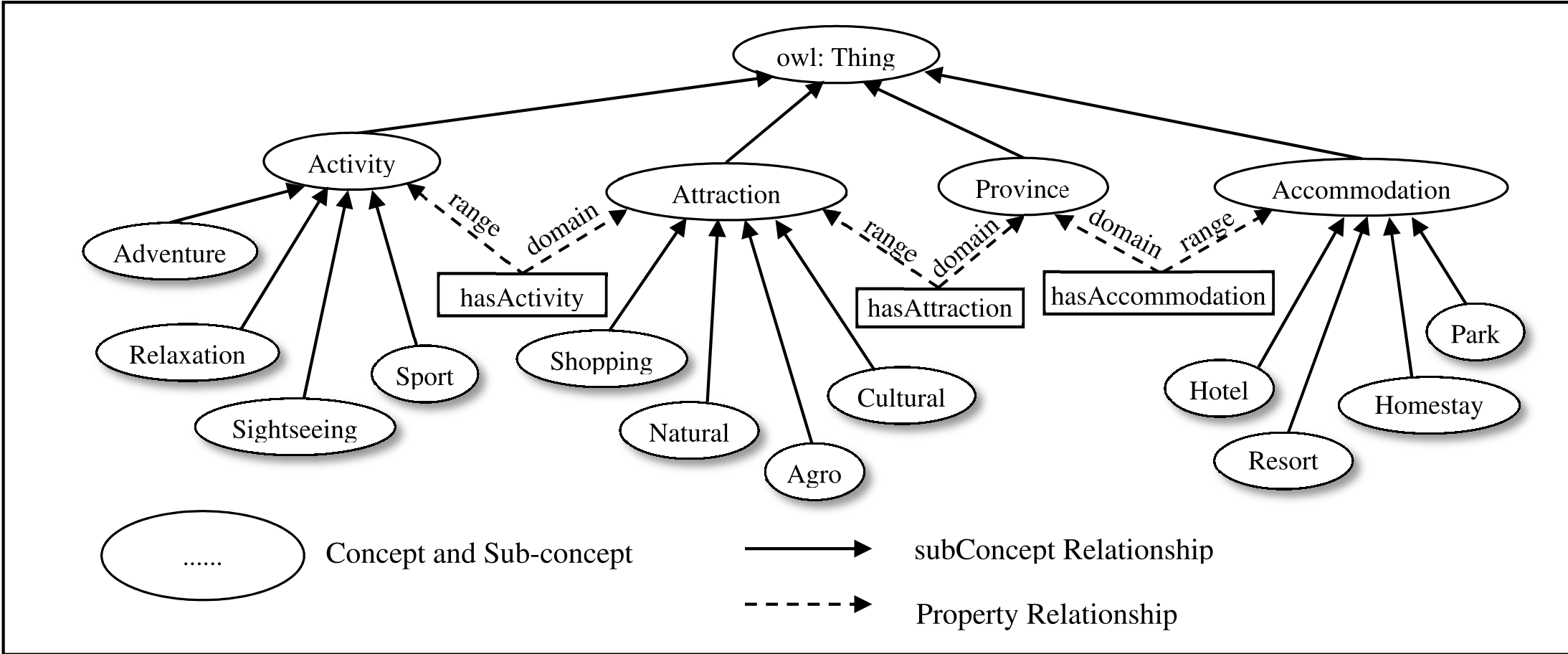 Figure 1: The target ontology structure representing the hierarchy of Attractions and Activities.
3. Heuristic Error Correction
Machine learning is never perfect. The authors added a "Rule-based Safety Net" to fix illogical sequences. For instance, if a model predicts O - Middle - End, the heuristic rule automatically corrects the first tag to Begin (B - M - E), ensuring the structural integrity of the extracted data.
Experimental Insights: Where the System Shines
The system was tested on 40,000 words of Thai web content. The results highlight a clear distinction between structured and unstructured naming:
| Attraction Type | Precision | Recall | F-measure |
|---|---|---|---|
| Natural | 79.25% | 87.50% | 83.17% |
| Cultural | 80.17% | 74.62% | 77.29% |
| Agro | 66.67% | 43.24% | 52.46% |
Analysis of Results:
- Success in Natural/Cultural Sites: These often have distinct "Cue words" (e.g., Wat for temple), making identification easier.
- The "Agro" Struggle: Agro-tourism sites often have long, descriptive names that mimic common sentences. The system often mistakenly tagged these as "Other" (
O), leading to a lower recall of 43.24%.
 Figure 2: Performance metrics for relationship extraction showing high precision in identifying "hasAttraction" links.
Critical Analysis & Takeaways
This research proves that CRFs remain a potent tool for specialized NER in morphologically rich languages. The inclusion of a post-processing layer is a practical "engineering" solution to the mathematical limitations of a standalone CRF.
Limitations:
- Window Size: The current relationship extraction depends on lexico-syntactic patterns which usually cover short-range dependencies.
- Vocabulary Dependency: The system relies heavily on cue word lists, which may struggle with slang or new, trendy tourism spots.
Future Outlook: As Thai NLP moves toward Transformer-based architectures (like ThaiBERT), the groundwork laid here regarding feature importance and heuristic correction will remain vital for fine-tuning those models for domain-specific knowledge extraction. This methodology bridges the gap between raw text and semantic intelligence.