
AMCOSOP: Breaking the Silence of Isolation for the Elderly via Ambient Social Networking
AMCOSOP: a social networking system for the elderly
AMCOSOP is a social networking system specifically designed to combat social isolation and improve the quality of life for the elderly. It employs an ambient communication architecture consisting of touch-screen home terminals and smart phone applications to provide a "safety net" through continuous presence and availability information.
TL;DR
Social isolation is a growing threat to the health and independence of the aging population. AMCOSOP (Ambient COmmunication and Sense Of Presence) is a specialized communication system designed to bridge the digital divide. By replacing complex interfaces with intuitive touch-screens and automated "presence" sharing, it creates a persistent digital safety net between the elderly and their relatives.
Background Positioning: Published at MindTrek '11, this work is a foundational exploration into Ambient Assisted Living (AAL), transitioning from reactive emergency devices to proactive, meaningful social inclusion.
Problem & Motivation: The Complexity Barrier
As mobility decreases and social circles shrink due to retirement or loss of loved ones, the elderly face significant risks of depression and dementia. While social media exists, current platforms suffer from:
- High Cognitive Load: Interfaces are designed for digital natives, leaving many seniors behind.
- Asynchronous Disconnect: Relatives are often too busy to call, and seniors fear "bothering" them, leading to a breakdown in communication.
- The Utility Gap: Safety wristbands provide security but do nothing to alleviate the daily crushing weight of loneliness.
The authors' insight was that loneliness isn't solved by more tools, but by a better "Sense of Presence"—the feeling that your safety net is there even when you aren't actively talking.
Methodology: The AMCOSOP Architecture
The system is built on a distributed tiers-based architecture designed for reliability and ease of use.
1. The Home Terminal
The primary interface for the elder is a touch-screen computer. It avoids menus and complex navigation, favoring:
- Large-scale visual elements.
- Presence indicators (seeing if a daughter is at work or home).
- Auxiliary info sharing (receiving photos or simple messages).
2. The Gateway and Server
Using the OSGi platform, the home gateway manages local sensors and acts as a proxy. This ensures the system can bridge local hardware (like smart home sensors) with the central AMCOSOP Server, which broadcasts the availability data.
3. Presence Automation
A critical component is the Smart Phone Application used by the "Safety Net" (family and doctors). It leverages GPS and calendar data to automatically update the senior’s terminal. If a relative is "Busy" or "Traveling," the senior sees this status, reducing the anxiety of unanswered calls.
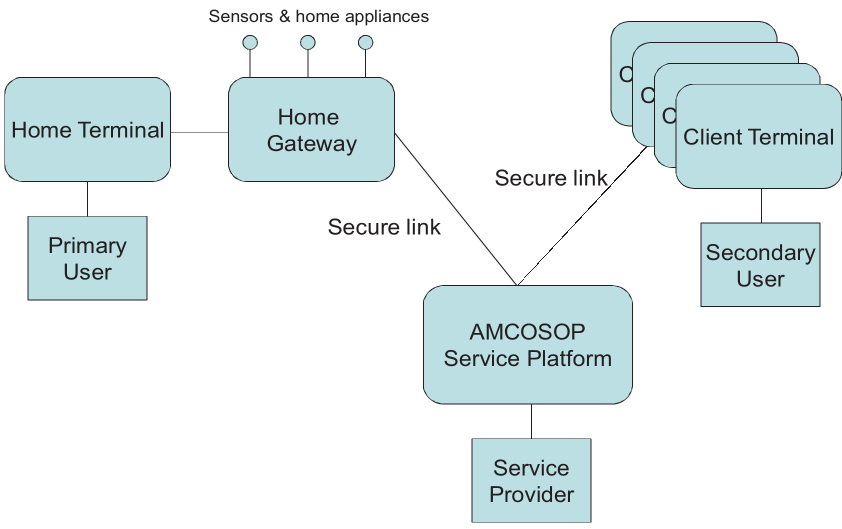 Figure 1: The technical interplay between the Elder's Home Terminal, the Gateway, and the remote Safety Network.
Experiments & Results: Real-World Validation
The researchers didn't just build a prototype; they launched year-long field trials in three countries: Finland, Austria, and Greece.
- Target Group: Active seniors aged 65–90.
- Scale: Approximately 30 households including their safety networks.
- Qualitative Impact: Preliminary findings suggest that the availability information acted as a catalyst for communication. Seniors felt more confident contacting relatives when they could "see" they were free, significantly reducing the "fear of disturbing" barrier.
Critical Analysis & Conclusion
Takeaway
AMCOSOP moves the needle from functional eldercare to emotional eldercare. By focusing on "ambient" information rather than "required interactions," it fosters a natural sense of belonging.
Limitations
- Privacy Concerns: The paper briefly touches on automation but does not deeply explore the privacy implications of sharing GPS/Calendar data 24/7 with family members.
- Connectivity Dependency: The heavy reliance on a permanent gateway and server connection could be a bottleneck in rural areas with poor infrastructure.
Future Work
The authors committed to releasing AMCOSOP as Open Source, providing a platform for future developers to integrate 3rd party services like meal ordering and hairdresser appointments directly into the UI, effectively making it a central portal for independent living.
For more details on the deployment and user-centered design, refer to the full paper via ACM Digital Library.