
Who Is Concerned about What? Decoding the Cultural DNA of Online Privacy
Who Is Concerned about What? A Study of American, Chinese and Indian Users’ Privacy Concerns on Social Network Sites
This study investigates the privacy attitudes and practices of social networking site (SOTA) users across the US, China, and India through a cross-cultural survey of 924 participants. The research identifies significant national variances in privacy sensitivity, trust in platform operators, and specific interpersonal concerns.
TL;DR
Privacy is often treated as a universal human right, but its execution on social media is deeply cultural. A landmark study from Carnegie Mellon University reveals that while Americans are the most "privacy-sensitive" regarding tech giants, Chinese users are significantly more proactive about restricting who sees their content and worry more about identity impersonation. Indian users, meanwhile, exhibit the highest level of overall trust in SNS platforms.
Context: Beyond the American-Centric Privacy Lens
Most privacy defaults on global platforms are designed in Silicon Valley. This paper argues that this creates a mismatch for the 70%+ of users living outside the US. By comparing users in the US, China, and India, the researchers aimed to map out the "Privacy Topography" of the modern web, moving beyond simple demographics to understand the underlying cultural drivers.
The Core Conflict: Institutional vs. Interpersonal Privacy
The researchers identified a fascinating divergence in what users actually fear:
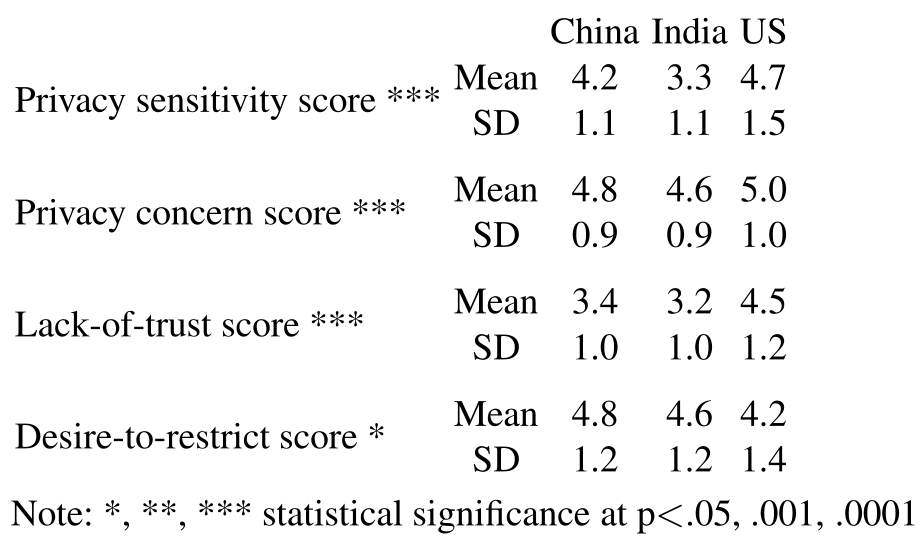
- The American Paradox: US users have a high "Lack-of-Trust" score (4.5) regarding platform operators. They fear the "system." However, they have the lowest desire to restrict information from people they know (coworkers, family).
- The Chinese Boundary: Chinese users exhibited a lower general "privacy concern" than Americans but had the highest "Desire-to-Restrict" score (4.8). For them, privacy is about managing social boundaries and avoiding government or social surveillance through pseudonymity.
Methodology & Taxonomy
The study broke down "Privacy" into four measurable scores using 69 Likert-scale questions:
- Privacy Sensitivity: Comfort with various data points (phone numbers, addresses) being public.
- Privacy Concern: Worry about what others can do with the data.
- Lack-of-Trust: Skepticism toward the platform owner.
- Desire-to-Restrict: The urge to hide posts from specific social circles.
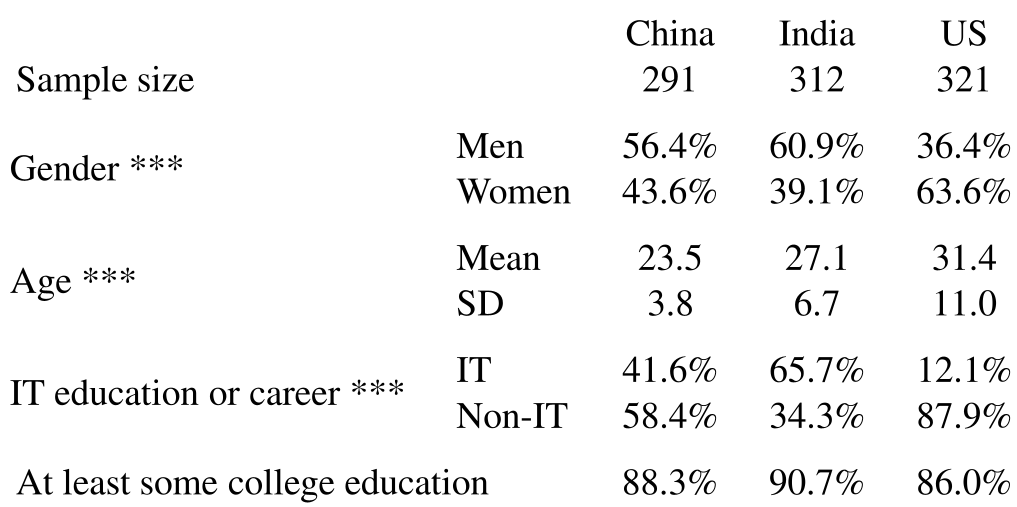
Key Findings: The Hierarchy of Sensitivity
Despite cultural differences, the study found a "Universal Ranking" of what people consider sensitive. Across all three countries, Phone Numbers and Home Addresses were universal red lines.
However, the intensity varied wildly:
- US > China > India: This was the standard pattern for sensitivity and lack of trust.
- China > India > US: This was the pattern for restricting information from friends and family.
Identity and "Fake Names"
One of the most striking findings was the role of anonymity. In China, using fake names is not just common—it's a privacy strategy. Over 36% of Chinese respondents expressed deep concern about impersonation, significantly higher than Indian users (19.4%). This suggests that in cultures where surveillance is a greater concern, identity becomes the primary battleground for privacy.
Critical Insight: Why Does This Happen?
The authors suggest two main drivers:
- Individualism vs. Collectivism: US individualism leads to a focus on personal "rights" against institutions. Chinese collectivism leads to a focus on "shame" and "face," resulting in more rigorous management of interpersonal boundaries.
- Media Influence: The intensive media coverage of Facebook's privacy blunders in the US likely inflated the "Lack-of-Trust" scores for American participants.
Conclusion & Future Directions
The paper concludes with a call for Personalized Privacy Tools. If a platform knows a user is from a specific cultural background, it shouldn't just offer the same default settings. Instead, tools should learn "routine patterns of privacy decisions."
Limitations: The study relies on crowdsourced participants (MTurk and ZBJ), which may lean more toward "tech-savvy" individuals than the general population.
Future Outlook: As we move into an era of Global AI, understanding these cultural nuances is no longer optional—it is the key to building platforms that users actually trust.