
Scaling the Social Brain: Do Facebook Groups Break Dunbar’s Number?
Analysing Dunbar Circles in Facebook Groups
This paper investigates structural patterns within 18 heterogeneous Facebook groups to determine if interactions between group members adhere to the "Dunbar's Circles" theory. By introducing the "Member Network" model and applying K-means clustering, the authors confirm that even in interest-based virtual communities, users maintain a hierarchical interaction structure typically consisting of 3 to 4 layers, aligning with offline cognitive limits.
TL;DR
Researchers from the University of Pisa analyzed 18 Facebook groups to see if the massive scale of Online Social Groups (OSGs) alters human social structures. They found that despite the potential to interact with thousands, users still organize their interactions into "Dunbar Circles"—inclusive layers of 5, 15, 50, and 150 people. This suggests that shared interests do not override our innate cognitive limits.
The "Friendship" vs. "Interest" Paradox
In a standard Social Network, you add friends you know. In a Facebook Group, you join a collective based on a topic (Education, Sport, Movies). Because interaction is driven by the topic rather than personal history, one might assume that our social boundaries would expand or become "flatter."
The authors set out to test this by defining the Member Network (MN). Unlike a traditional ego network, the MN maps interactions within a specific group, treating the frequency of comments as "Tie Strength."
Methodology: Mapping the Member Network
The study crawled nearly 70,000 active users across 18 groups. To ensure they weren't just looking at "lurkers" or one-time posters, they applied interaction filters.
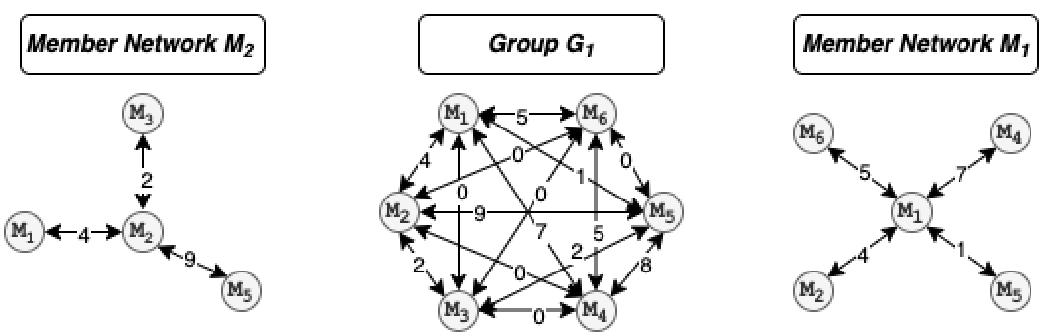 Figure: The Member Network model defines how an individual (Ego) interacts with other members (Alters) within the group clique.
Using the K-means clustering algorithm, they grouped these ties into "inclusive circles." Each circle represents a layer of social intimacy based on how often you interact with those people.
The Results: The 150 Limit Still Holds
The most striking finding is that the structure of these Facebook groups almost perfectly replicates the structure of offline friendships.
1. The Magic Number 3
The study found a "Scaling Factor" of approximately 3. This means each successive circle is roughly three times larger than the one inside it (e.g., 5 -> 15 -> 50 -> 150).
2. Physical Limits in Digital Space
Even in groups with 100,000+ members, the total number of "meaningful" interaction partners for any given user plateaued around 150. Even the highest-activity users (Filter 10) adhered to this rule.
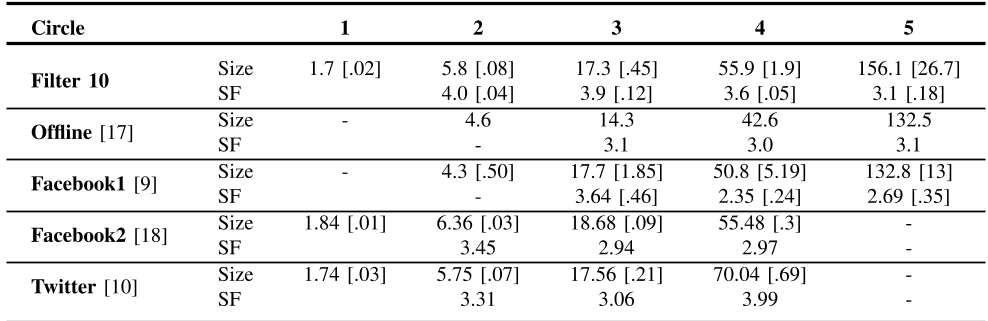 Table: Comparison of circle sizes across Offline, Twitter, Facebook Friends, and Facebook Groups.
As seen in the table above, the sizes of the detected circles in Facebook Groups (Filter 10) are remarkably consistent with offline data collected by Dunbar in 2005.
Critical Insight: Why Does This Matter?
This research confirms that OSGs do not increase human cognitive information-processing capacity. While technology allows us to reach more people, our brains still filter these contacts into the same hierarchical "slots" we used in ancestral environments.
Limitations and Future Work
The study primarily focused on comments. However, modern interaction is increasingly passive (likes, "love" reactions, etc.). The authors acknowledge that future studies must incorporate these "reactions" to see if they represent a "weaker" form of tie that might expand the outer circles.
Conclusion
Whether you are discussing "Programmers" in an Education group or "Gym" tips in a Sport group, your social brain is still operating on primitive software. Understanding these Member Networks is vital for developers designing community-based platforms: if you want to foster deep engagement, you must design for circles of 50 or 150, not 100,000.