
Beyond the Résumé: Reimagining Job Hunting through Participatory Design and EdgeMap
An Analysis and Evaluation of the Design Space for Online Job Hunting and Recruitment Software
2021-01-01
Summary
Problem
Method
Results
Takeaways
Abstract
This paper investigates the design space of online recruitment software by proposing and evaluating EdgeMap, a social networking-based job platform. Developed using a Participatory Design methodology involving both youth job seekers and business owners, the system prioritizes visual skill-matching and e-portfolio features to bridge the gap between traditional job boards and professional SNS.
## TL;DR
Researchers from the University of British Columbia and Wilfrid Laurier University have developed **EdgeMap**, a recruitment platform that replaces static résumés with dynamic, visual skill comparisons. By involving both youth job seekers and business owners in the design process, they identified a critical need for social-networking features and quantitative skill mapping in the hiring process, resulting in a system that makes candidate evaluation faster and more transparent.
## The Motivation: Why Job Boards are Failing
The digital recruitment landscape is currently bifurcated: on one side are traditional job boards (e.g., Monster, Workopolis) that are "content-heavy" and interaction-poor; on the other are professional social networking sites (SNS) like LinkedIn.
The authors argue that both fall short for specific demographics. Youth job seekers often lack the experience to fill a traditional résumé, while small business owners struggle to differentiate between similar-looking entry-level applications. The core insight of this paper is that **usability equals opportunity**—roughly 25% of job seekers abandon applications due to poor website design.
## Methodology: Designing with the User, Not for the User
To bridge the gap, the team employed **Participatory Design (PD)**. Instead of designers guessing what users want, they hosted co-design sessions involving:
* **Brainstorming**: Generating functional requirements (e.g., mass applications, direct messaging).
* **Card Sorting**: Organizing features into intuitive categories like "Job Consideration" and "Resources."
* **Paper Prototyping**: Generating low-fidelity sketches that emphasized a "mobile-first" preference for younger users.
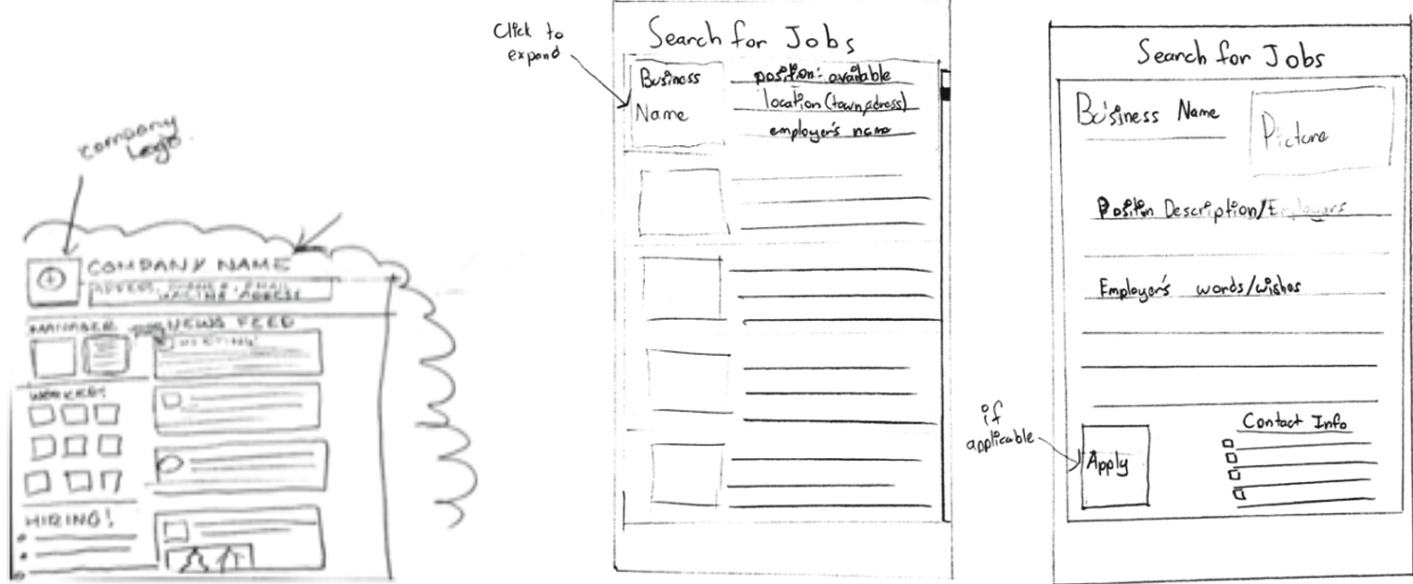
*Figure 1: Early paper prototypes showing how participants visualized search results and job details.*
## EdgeMap: Architecture of a Skill-Centric Platform
The resulting MVP, **EdgeMap**, introduces several key innovations:
### 1. The Skills Survey
Unlike LinkedIn’s "endorsements," which are often subjective, EdgeMap uses a standardized mini-questionnaire. Users self-report expertise across tasks categorized into Basic, Intermediate, Advanced, and Expert levels.
### 2. The Ideal Candidate Comparison
Recruiters can define an "Ideal Candidate" profile. When an applicant applies, the system generates a comparison graph. This "at-a-glance" visualization allows recruiters to see exactly where a candidate exceeds or falls short of the requirements.
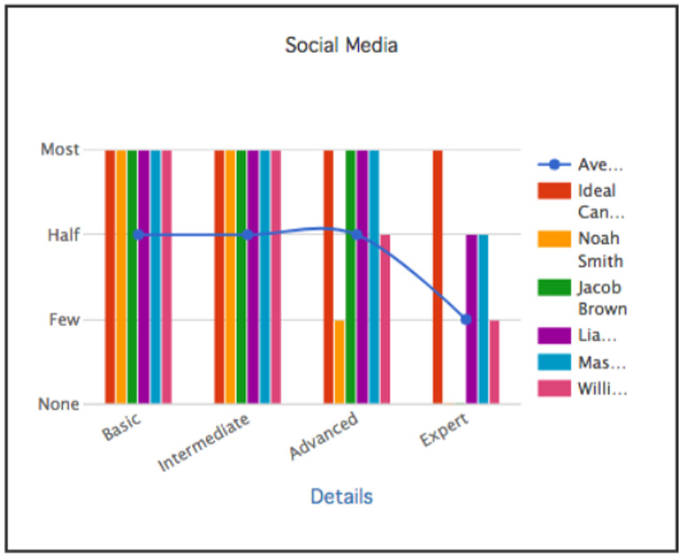
*Figure 2: EdgeMap’s core innovation—visualizing applicant skills side-by-side against an ideal profile and the community average.*
## Experimental Results & Impact
The usability study confirmed the effectiveness of this visual approach:
* **Recruiter Efficiency**: 6 out of 7 business participants found the system faster for reviewing applicants than traditional methods.
* **Candidate Confidence**: Youth participants used the comparison graphs for self-assessment, helping them decide whether they were truly qualified before spending time on an application.
* **Adoption Criteria**: For businesses, the "visual skill graph" was the #1 strength, though they noted that a "critical mass" of users is required for full adoption.
## Critical Analysis & Future Outlook
While EdgeMap succeeds in making the recruitment process more data-driven, it faces the classic "chicken-and-egg" problem of all social platforms: it needs job seekers to attract employers and vice-versa.
**The Takeaway**: This research highlights a shift toward **central processing of information** in recruitment. As we move forward, the integration of career mapping—where the software doesn't just show you what you lack, but tells you exactly which training program will fill that gap—will be the next frontier in HR-Tech.
### Conclusion
EdgeMap demonstrates that by dismantling the traditional résumé and replacing it with structured, visual data, we can reduce the "sludge" in the hiring process, making it more equitable for youth and more efficient for employers.