
Digital Echoes: How We Remember History in 140 Characters
Analysis of Temporal and Web Site References in History-related Tweets
This paper presents an exploratory analysis of collective memory on Twitter, using an 11-month dataset of over 888,000 history-related tweets. The authors focus on extracting temporal references and identifying the external web resources (URLs) shared when users discuss the past.
TL;DR
This study explores the "Digital Collective Memory" by analyzing nearly 900,000 history-related tweets over an 11-month period. It reveals that while we are naturally biased toward the recent past, major historical events like the World Wars still command significant "spikes" of attention, often driven by anniversaries and multimedia sharing on platforms like Instagram and YouTube.
Context: Social Media as a Living Archive
Traditionally, "History" was the domain of textbooks, news archives, and Wikipedia. However, platforms like Twitter have turned history into a participative, real-time activity. Whether it's #ThrowbackThursday or a centennial commemoration of a battle, social media provides a unique lens into what the public deems worth remembering. The researchers in this paper aimed to quantify this "remembering curve" to see if social media mirrors the memory patterns found in professional journalism.
Methodology: Mapping Time and Links
The research team used a two-pronged approach:
- Temporal Tagging: Using the HeidelTime tool, they extracted both absolute years and relative expressions. By converting "10 years ago" into a specific year, they could plot the "Strength of Collective Attention" over a timeline.
- Dataset Bootstrapping: Starting with expert-curated hashtags like
#historyand#WmnHist, they iteratively added frequently co-occurring hashtags to capture a diverse range of historical discussions.
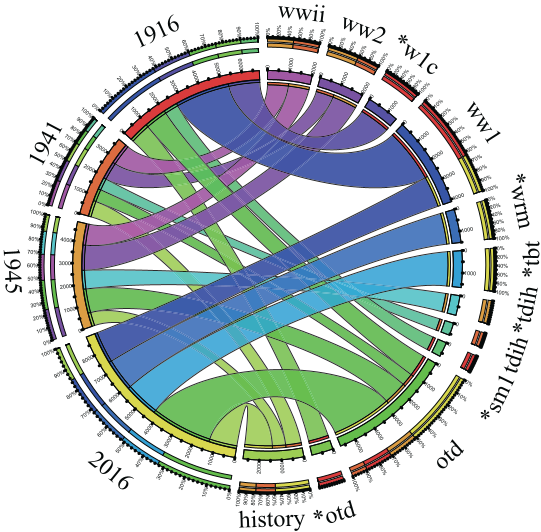 Figure 1: Common hashtags associated with key historical peak years (1916, 1941, 1945, and 2016).
Insights: The Shape of Memory
The study produced a "Remembering Curve," which showed a rapid increase in references as we approach the present day—a phenomenon known as Memory Decay.
However, there are fascinating exceptions:
- The War Effect: Huge spikes were found around 1914-1918 (WWI) and 1939-1945 (WWII). Interestingly, 2016 saw a massive surge in WWI mentions due to the 100th anniversary of the Battle of Verdun.
- The "On This Day" Mechanism: Hashtags like
#otdand#onthisdayact as powerful temporal anchors, connecting specific calendar dates to historical events, mirroring traditional "This day in history" newspaper columns. - Visual Documentation: History on Twitter isn't just text. The study found that roughly half of the tweets contained links.
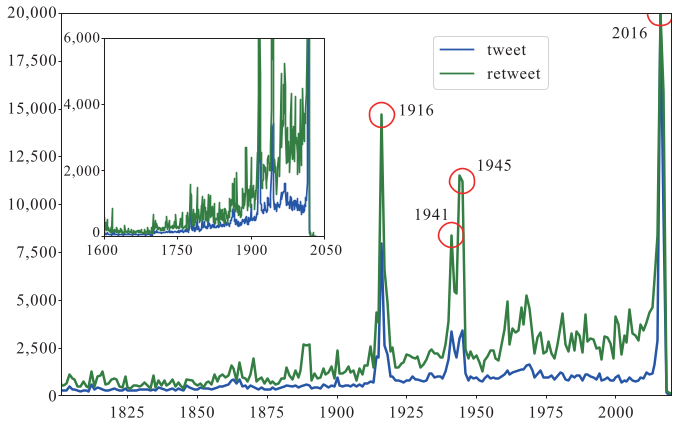 Figure 2: Top 20 domains referred to in history-related tweets, showing a preference for visual platforms and e-commerce (Amazon, eBay) for historical artifacts.
Conclusion and Analysis
The researchers demonstrate that Twitter's collective memory is both present-biased and event-driven. The high prevalence of links to Instagram and YouTube suggests that visual artifacts are the primary "currency" of historical remembrance in the digital age.
From a technical perspective, this work highlights the importance of temporal normalization in social media analysis. Future research could expand this by looking at sentiment—do we remember the distant past more fondly than the recent past, or is collective memory on social media primarily a tool for political and social commentary on the present?
Takeaways for the Future
- Anniversaries are Catalysts: For educators and museums, the "Today in History" format is the most effective way to trigger public engagement.
- Multimodality is Key: History is shared via images and videos; text-only archives are likely to be ignored in the social stream.