
Mapping 45 Years of Marketing Science: A Deep Dive into the JAMS Retrospective (1973–2018)
an analytical retrospective
This paper presents a comprehensive bibliometric and analytical retrospective of the Journal of the Academy of Marketing Science (JAMS) from its inception in 1973 to 2018. Utilizing network analysis, text mining, and community detection algorithms on 1,747 documents, the study maps the structural evolution of marketing science and identifies the journal's core thematic contributions.
TL;DR
What does the DNA of a top-tier academic journal look like over nearly half a century? This analytical retrospective of the Journal of the Academy of Marketing Science (JAMS) uncovers the evolution of marketing thought from 1973 to 2018. By processing 1,747 documents through advanced text mining and network analysis, the study identifies a "strategic triad" that defines modern marketing: Firm Capability, Branding, and Customer Service.
Context: Beyond the Rankings
In the academic world, JAMS is a powerhouse, consistently ranked among the top five marketing journals globally. However, ranking scores (like an H-index of 139) only tell part of the story. The real value lies in the knowledge structure—the specific themes, methodologies, and collaboration patterns that have shaped how we understand consumer behavior and firm strategy today.
Problem & Motivation: The Need for Longitudinal Perspective
Most bibliometric studies are "snapshots," looking at 5 or 10 years of data. This creates a fragmented view of the discipline. The authors of this retrospective argue that to truly understand the "geography" of marketing science, one must look at the entire lifecycle. They set out to answer:
- What are the recurring "communities" of research?
- How has the profile of the "Marketing Scholar" changed?
- Which methodologies have stood the test of time?
Methodology: The SLPA and Text Mining Hybrid
To ensure the analysis wasn't just a simple word count, the researchers used a sophisticated two-pronged approach:
- Network Analysis (SLPA Algorithm): Used to detect "overlapping communities." Unlike simpler algorithms, SLPA can identify keywords or authors that belong to multiple research areas, reflecting the interdisciplinarity of marketing.
- Text Mining (Topic Extraction): Utilizing WordStat to analyze 1,619 abstracts, the authors extracted latent themes and "Marketing Constructs" (e.g., Brand Equity, Customer Satisfaction) to see how their frequency fluctuated over decades.
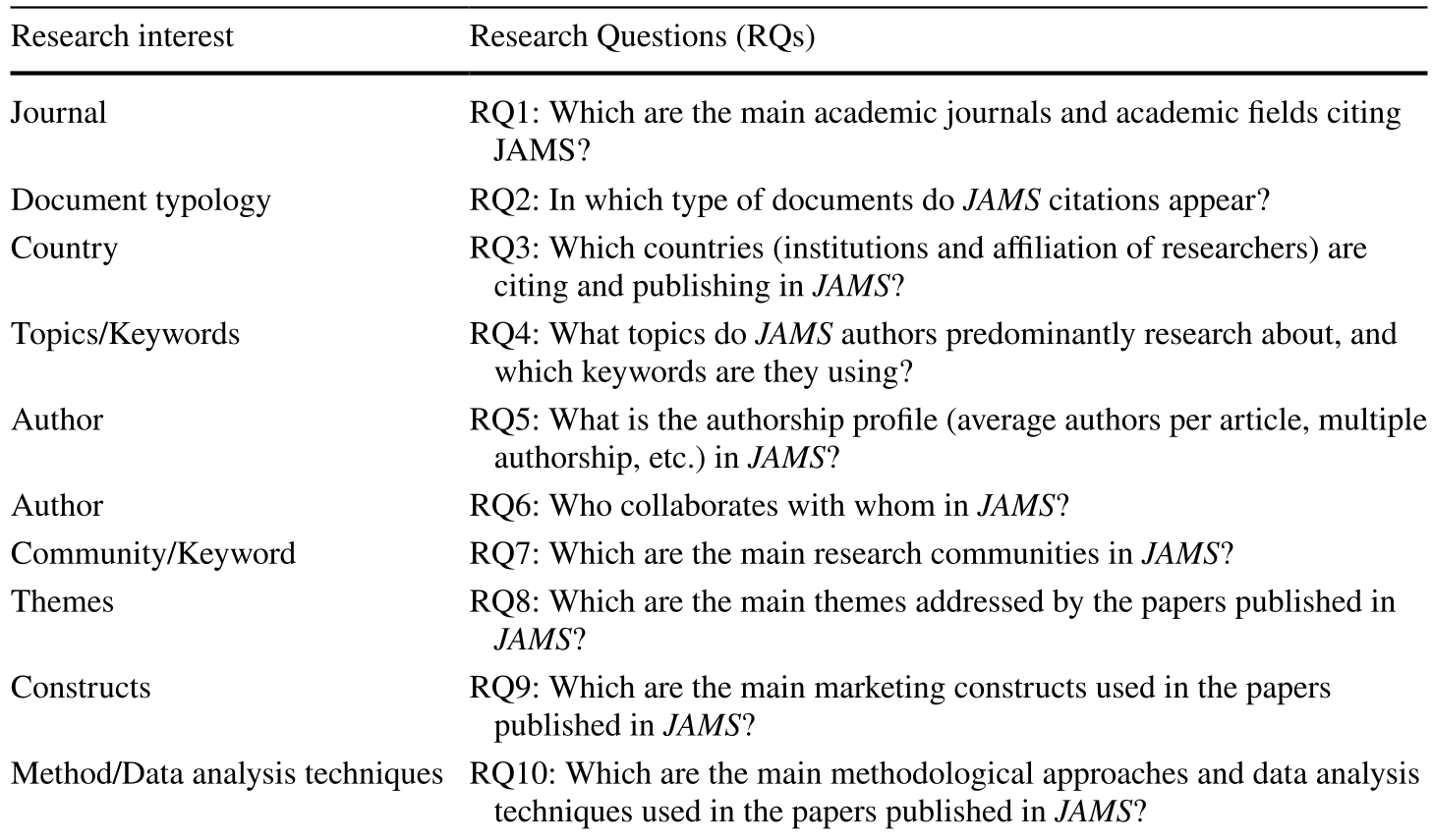 The research framework utilized ten core Questions (RQs) to dissect the journal's impact at individual, institutional, and thematic levels.
Core Findings: The Three Pillars of JAMS
The study identifies three major "communities" that act as the pillars of the journal's intellectual history:
1. Firm Capability and Performance
The largest community, focusing on how marketing strategy (branding, B2B partnerships) translates into financial results. This reflects the journal's "science" mandate—proving the ROI of marketing.
2. Brand and Value Co-creation
Centering on "Service-Dominant Logic" (Vargo & Lusch, 2008), this community explores how value isn't just delivered by the firm but created with the customer.
3. Customer Service
The core of this pillar is Customer Satisfaction. Analysis shows this is the most frequent keyword in JAMS history, often linked to emotional triggers and service recovery strategies.
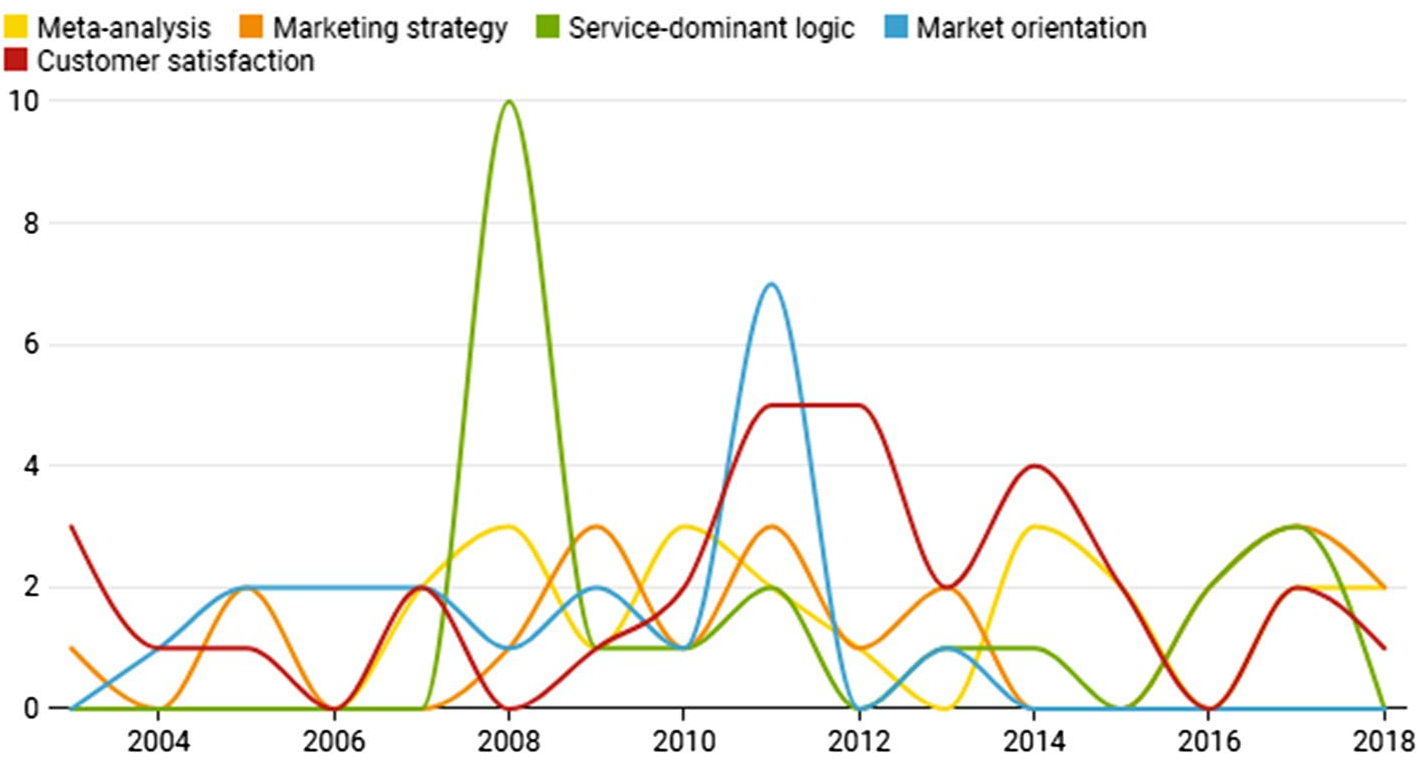 The shift in keyword popularity highlights the mid-2000s explosion of interest in Service-Dominant Logic and the persistent dominance of Customer Satisfaction.
The "Publish or Perish" Evolution
The data reveals a striking sociological shift in the marketing academy. In the 1970s, solo-authored papers were nearly as common as co-authored ones (1:1.3 ratio). By 2017, the ratio exploded to 1:9.0, with multi-authored papers becoming the absolute standard. This suggests that marketing science has become a highly collaborative, "big science" endeavor requiring diverse expertise.
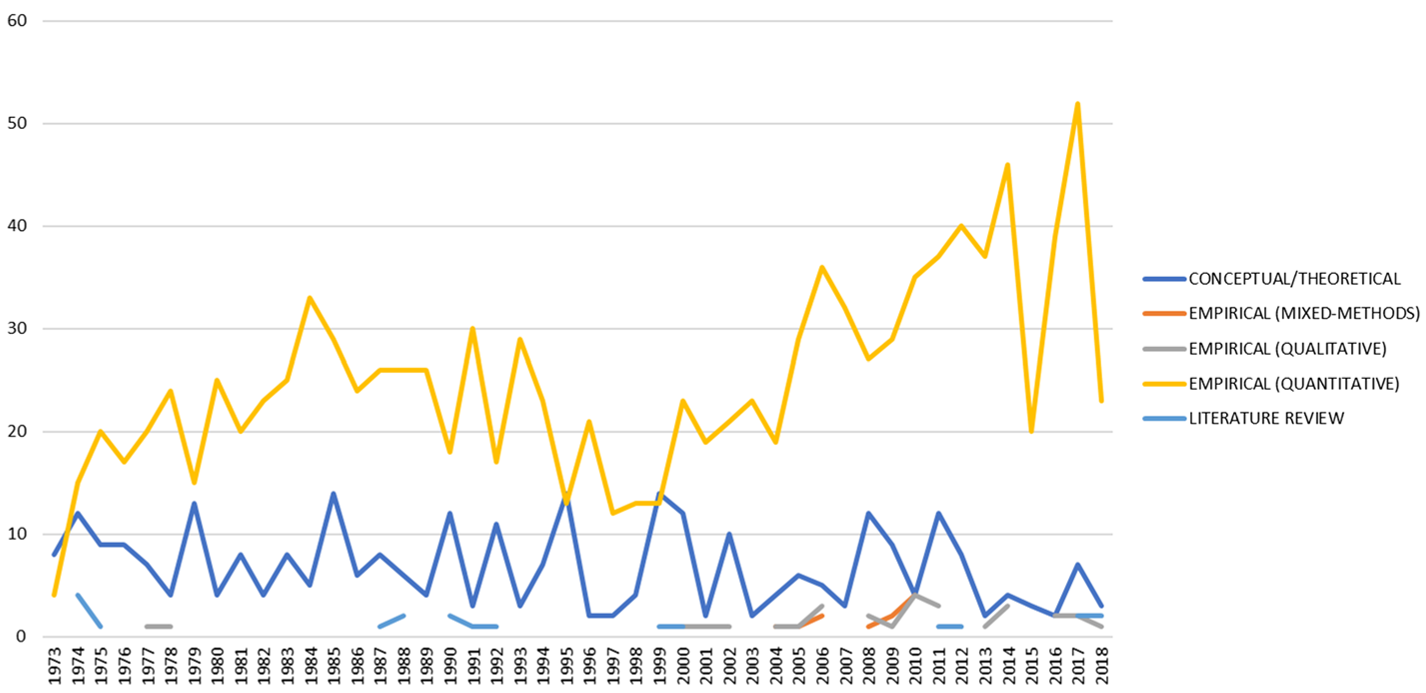 Quantitative methods remain the "gold standard" for JAMS, accounting for nearly 75% of all published work, with Structural Equation Modeling (SEM) and Meta-analysis leading the analytical toolkit.
Critical Insight: The Strategic Triad
The most profound takeaway is the convergence of seemingly disparate themes. Whether the topic is CSR (Corporate Social Responsibility) or Sales Force Management, the "North Star" of JAMS research is almost always Strategic Performance. The study confirms that JAMS isn't just about theory for the sake of theory; it is a bridge looking for how specific constructs (like brand personality) impact the firm's bottom line.
Conclusion & Limitations
This retrospective provides an invaluable map for any researcher looking to publish or understand the trends in marketing. However, the authors note a primary limitation: JAMS is heavily US-centric (the US accounts for 1,366 first-author spots compared to 62 for Canada or Germany). Future research must investigate whether these "triads" of performance and branding hold the same weight in emerging or non-Western markets.
Final Takeaway: For the modern marketer, this paper proves that rigor (quantitative SEM) and relevance (managerial implications) are the twin engines of long-term academic success.