
Mining the Intellectual Pulse: Social Network Analysis of Peking University Library Logs
14660_Analyzing user's book-loan behaviors in Peking university library from social network perspective.
This paper explores user book-loan behavior at Peking University Library by constructing and analyzing social networks from transaction logs. It utilizes both a bipartite (two-mode) student-book network and a one-mode co-borrowing network to map knowledge sharing patterns across the university.
TL;DR
This research transforms static library loan records into a dynamic "knowledge sharing network." By analyzing nearly a million borrowing events at Peking University, the authors reveal that student borrowing behaviors form a highly connected social network with small-world properties, offering a unique window into interdisciplinary dependencies and academic influence.
Problem & Motivation
Libraries have transitioned into the digital age, yet the wealth of data in their transaction logs remains underutilized. Most systems treat a borrowed book as a single data point. However, the authors argue that when two students borrow the same book, they are "connected" in a latent space of shared interests and intellectual pursuits.
The challenge lies in moving beyond simple metrics (e.g., "most borrowed books") to understanding the Macro-level structure (how connected is the student body?) and Micro-level patterns (which departments depend on each other's literature?).
Methodology: From Logs to Graphs
The study utilizes a massive dataset of 859,735 records from 19,773 students over a complete academic year. The core innovation is the modeling of this data through two distinct lenses:
- Two-Mode Book-Borrowing Network: A bipartite graph where one set of nodes represents students (with attributes like school and degree) and the other represents book categories.
- One-Mode Co-borrowing Network: A projection where students are linked if they have borrowed at least one common book.
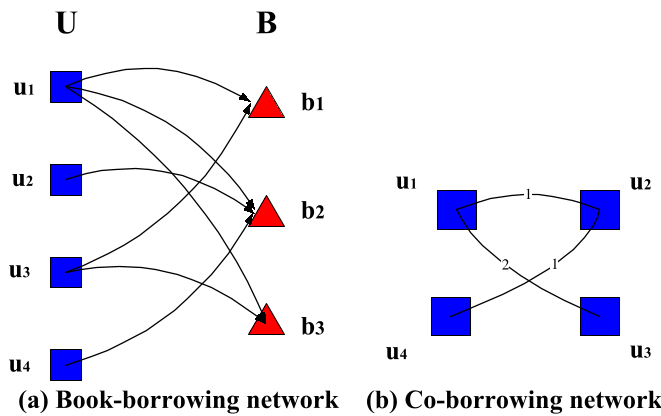
Figure 1: Illustration of the transformation from bipartite student-book links to student-student co-borrowing social networks.
Key Insights & Results
1. The Small World of Knowledge
The analysis confirms that the co-borrowing network is not random; it follows a Power-Law Distribution, meaning a few "intellectual hubs" (students or books) link the majority of the community.
- Average Path Length: 2.52. This suggests that any two students at Peking University are separated by fewer than 3 books in terms of shared interests.
- Giant Component: 99.99% of nodes are connected in a single massive cluster, showing extreme academic integration across the university.
2. Subject Dependency & Influence
By adding school attributes to the nodes, the authors identified:
- Core Disciplines: Certain categories of books act as "bridges" that connect diverse schools (e.g., Computer Science students borrowing Mathematics or Economics literature).
- Inter-School Similarity: Measuring the edge weights between different departments allows the library to visualize which schools have the most overlapping research interests.
Critical Analysis & Future Outlook
This paper, published in JCDL '09, was an early pioneer in using Social Network Analysis (SNA) for digital libraries. While it provides a robust structural analysis, it focuses primarily on the topology of the network.
Limitations:
- The study treats all loan records with equal weight, whereas a student borrowing a book for a week might indicate less "interest" than a student renewing it for a month.
- It does not account for the temporal evolution of interests over the 4-year degree cycle.
Future Path: Modern iterations of this work could use Graph Embeddings to create sophisticated recommendation engines, suggesting books to students not just because they are popular, but because "intellectual peers" in distant departments are finding them useful.
Conclusion
The library is more than a warehouse for books; it is a map of a university's collective mind. By viewing borrowing through the lens of social networks, we can better understand how knowledge flows between disciplines and improve the delivery of information in academic ecosystems.