
ERA: Finding the Most Reachable Experts in Your Social Circle
Based on Analyzing Closeness and Authority for Ranking Expert in Social Network
This paper introduces the Expert Ranking Algorithm (ERA), a novel approach for social networks that identifies experts based on both their topic-specific authority and their network closeness to the requester. By integrating structural centrality with publication-based relevancy, it ensures that recommended experts are both qualified and easily reachable.
TL;DR
The Expert Ranking Algorithm (ERA) bridges the gap between searching for "the best" expert and "the most accessible" expert. By combining professional authority (derived from publications) with social closeness (calculated via weighted path analysis), this methodology ensures you find experts you can actually talk to.
Background: Beyond the Academic Ivory Tower
In the era of Web 2.0, information retrieval has shifted from searching documents to searching for people. However, a major issue in Social Network Analysis (SNA) has been the "Authority vs. Accessibility" trade-off. Most SOTA (State-of-the-Art) methods back in the late 2000s focused on profile matching—if your keywords matched the expert’s papers, it was a hit. But if that expert is ten degrees of separation away, they are effectively invisible to you.
The Core Insight: Authority + Closeness
The researchers argue that an expert's value in a social network is defined by two dimensions:
- Deepness (Authority): Is the person active in the field and highly cited?
- Closeness (Reachability): How much "social effort" does it take to reach them through my friends?
1. Relevancy and Deepness
The paper derives a formula for expert relevancy that weighs an expert's local publications against their total global reference impact. This is further refined into a Deepness score: This formula penalizes "silent" experts who have knowledge but no active connections (linkage).
2. The Weight of Connections
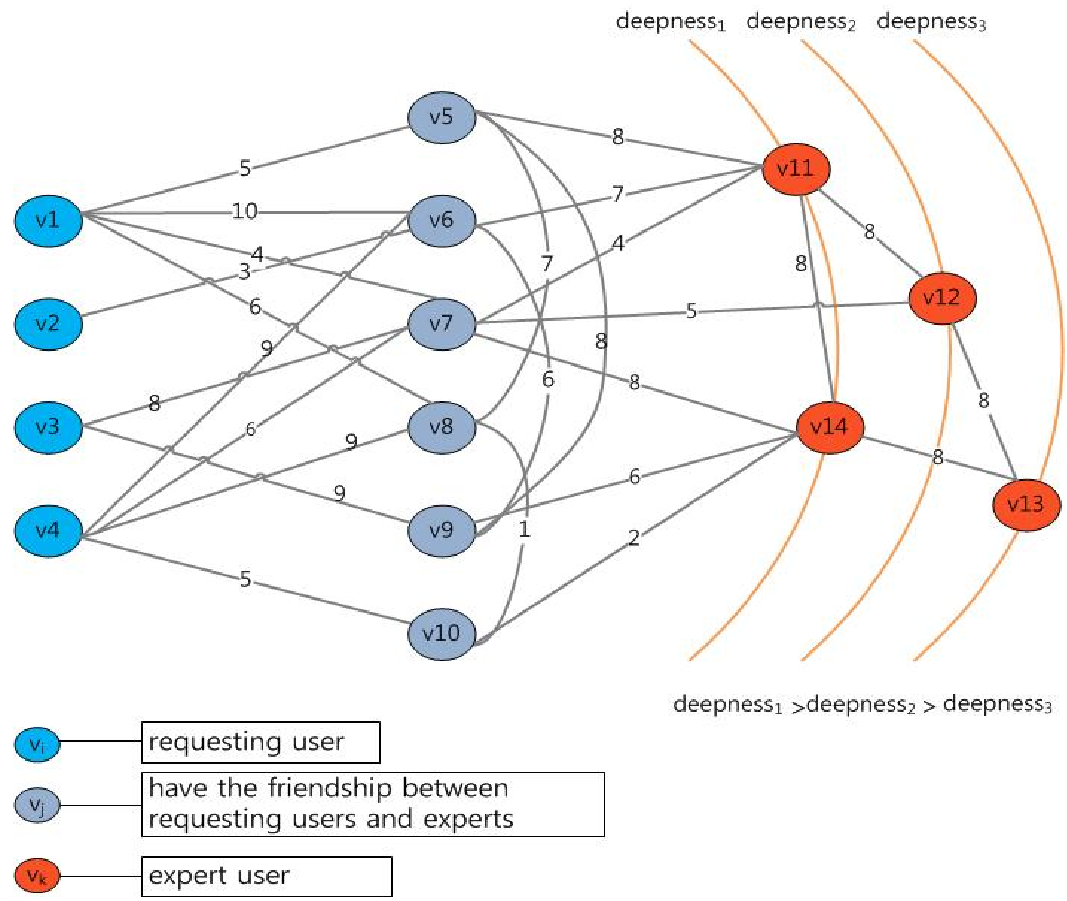
Unlike simple graphs, this model uses weighted edges (1-10) to represent the strength of communication. The Closeness Centrality calculates the maximum path weight relative to the shortest possible path.
The Ranking Engine: Implementation
The final ERA score is a weighted sum: Setting balances the search between someone who is an absolute genius and someone who is a "friend of a friend."
Experimental Walkthrough
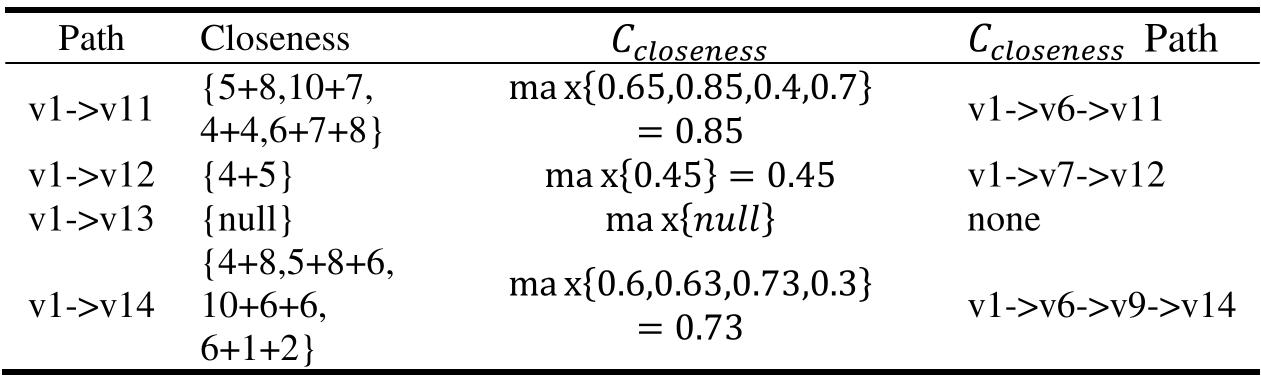
In a test graph of 14 nodes, the algorithm analyzed a search for a "Data Mining" expert. While multiple experts existed (v11, v12, v14), the algorithm identified that even if v14 was highly authoritative, the path to v11 was significantly stronger ().
Critical Analysis & Conclusion
The beauty of this work lies in its Inductive Bias: it assumes that human resources are more valuable when facilitated by trust (the "chain of friends").
- Value: It transforms a static directory of experts into a dynamic, user-centric recommendation engine.
- Limitations: The model assumes undirected edges and manual weight assignments. In modern massive networks, weights would need to be inferred automatically from interaction frequency or sentiment analysis.
- Future Outlook: As LinkedIn and academic platforms like ResearchGate grow, the ERA model provides a fundamental blueprint for "Social Search" that values the relationship as much as the result.
Takeaway: Don't just find the expert; find the expert who will answer your call.