
Disproportionate Reactions: Unveiling Regional Bias in Multilingual Twitter Sentiment
16896_Analyzing Disproportionate Reaction via Comparative Multilingual Targeted Sentiment in Twitter.
The paper presents a comparative multilingual study on targeted sentiment analysis within Twitter during the 2015 Paris terrorist attacks. It focuses on specific entities (French President, Europe, and Muslims) using English and French datasets, revealing a significant geographical and linguistic disparity in public reaction and annotator perception.
TL;DR
When major global tragedies occur, how does the world react? This study analyzes Twitter sentiment during the 2015 Paris attacks, comparing English and French reactions toward specific targets like "Muslims" and "Europe." The researchers discovered two startling trends: first, English-speaking Twitter was significantly more negative than the local French population; second, the people we hire to label this data (crowd workers) bring their own regional biases that can distort AI training data.
Background: The Limits of Monolingual Analysis
In the wake of a crisis, social media becomes a digital town square. However, academic focus has historically suffered from "English-centeredness." By ignoring local languages—in this case, French—researchers miss the primary perspective of those directly affected. This paper shifts the focus from general "tweet mood" to Targeted Sentiment, looking specifically at how people feel about political figures and social groups.
Problem & Motivation: The Gap Between Local and Global
The authors were driven by a core intuition: proximity to an event matters. Generally, one might expect the local population (the French) to exhibit the most intense emotional reactions. However, preliminary data suggested that "external" reactions might actually be more polarized or inflammatory. This raises a critical question: If our data labeling is done by a geographically diverse crowd, are we capturing the ground truth or the crowd's local prejudices?
Methodology: Comparative Targeted Sentiment
The researchers filtered millions of tweets mentioning #Paris into six subsets based on language (English/French) and target (Hollande, Europe, Muslims).
Architecture: The Sampling and Labeling Pipeline
To ensure a representative and high-quality dataset, the team used:
- Temporal Sampling: Segmenting tweets by the hour.
- Length Optimization: Using a Gaussian function to select tweets with a "natural" sentence length to avoid fragments or overly long rants.
- Language-Specific Crowdsourcing: Only French speakers evaluated French tweets, and English speakers evaluated English tweets.
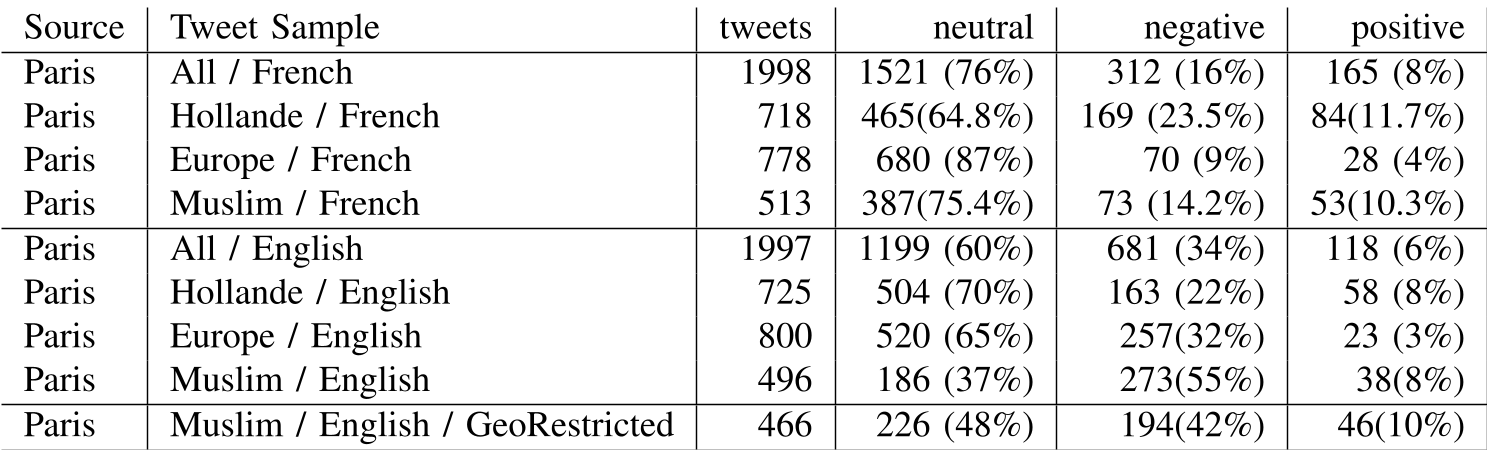 Table 1: Sentiment breakdown across languages and targets.
Experiments & Results: The "Disproportionate" Discovery
The most striking finding was the sentiment toward the target "Muslim". While only 14.2% of French tweets were labeled as negative toward Muslims during the attack, a staggering 55% of English tweets were labeled negative.
The Annotator Bias Experiment
The authors suspected that the English labels were influenced by the annotators' own locations (primarily USA, UK, and Canada). To test this, they conducted a Geo-Restricted experiment:
- They re-labeled the English/Muslim sample, but excluded workers from the US, UK, and Canada.
- The Result: Negative labels dropped by 14%. This proves that Western English-speaking annotators were "over-labeling" tweets as negative, even when the content was neutral or reporting a fact (e.g., news about a peace march).
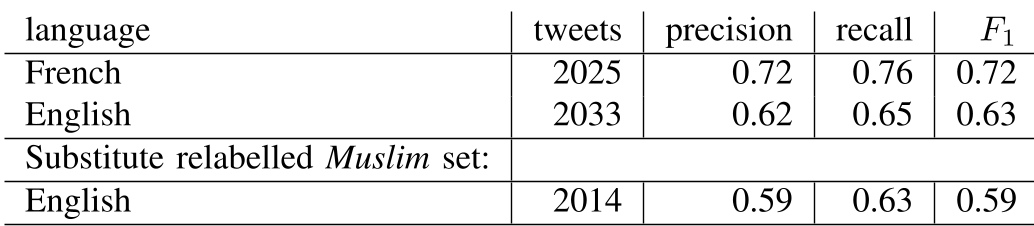 Table 2: SVM Classifier performance comparison.
When using these biased labels to train an SVM classifier, the French model achieved an F1 of 0.72, while the English model lagged at 0.63. Interestingly, when the "cleaner" (Geo-Restricted) labels were used, the accuracy actually dropped to 0.59, likely because the dataset became more balanced and harder to predict than a dataset dominated by a single "negative" majority class.
Critical Insight & Conclusion
This paper serves as a warning for the AI and Social Science communities.
- Sentiment is not Objective: What a US-based worker considers "negative," a French-based worker might consider "reporting a fact."
- The "Local" Baseline: Reactions from those at the heart of a crisis (France) were notably more measured than the digital feedback from the English-speaking world.
Future Outlook: As we build more automated moderation and sentiment systems, we must account for "annotator genealogy." Who labeled the data is just as important as what the data says. If our "ground truth" is biased by regional prejudice, our AI will inevitably inherit those same flaws.