
Sensing Social Bridges: How RFID Tags Reveal the Hidden Dynamics of Human Interaction
Analyzing group interaction and dynamics on socio-behavioral networks of face-to-face proximity
This paper presents a large-scale analysis of social dynamics during a university freshman week using high-resolution wearable RFID tags and self-report surveys. It introduces a methodology to bridge the gap between objective sensor-based face-to-face (F2F) proximity data and subjective social networks (SRN), establishing SOTA insights into group formation and gender homophily in newly composed social groups.
TL;DR
How do strangers become friends, mentors, or collaborators? This paper investigates the "Social Distributional Hypothesis" by tracking 77 students during a week-long freshman orientation using wearable RFID sensors. By combining objective proximity logs with subjective surveys, the researchers uncover how "super-spreader" individuals drive initial connections and how the duration of a conversation is the ultimate predictor of a long-term professional bond.
The Gap Between "Being There" and "Being Connected"
In social science, there is a persistent "reality gap." If you ask someone who they spoke to at a conference, they might remember 20% of their interactions (Subjective). If you track them with GPS, you know they were in the same room, but not if they actually looked at each other (Objective).
The authors identified that prior work either relied on biased self-reports or "blind" location data like Bluetooth co-location, which doesn't guarantee a face-to-face (F2F) interaction. Their motivation was to find the "magic threshold"—exactly how long do two people need to stand face-to-face before a physical encounter transforms into a meaningful social tie?
Methodology: The Filter of Time
The researchers deployed a variant of the MYGROUP system. Students wore RFID tags that only registered a "hit" when they were within 1-1.5 meters of each other, facing forward.
The core innovation was the use of temporal thresholds (τ). By analyzing the network at different scales—from any contact (τ=0s) to deep conversations (τ=300s)—they could filter out the "noise" of people passing each other in hallways to focus on the "signal" of genuine engagement.
 The study environment involved both structured plenary sessions and "free sessions" designed to induce social mixing.
Key Metrics Analyzed:
- Strength/Degree Centrality: Identifying the "popular" nodes.
- Gender Homophily: Testing if "birds of a feather" really do flock together in a new environment.
- Spearman Correlation: Mapping sensor data to survey categories (Interaction, Cooperation, Mentoring).
The Anatomy of a Social Group
1. The "Super-Spreader" Effect
The data revealed that in the early stages of a group (Monday/Tuesday), certain "super-spreader" nodes (high-degree individuals) are essential. These people have many short interactions (small talk), acting as bridges that lower the "social friction" for everyone else. As the week progresses and thresholds increase to 300s, these super-spreaders disappear, replaced by a more balanced network of stable, long-form pairs.
2. The Homophily Persistent
Despite being a newly formed group, gender homophily was rampant. The researchers used a null-model permutation test to prove that students were significantly more likely to engage in long conversations with the same gender. Mixed-gender interactions were consistently shorter and more infrequent.
 Table 1: As the minimal contact threshold (i) increases, the density of the network drops, but the clustering remains significant, indicating the formation of robust social "islands."
Results: Sensors vs. Surveys
One of the most striking findings was the correlation between RFID data and the Self-Report Network (SRN).
- Low thresholds (0-60s): Correlated poorly with who students said they wanted to "cooperate" with.
- High thresholds (180-300s): Showed a strong, statistically significant correlation (p < .01) with future mentoring and cooperation.
Insight: Physical proximity is only "socially relevant" after the 3-minute mark. Small talk doesn't build a network; sustained attention does.
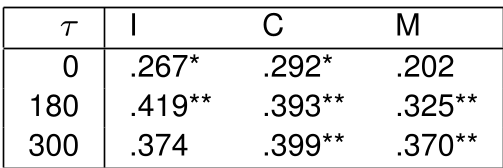 Table 5: The jump in correlation coefficients at τ=180 and τ=300 proves that longer physical proximity directly maps to subjective social value.
Critical Insight & Future Outlook
This work moves beyond mere data collection; it provides a blueprint for Anticipatory Ubiquitous Systems. Imagine a professional conference app that notices you haven't had a conversation longer than 60 seconds all day. It could suggest a "super-spreader" to introduce you to a sub-clique or recommend a lunch table based on your background to break homophily bubbles.
Limitations: The study was conducted in a psychology department with a skewed gender ratio (60F/17M), which may amplify the homophily effects. Furthermore, it focuses on indoor proximity—extending this to "digital proximity" (Slack/Teams) alongside physical data is the next frontier for understanding the modern hybrid social fabric.
Conclusion
The freshman week isn't just a series of lectures; it's a high-speed engine for social network construction. By utilizing RFID sensors, Atzmueller et al. have shown that we can quantify the invisible "vibes" of a room and turn proximity into predictable social capital.