
BuddyShare: Scaling Mobile Internet via Social Trust and Physical Proximity
17285_Analyzing Human Centric Data for Sharing Mobile Internet with Social Buddies.
This paper introduces BuddyShare, a middleware system that enables mobile users to share internet bandwidth through a social-based collaborative overlay. By leveraging Bluetooth for short-range ad hoc connections and social trust for group formation, the system achieves a 3.5x scaling in average download rates in university environments.
TL;DR
BuddyShare is a middleware system that turns your nearby friends' phones into a collaborative download cluster. By aggregating multiple cellular connections via a Bluetooth-based social overlay, it achieves more than a 300% increase in download speeds. Unlike previous "open market" sharing systems, BuddyShare relies on the inherent trust within social circles, making it a more realistic solution for data sharing.
Context: This work fits into the niche of Collaborative Downloading and Mobile Ad-hoc Networks (MANETs), specifically addressing the "trust gap" in peer-to-peer resource sharing.
Problem & Motivation: The Trust Barrier in Sharing
While cellular data demand has skyrocketed, individual bandwidth remains expensive and often capped. Previous solutions like MAR and COMBINE treated bandwidth as a commodity to be traded in marketplaces. However, the authors argue that individuals are biologically and socially predisposed to help their "buddies" rather than strangers.
The core research question was: Can we prove that friends actually spend enough time together to make a collaborative sharing system viable?
Methodology: Validating the Social Fabric
To answer this, the researchers analyzed three distinct datasets:
- MIT Reality Mining: Real-world Bluetooth and call logs over 9 months.
- Self-Reported Surveys: Capturing user willingness and social ties.
- The "Connect" Portal: Data from a specialized educational social network.
1. Social Connectivity
The study focused on Clustering Coefficients (CC) and Path Lengths. They found that social networks in university settings follow a normal distribution (rather than just a power law), meaning most users are well-connected and have a high probability of finding enough "buddies" nearby to form an overlay.
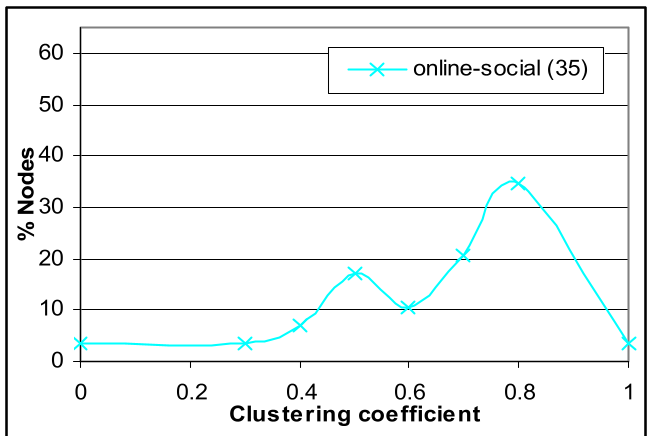 Figure 1: Distribution of social clustering across different datasets.
2. Proximity Behavior
BuddyShare requires users to stay within Bluetooth range (approx. 10 meters) for long enough to complete a file download. The data showed that the average interaction time is approximately 56 minutes, which is more than enough for substantial data transfers.
Experiments & Results: A 3.5x Speed Boost
The authors simulated the BuddyShare system by segmenting large files using HTTP byte-range requests and distributing them across the social overlay.
Throughput Scaling
As seen in the figure below, the throughput scales almost linearly as the overlay size increases.
- 1-physical-hop-overlay: Direct Bluetooth links between friends.
- 2-physical-hop-overlay: Using an intermediate friend as a relay.
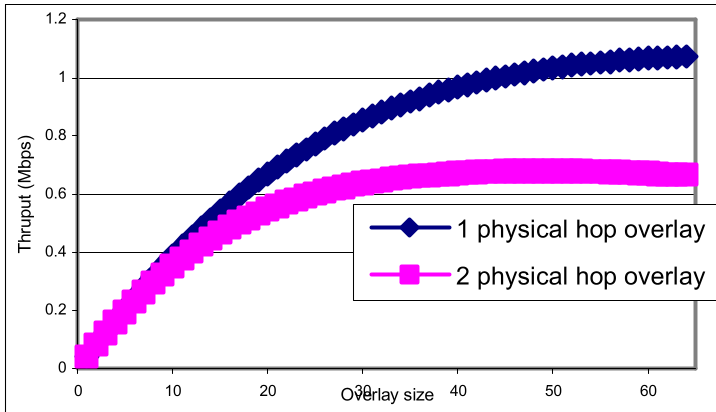 Figure 2: Throughput increases as more friends join the download task.
The study concluded that with an average of 3.5 friends nearby, the download speed scales by a factor of 3.5. Importantly, the researchers tested four "walls" of trust:
- S1: Sharing with anyone (Maximum throughput).
- S2: Sharing based on proximity-inferred trust (BuddyShare method).
- S3: Sharing via strict call-log relationships.
- S4: No sharing (Baseline UMTS).
Discovery: S2 (BuddyShare) often matched the performance of S1, proving that physical proximity at non-office hours is a high-fidelity proxy for social trust.
Critical Insight & Conclusion
BuddyShare moves from the "Economic Incentive" model toward a "Social Incentive" model.
Key Takeaways:
- Social Proximity = Trust: The strongest finding is that persistent physical presence (being together after 5 PM and on weekends) correlates 90% with social relationships.
- Feasibility: A group size of ~3 friends is frequent enough in academic environments to sustain a middleware like BuddyShare.
Limitations:
- Environment Specificity: The results are currently constrained to university settings (students/faculty) where "people hotspots" are common.
- Hardware Efficiency: While throughput increases, the paper notes that Bluetooth network capacity eventually saturates, and frequent multi-hop relays can degrade performance.
Future Outlook: With the advent of 5G D2D (Device-to-Device) communication and Ultra-Wideband (UWB), the technical bottlenecks of Bluetooth observed in this study could be minimized, making BuddyShare-like architectures even more potent for modern mobile ecosystems.