
SIDL: Decoding Real-World Human Behavior through the Lens of Social Influence and Deep Learning
Analyzing and inferring human real-life behavior through online social networks with social influence deep learning
The paper introduces Social Influence Deep Learning (SIDL), a framework that integrates Deep Neural Networks (DNN) with network science to predict offline human behaviors (e.g., event attendance, location visits) based on Online Social Network (OSN) data. It achieves state-of-the-art performance, outperforming traditional Independent Cascade and Linear Threshold models by over 20% in prediction accuracy.
Executive Summary
TL;DR: Researchers have developed Social Influence Deep Learning (SIDL), a framework that leverages the hidden patterns of online social networks to predict where you go and what events you attend in the physical world. By moving beyond traditional probabilistic models to deep neural architectures, the study achieves over 85% accuracy in behavior prediction, while introducing a "Community-SIDL" approach to solve the massive scalability issues inherent in global social graphs.
Academic Positioning: This work bridges the gap between Network Science (community detection, social influence) and Deep Learning (non-linear feature extraction). It transforms the social influence problem from a theoretical diffusion exercise into a high-performance classification task, setting a new SOTA for Event-Based (EBSN) and Location-Based (LBSN) social networks.
The "Independence" Trap: Why Old Models Fail
For decades, models like Linear Threshold (LT) and Independent Cascade (IC) defined the field. However, they suffer from two fatal flaws:
- Peer Independence: They assume that the influence of Friend A and Friend B on a subject is independent, ignoring the complex, non-linear synergies between social groups.
- Information Neglect: They rarely account for "negative samples"—actions that friends performed but the subject chose not to follow—which are crucial for calibrating influence strength.
The authors argue that human behavior is not just a sum of probabilities but a complex hierarchy of social signals that only a Deep Neural Network (DNN) can effectively map.
Methodology: From Global Overviews to Community Insights
The core of the SIDL framework is its flexibility in granularity. The researchers proposed three specific implementations:
1. Global-SIDL (G-SIDL)
The "brute force" approach. It treats the entire social network as a single input, using one-hot encoding for user IDs and state vectors for friend activities. While highly accurate (~89%), it faces a "Black Box" problem and collapses under the weight of millions of users.
2. Local-SIDL (L-SIDL)
Focuses only on a user's Ego-Network (direct friends). It is fast and interpretable but loses the "friend-of-a-friend" signals that often drive social contagion.
3. Community-SIDL (C-SIDL) - The Optimal Middle Ground
This is the most innovative part of the methodology. By applying the Louvain Method for community detection, the authors partition the network into dense mesoscale structures.
- IFC-SIDL (Inter-Friendship): This variant includes users directly connected to the community from outside, capturing crucial "bridge" influences.
- Scaling Logic: When a new user joins, you don't retrain the whole world (G-SIDL); you only retrain the specific community model (C-SIDL).
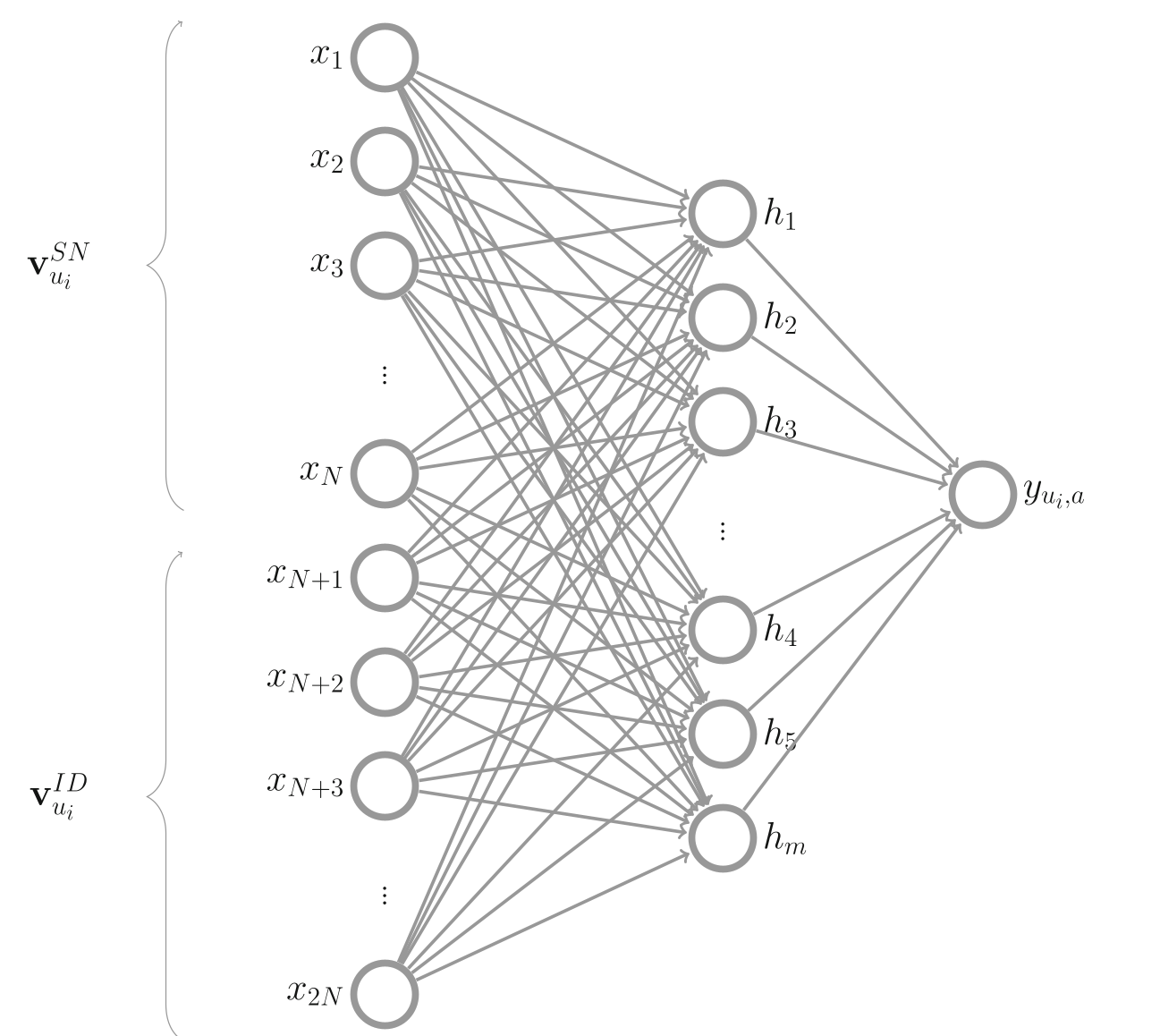 Figure 1: The architecture of Global-SIDL, showing the concatenation of Target User IDs and Social Network vectors.
Battle-Tested: Foursquare and Plancast
The model was validated using two distinct real-world datasets:
- Foursquare: 30+ months of check-ins in NYC and LA (Location behavior).
- Plancast: Event participation logs (Social-driven behavior).
The results were striking. SIDL approaches consistently outperformed IC-EM and LT-DT baselines across all metrics.
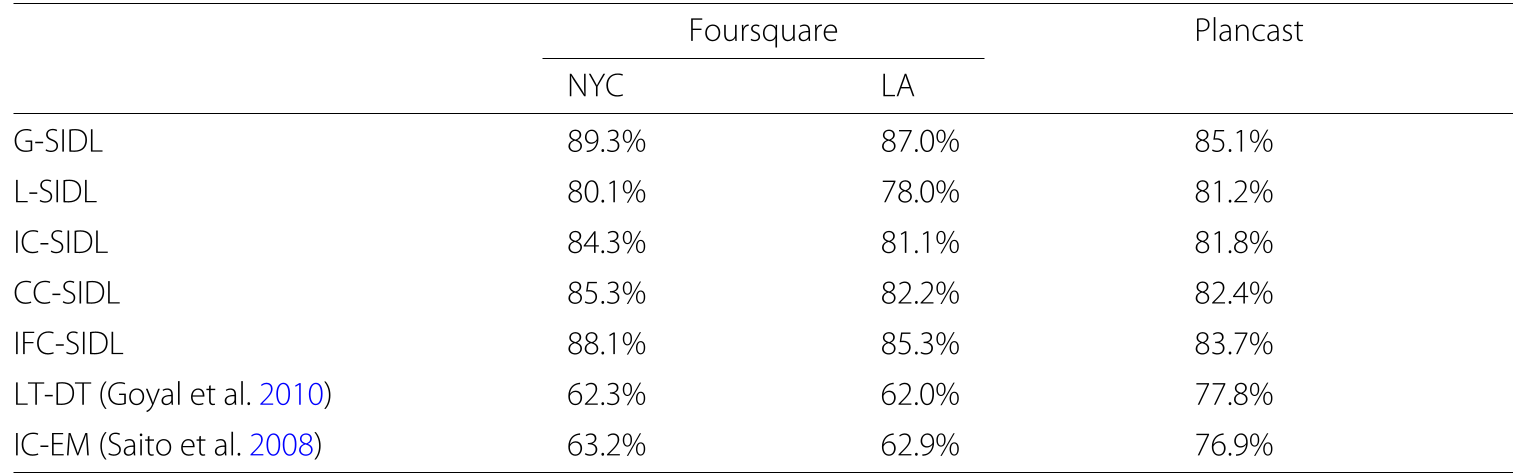 Table 1: Accuracy comparison showing SIDL's dominance over traditional models (LT-DT and IC-EM).
Key Experimental Insights:
- The Scalability Trade-off: C-SIDL achieved performance within 1-2% of the Global model but was 7.5x faster to train than G-SIDL.
- Architecture Evolution: Preliminary tests showed that LSTM (Long Short-Term Memory) networks improved accuracy over standard feedforward layers (91.1% in NYC check-ins), suggesting that the order of your friends' actions matters as much as the actions themselves.
Critical Insight: The Death of Individual Privacy
Perhaps the most alarming finding is the Social Privacy Leak. The authors conducted an experiment varying the probability (p) of friends sharing data.
- The Result: Even if 50% of your friends hide their activities, the model can still predict your real-life actions with 70% accuracy.
- Takeaway: Your privacy is not in your hands; it is a collective asset managed by your social circle. "Shadow Profiling" is not just a theory—it is a mathematical reality enabled by deep learning.
Conclusion and Future Work
The SIDL framework proves that combining Network Science (for structure) with Deep Learning (for inference) is the future of social behavior analysis. While the scalability of Community-SIDL makes it viable for production environments in marketing and urban planning, the privacy implications remain a significant ethical hurdle.
Future iterations will likely focus on Homophily (incorporating user similarity) and more advanced Temporal Dynamics to move from predicting what you do to when you will do it.